
Are you an ectomorph, a mesomorph, or an endomorph? For most people the honest answer is a mix — and this calculator tells you which way you lean, and by how much. Enter your sex, height, weight, and wrist circumference, and optionally your shoulder and hip measurements, and you will get an estimated somatotype based on a transparent scoring rule: your frame size from your wrist-to-height ratio, your body mass index (BMI) band, and your shoulder-to-hip shape. This is an educational estimate, not a diagnosis and not a verdict on your worth or your potential. Body types describe tendencies — how easily you tend to gain muscle or fat, and where you tend to carry it — and they are a starting point for smarter training and eating, not a box you are stuck in. If you want the fuller picture of your body composition, pair this result with our body fat calculator and our BMI calculator.
Pure ectomorphs, mesomorphs, and endomorphs are rare. Most people score highest in one type with clear traits of a second — for example, mesomorph-leaning with endomorph traits, meaning you build muscle fairly easily but also gain fat easily. Use the calculator below to find your lean, then read what it means for how you should train and eat.
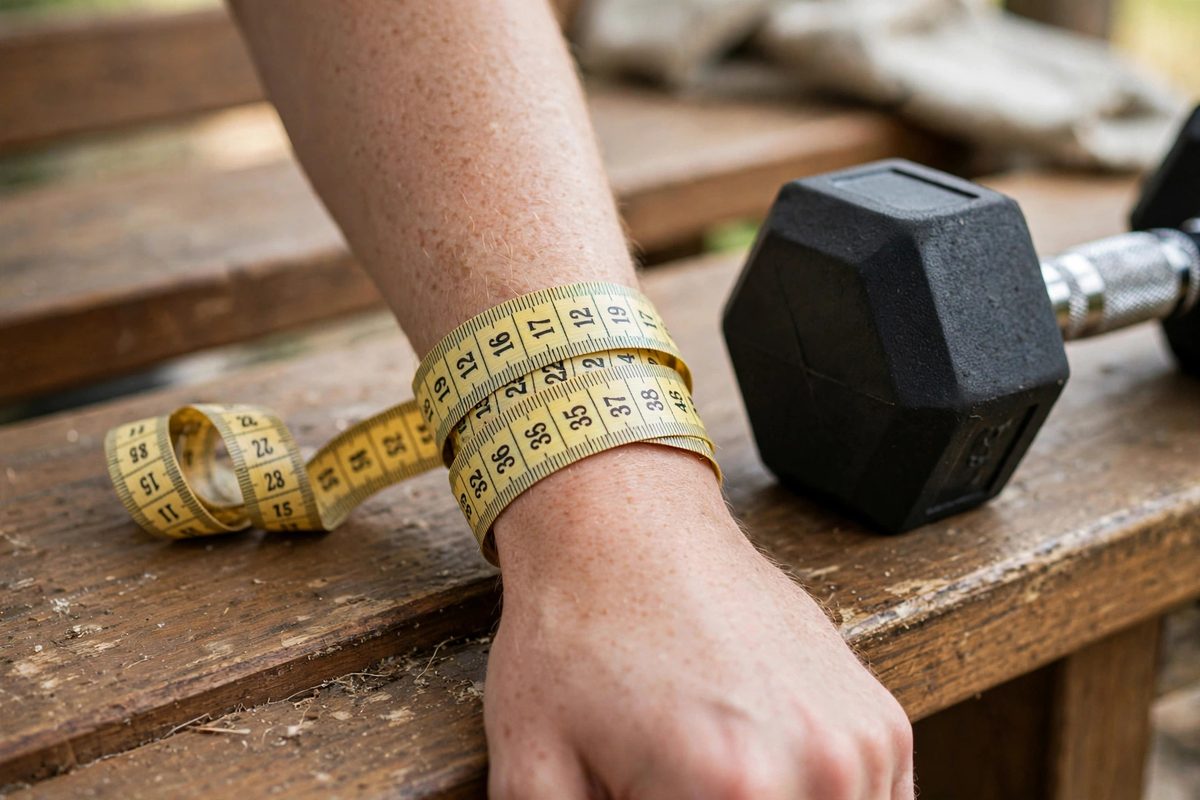
The calculator scores you on three visible inputs and adds the points up, so you can check every step of its reasoning. First, it works out your BMI from your height and weight using the standard imperial formula: BMI = 703 × weight in pounds ÷ (height in inches)². Second, it estimates your frame size from your wrist-to-height ratio — your wrist circumference divided by your height in inches. A ratio under 0.10 counts as a small frame, 0.10 to 0.109 counts as a medium frame, and 0.11 or above counts as a large frame. Third, if you entered shoulder and hip measurements, it compares them: shoulders at least 2 inches wider than hips adds a mesomorph point, and hips at least 2 inches wider than shoulders adds an endomorph point. The type with the highest total is your lean; if the runner-up is within 1 point, the result says so, because that near-tie is genuinely informative — it means you carry meaningful traits of both types.
| Input | Rule | Points |
|---|---|---|
| Frame: wrist ÷ height under 0.10 | Small frame — narrow wrists relative to height | Ectomorph +2 |
| Frame: wrist ÷ height 0.10–0.109 | Medium frame | Mesomorph +1 |
| Frame: wrist ÷ height 0.11 or above | Large frame — thick wrists relative to height | Mesomorph +2 |
| BMI under 18.5 | Underweight band | Ectomorph +2 |
| BMI 18.5–21.9 | Lower healthy band | Ectomorph +1 |
| BMI 22.0–26.9 | Mid band | Mesomorph +2 |
| BMI 27.0–29.9 | Upper overweight band | Endomorph +2 |
| BMI 30.0 or above | Obesity band | Endomorph +3 |
| Shoulders ≥ 2 in wider than hips | Broad-shouldered shape | Mesomorph +1 |
| Hips ≥ 2 in wider than shoulders | Hip-dominant shape | Endomorph +1 |
Two honest caveats belong right next to that table. First, BMI is a weight-for-height index, not a body-fat measurement: a muscular person can land in the 27–29.9 band and collect endomorph points while actually being lean, which is why the frame and shape inputs exist to balance it. Second, this scoring rule is a transparent heuristic built for this page — it is not the clinical Heath-Carter somatotype method, which needs skinfold measurements, bone widths, and trained measurers. What you get here is a useful, checkable estimate for planning your training and eating, and it is labelled as exactly that. If your result surprises you, trust the mirror, your training history, and your body-fat estimate more than any single score.
Ectomorphs tend to be naturally slim, with narrow shoulders and wrists, long limbs, and a fast metabolism relative to their size. The classic struggle is gaining weight: ectomorphs often eat what feels like a lot and stay the same weight, and muscle comes slowly. The upside is that staying lean is rarely the problem, and endurance activities often come naturally. If you lean ectomorph, your training priority is progressive strength work plus enough food — and "enough" usually means more than you think, which is why tracking intake for a few weeks with our TDEE calculator is so useful.
Mesomorphs tend to be naturally athletic: broad shoulders, a medium-to-large frame, and a body that responds quickly to training in both directions — muscle goes on relatively easily, and so does fat when training and eating slip. This is the type most often described as "naturally sporty," and it is also the type most likely to be misread: a mesomorph who stops training can look like an endomorph within a year, because the same responsive body that builds muscle fast also stores fat fast. If you lean mesomorph, consistency is your superpower and your risk — train hard, eat mostly whole foods, and you will usually see results quickly.
Endomorphs tend to have a larger frame, a softer, rounder build, and a body that holds on to fat more readily — and often builds muscle well underneath it. The classic frustration is that the scale moves slowly even when the training is honest, and the classic advantage is real underlying strength: many endomorphs are far stronger than they look. If you lean endomorph, your training priority is the same strength work everyone needs, plus daily movement and portion awareness, and your progress metric should be measurements and photos and strength numbers, not the scale alone.
Example 1 — Ectomorph-leaning. A man, 5 ft 10 in (70 in), 150 lbs, wrist 6.5 in. BMI = 703 × 150 ÷ 70² = 105,450 ÷ 4,900 = 21.5. Wrist-to-height ratio = 6.5 ÷ 70 = 0.093, a small frame, so ectomorph +2. BMI 21.5 sits in the 18.5–21.9 band, so ectomorph +1. Total: ectomorph 3, mesomorph 0, endomorph 0 — a clear ectomorph-leaning result, matching the slim build you would expect at 150 lbs and 5 ft 10 in.
Example 2 — Mesomorph-leaning, with endomorph traits. A man, 5 ft 10 in (70 in), 190 lbs, wrist 7.75 in, shoulders 48 in, hips 40 in. BMI = 703 × 190 ÷ 70² = 133,570 ÷ 4,900 = 27.3. Wrist-to-height ratio = 7.75 ÷ 70 = 0.111, a large frame, so mesomorph +2. BMI 27.3 sits in the 27.0–29.9 band, so endomorph +2. Shoulders exceed hips by 8 in, so mesomorph +1. Total: mesomorph 3, endomorph 2 — the top type wins by a single point, so the result reads mesomorph-leaning, with endomorph traits. That is exactly the profile of a big-framed lifter carrying some extra body fat: strong frame, muscle underneath, fat to lose on top.
Example 3 — Endomorph-leaning. A woman, 5 ft 4 in (64 in), 175 lbs, wrist 7 in. BMI = 703 × 175 ÷ 64² = 123,025 ÷ 4,096 = 30.0. Wrist-to-height ratio = 7 ÷ 64 = 0.109, a medium frame, so mesomorph +1. BMI 30.0 sits in the 30.0-or-above band, so endomorph +3. Total: endomorph 3, mesomorph 1 — a clear endomorph-leaning result. Note how close the frame ratio is to the large-frame cutoff (0.109 vs 0.11): a slightly thicker wrist would flip the frame point, but the BMI points would still carry the result, which is a good reminder not to over-read any single input.
Start with training, because it is the same foundation for every type: 2–4 strength sessions a week built on squats, hinges, presses, rows, and carries, progressed gradually. Where your type changes the plan is in the emphasis. Ectomorph-leaning lifters should protect recovery and eat in a consistent calorie surplus — our protein calculator can set the daily protein target that makes a surplus build muscle instead of just fat. Mesomorph-leaning lifters should guard against drifting: keep the training log honest, and when fat creeps up, tighten portions before overhauling the program. Endomorph-leaning lifters should add daily walking — 8,000–10,000 steps is a realistic, high-return target — and judge progress on waist measurements and strength, since the scale is the slowest signal for this type. Whatever your lean, re-measure in 8–12 weeks rather than chasing a new label every Monday: body type is a planning aid, not a weekly horoscope, and the habits matter far more than the category.
Written by the Live Fitness Check editorial team · Reviewed against our calculator methodology · Last updated November 2026
Disclaimer: This calculator is for educational purposes only and is not medical advice or a diagnosis. Somatotype is a descriptive estimate of body-build tendencies, not a clinical assessment, and it does not predict your health, your potential, or your worth. BMI does not distinguish muscle from fat. If you have concerns about your weight, body composition, or health, talk to your doctor or a qualified health professional.
