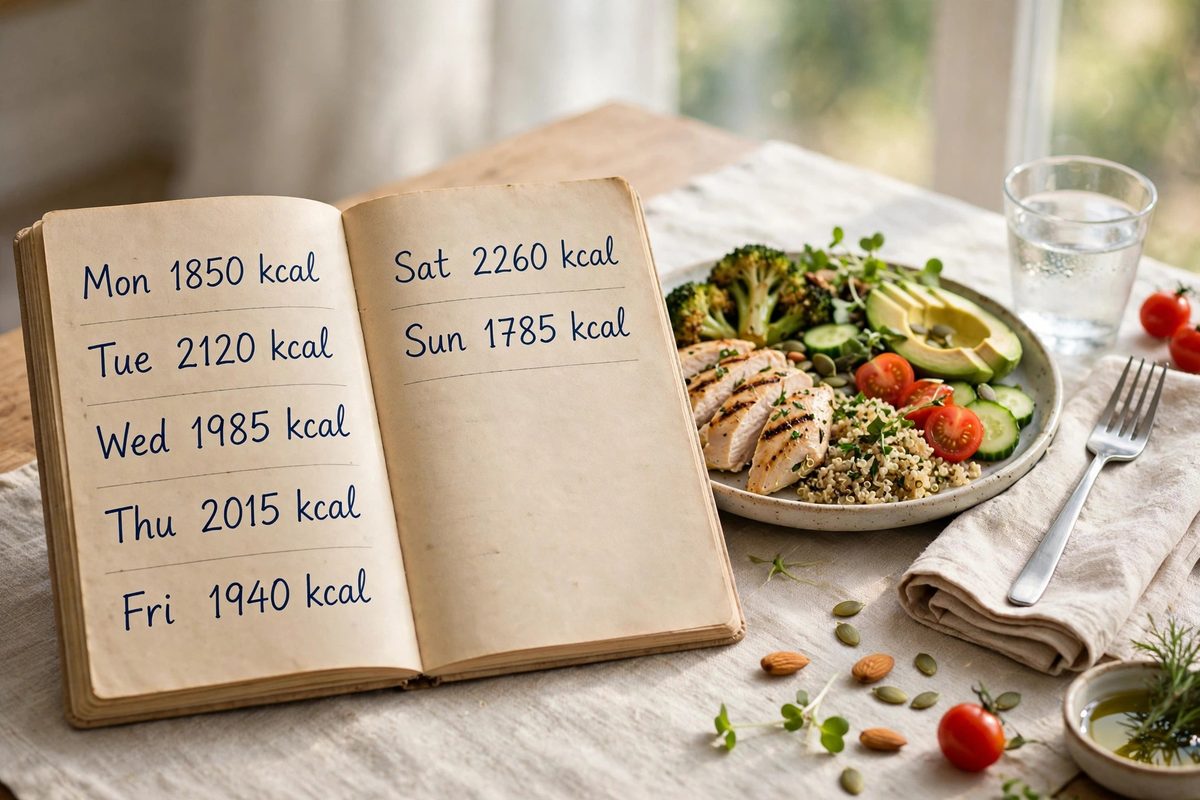
Calorie cycling — also called the zigzag diet — means eating more on some days and less on others while keeping the same weekly total. A 35-year-old man at 180 lb (81.6 kg) who is moderately active burns about 2,726 calories a day; to lose 1 lb (0.45 kg) a week he averages 2,226 a day, but with 2 high days at 2,726 his other 5 days drop to just 2,026 calories — a far easier week than 2,226 every single day. Enter your stats below and this calculator builds your exact high-day and low-day targets plus a full 7-day plan. If you do not know your daily burn yet, start with our calorie calculator to find your maintenance level first.
Your body responds to your total calories over a week far more than to any single day. Calorie cycling keeps that weekly total exactly where your goal needs it, but puts more calories on the days you train hard or eat out, and fewer on quiet days. For weight loss, high days sit at maintenance and low days carry the whole deficit; for weight gain, low days sit at maintenance and high days carry the whole surplus. The calculator below does the split for you — you pick how many high days you want (1 to 3 a week) and it returns both numbers and a day-by-day table.
| Day | Type | Calories |
|---|
Calorie cycling works because weight change follows your average intake over days and weeks, not any single meal. A pound of body fat stores roughly 3,500 calories, so losing 1 lb (0.45 kg) a week needs a weekly deficit of about 3,500 calories, or 500 a day on a flat plan. Cycling keeps that same 3,500-calorie weekly deficit but distributes it unevenly: on high days you eat at maintenance, and on low days you eat below it by enough to cover the whole deficit. The weekly math is identical — only the daily experience changes, and for many people that is the difference between sticking to a plan for three months and quitting in week two. Studies of alternate-day and zigzag patterns consistently find the same result: when weekly calories match, weight loss matches a flat deficit, but adherence and training performance are often better on the cycled plan because the hard days are not every day.
The method behind this calculator has three steps. First, it estimates your basal metabolic rate (BMR) — the calories you burn at complete rest — with the Mifflin-St Jeor equation, the formula most dietitians use because it has held up best against measured metabolic rates. Second, it multiplies BMR by an activity factor to get your total daily energy expenditure (TDEE), the calories that maintain your current weight. Third, it applies your weekly goal and splits the week into high and low days. For weight loss and maintenance, high days sit at your TDEE and low days absorb the deficit. For weight gain, the split flips: low days sit at your TDEE and high days absorb the surplus, so high days stay the bigger days in every case. Check your maintenance figure against our TDEE calculator if you want to confirm the starting point before you cycle.
Step 1 — BMR (Mifflin-St Jeor). For men: BMR = 10 × weight in kg + 6.25 × height in cm − 5 × age in years + 5. For women: BMR = 10 × weight in kg + 6.25 × height in cm − 5 × age in years − 161. To convert, divide pounds by 2.2046 to get kilograms, and multiply feet and inches out to centimeters (1 inch = 2.54 cm). A 35-year-old man at 180 lb (81.6 kg) and 5 ft 10 in (178 cm) has a BMR of 10 × 81.6 + 6.25 × 178 − 5 × 35 + 5 = 816 + 1,112.5 − 175 + 5 = 1,758.5 calories a day at rest.
Step 2 — TDEE. Multiply BMR by an activity factor: 1.2 for sedentary, 1.375 for lightly active, 1.55 for moderately active, 1.725 for very active, and 1.9 for extremely active. Our example man at 1.55 gives 1,758.5 × 1.55 = 2,725.7 calories a day, rounded to 2,726. That is his maintenance level — the flat daily intake that holds his weight steady.
Step 3 — the weekly split. Weekly target = TDEE × 7, plus or minus your weekly change (1 lb a week = 3,500 calories). For weight loss with 2 high days at maintenance: weekly target 2,725.7 × 7 − 3,500 = 19,079.7 − 3,500 = 15,579.7 calories a week; high days take 2 × 2,725.7 = 5,451.4, leaving 15,579.7 − 5,451.4 = 10,128.3 for 5 low days, or 2,025.7 calories per low day, rounded to 2,026. The weekly average is 15,579.7 ÷ 7 = 2,225.7 calories a day. Every number the calculator shows is this same arithmetic with your inputs — nothing hidden, and you can check it with a pocket calculator.
| Activity level | Multiplier | What it means |
|---|---|---|
| Sedentary | 1.2 | Desk job, little or no exercise |
| Lightly active | 1.375 | Light exercise 1–3 days a week |
| Moderately active | 1.55 | Moderate exercise 3–5 days a week |
| Very active | 1.725 | Hard exercise 6–7 days a week |
| Extremely active | 1.9 | Physical job plus daily hard training |
| Weekly rate | Weekly change | Daily equivalent (flat plan) |
|---|---|---|
| Lose 0.5 lb (0.23 kg) / week | −1,750 calories | −250 calories a day |
| Lose 1 lb (0.45 kg) / week | −3,500 calories | −500 calories a day |
| Lose 1.5 lb (0.68 kg) / week | −5,250 calories | −750 calories a day |
| Lose 2 lb (0.91 kg) / week | −7,000 calories | −1,000 calories a day |
| Maintain | 0 calories | 0 a day |
| Gain 0.5 lb (0.23 kg) / week | +1,750 calories | +250 calories a day |
| Gain 1 lb (0.45 kg) / week | +3,500 calories | +500 calories a day |

Example 1 — Weight loss, 2 high days. Man, 35, 5 ft 10 in (178 cm), 180 lb (81.6 kg), moderately active (1.55), losing 1 lb a week. BMR = 10 × 81.6 + 6.25 × 178 − 5 × 35 + 5 = 1,758.5. TDEE = 1,758.5 × 1.55 = 2,725.7, rounded to 2,726. Weekly target = 2,725.7 × 7 − 3,500 = 15,579.7 calories. Two high days at 2,726 take 5,451.4, so the 5 low days share 15,579.7 − 5,451.4 = 10,128.3, or 2,026 calories each. Weekly average: 15,579.7 ÷ 7 = 2,226 a day. His week looks like 2,726 on Saturday and Sunday and 2,026 Monday through Friday — the same 3,500-calorie deficit as a flat 2,226 a day, but with two normal-feeling days built in.
Example 2 — Weight gain, 3 high days. Man, 25, 6 ft (183 cm), 198 lb (90 kg), very active (1.725), gaining 0.5 lb a week. BMR = 10 × 90 + 6.25 × 183 − 5 × 25 + 5 = 900 + 1,143.75 − 125 + 5 = 1,923.75. TDEE = 1,923.75 × 1.725 = 3,318.5 calories. Weekly target = 3,318.5 × 7 + 1,750 = 24,979.3 calories. For a gain the split flips: 4 low days sit at maintenance (4 × 3,318.5 = 13,273.9), so the 3 high days share 24,979.3 − 13,273.9 = 11,705.4, or 3,902 calories each. Weekly average: 24,979.3 ÷ 7 = 3,568 a day. The heavy eating lands on his three training days, when appetite and recovery demand are highest. If you are gaining, pair this with our weight loss calculator in reverse — it shows the same weekly math from the other direction — and check protein targets with our calorie calculator family of tools.
Example 3 — Gentle loss, 3 high days. Woman, 45, 5 ft 3 in (160 cm), 170 lb (77 kg), sedentary (1.2), losing 0.5 lb a week. BMR = 10 × 77 + 6.25 × 160 − 5 × 45 − 161 = 770 + 1,000 − 225 − 161 = 1,384. TDEE = 1,384 × 1.2 = 1,660.8 calories. Weekly target = 1,660.8 × 7 − 1,750 = 9,875.6 calories. Three high days at 1,661 take 4,982.4, so the 4 low days share 9,875.6 − 4,982.4 = 4,893.2, or 1,223 calories each. That low-day number is below the 1,200-calorie floor many dietitians use as a minimum for women, so the calculator flags it: this plan is too aggressive for her stats, and she should pick 1 high day instead (low days rise to about 1,313) or slow to a smaller deficit. The flag matters — cycling only works if the low days are livable.
Start by placing your high days where they help most: on your hardest training days, on the day you eat out with family, or on the weekend if that is when your willpower usually breaks. A runner doing a long Saturday run should make Saturday a high day; a lifter with heavy squat and deadlift sessions on Monday and Thursday should make those the high days. Then build low days around foods that fill you up cheaply — lean protein, vegetables, broth-based soups, and high-fiber carbohydrates — and save calorie-dense foods like oils, nuts, cheese, and alcohol for high days, where they fit without breaking the week. Track the weekly total, not the daily one: a low day that runs 200 calories over is fixed by trimming 200 from another low day, not by guilt or by skipping the next high day. Weigh yourself once a week, same day and same conditions, and compare 3-week rolling averages rather than single weigh-ins, because water weight from a high-carb high day can mask a full week of fat loss on the scale. After 3 to 4 weeks, if your average weekly loss is more than 0.5 lb off your target, recalculate: your TDEE falls as you get lighter, so a plan that was right at 180 lb is about 50 to 70 calories a day too high at 170 lb. For the bigger picture, our calorie deficit calculator shows the flat-plan version of the same target, and our maintenance calorie calculator is the tool to recheck when you reach your goal and want to stop cycling.
Calorie cycling is not for everyone. Skip it — or talk to a doctor first — if you are pregnant or breastfeeding, have diabetes or take blood-sugar medication, have a history of disordered eating, or are under 18. Very low low-days are the biggest risk: women should generally not drop below about 1,200 calories on any day and men not below about 1,500 without medical supervision, and this calculator warns you when your plan crosses those lines. The most common mistake is treating high days as cheat days with no ceiling — a "maintenance" day that quietly becomes 4,000 calories wipes out the whole week's deficit, because one unplanned 1,300-calorie overshoot cancels more than two days of dieting. The second mistake is cycling too hard: a 2 lb-a-week target with only 1 high day pushes low days so low that hunger wrecks training and sleep, and the plan collapses by week three. The third is judging the plan by a single weigh-in after a high day — glycogen and water from extra carbohydrates can add 2 to 4 lb (0.9 to 1.8 kg) of scale weight overnight, and it is gone in two days. Judge by the 3-week trend, keep protein steady at roughly 0.7 to 1 gram per pound (1.6 to 2.2 g per kg) of body weight on every day of the cycle, and let the weekly average do the work.
Written by the Live Fitness Check editorial team · Reviewed against our calculator methodology · Last updated November 2026
Disclaimer: This calculator is for general information only and is not medical advice. The Mifflin-St Jeor equation and the 3,500-calories-per-pound rule are estimates — real metabolic rates and fat loss vary by individual. Talk to your doctor or a registered dietitian before starting a weight-loss plan, especially if you are pregnant, take medication, or have diabetes, heart disease, or a history of disordered eating.