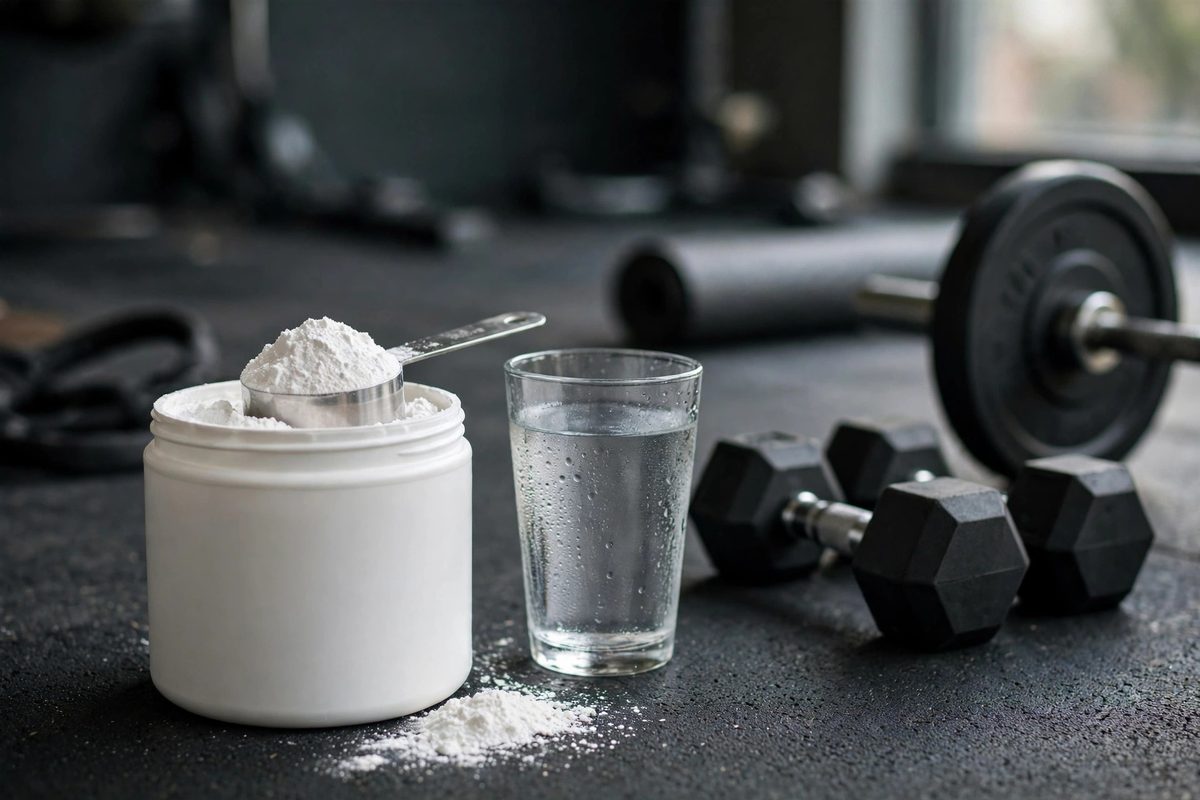
Creatine is one of the most studied sports supplements in the world, and its dose is simpler than the internet makes it look. You either load for a week to fill your muscles fast, or you take a small daily dose and get to the same place in about a month. This calculator works out both numbers from your body weight, splits the loading dose into manageable servings, and adds a sensible water target. Check your overall fueling first with our TDEE calculator and protein calculator.
If you want the simplest plan, take 3-5 g of creatine monohydrate every day and do not worry about loading at all. If you want full muscles sooner, load at 0.3 g per kilogram of body weight per day for 5-7 days, then drop to the same 3-5 g daily dose.
Your creatine dose depends mainly on your body weight, not on your age, sex, or training style. Heavier people store more creatine, so they need a larger loading dose to fill stores quickly. The daily maintenance dose, by contrast, is the same small range for almost everyone: 3-5 grams per day.
That is why this calculator asks for weight first and treats goal and age band as guidance, not as dose multipliers. Your goal changes how you should think about the maintenance range — someone training hard for strength will usually sit at the top of the range, while someone training for general health may be fine at the lower end — but it does not change the underlying math. The same applies to age: the studied maintenance range for healthy adults is 3-5 g per day across adult age bands, so a 55-year-old and a 25-year-old of the same weight get the same dose numbers, with different notes about what to watch for.
Creatine monohydrate is the form used in most research and the form these numbers assume. Other forms — hydrochloride, ethyl ester, buffered blends — are marketed as needing smaller doses, but they do not have the same depth of evidence, and they cost more per serving. If you are buying for the first time, plain creatine monohydrate powder, measured with the scoop or a kitchen scale, is the straightforward choice. One level teaspoon is roughly 5 g, but scoops vary, so weigh your first few servings if you want precision.
Neither protocol is better in the long run; they differ only in speed, convenience, and stomach comfort. Loading fills your muscles in 5-7 days, while a daily dose takes about 3-4 weeks to reach saturation. After that point, both paths converge on the same 3-5 g daily dose, and the research shows no lasting advantage for either starting route.
| Protocol | Daily dose | Time to full muscles | Best for |
|---|---|---|---|
| Loading, then daily | 0.3 g/kg/day for 5-7 days, then 3-5 g/day | 5-7 days | Starting a training block and wanting results fast |
| Daily dose only | 3-5 g/day from day one | About 3-4 weeks | Anyone who prefers one simple habit, or a sensitive stomach |
Loading has two real downsides. First, the dose is large — 20-27 g a day for most adults — and taking it all at once commonly causes bloating, stomach cramps, or loose stools. Splitting it into four servings across the day, each taken with a meal and a full glass of water, avoids most of that trouble. Second, loading makes the scale jump faster, because creatine pulls water into muscle cells as stores fill; that is expected, and it settles into your new normal once you drop to maintenance. If either downside puts you off, skip loading entirely. You lose a few weeks of speed and gain a much simpler routine, and your muscles end up in exactly the same place.
There is no benefit to loading for longer than a week, and no benefit to mega-doses beyond 0.3 g/kg/day. Extra creatine beyond saturation is simply excreted — it does not build extra muscle, and it increases the chance of stomach discomfort. Likewise, there is no need to cycle off creatine. Long-term studies in healthy adults have used daily maintenance doses for years without a washout period, and stopping only lets your muscle stores gradually fall back to their natural level over about a month.

Every number below comes straight from the calculator's formulas, so you can verify them by hand. Loading dose equals 0.3 grams multiplied by body weight in kilograms, and pounds convert to kilograms by multiplying by 0.4536. Maintenance stays at 3-5 grams per day in every example, because that range does not scale with weight.
| Body weight | Weight in kg | Loading dose | Split into 4 servings | Daily dose (no-loading) |
|---|---|---|---|---|
| 150 lbs | 68.0 kg | 20.4 g/day | 4 x 5.1 g | 3-5 g/day |
| 180 lbs | 81.6 kg | 24.5 g/day | 4 x 6.1 g | 3-5 g/day |
| 200 lbs | 90.7 kg | 27.2 g/day | 4 x 6.8 g | 3-5 g/day |
Take the 180 lb example step by step. First, 180 lbs x 0.4536 = 81.6 kg. Then, 81.6 kg x 0.3 g/kg = 24.5 g per day during loading. Split across four servings, that is 24.5 / 4 = 6.1 g per serving — roughly a heaped teaspoon each, taken with breakfast, lunch, dinner, and an evening meal or snack. Over a 5-day load that totals 122.5 g, and over a 7-day load it totals 171.5 g, after which you drop to 3-5 g once a day. A simpler illustration: a round 24 g loading dose splits neatly into four 6 g servings, which is why four servings a day is the standard advice regardless of your exact weight.
The 150 lb and 200 lb rows show how little the answer moves across a wide weight range. A 50 lb difference changes the loading dose by only 6.8 g per day, and the maintenance dose does not change at all. That is worth remembering when you see online calculators promising precision to the decimal point: your body does not distinguish between 24 g and 25 g of creatine, and a scoop that is slightly heaped or slightly flat will not change your results. Consistency over months matters far more than decimal-point accuracy on any single day.
No — creatine does not cause the kind of bloating most women worry about, and it does not build bulk on its own. The water creatine draws in goes inside your muscle cells, where it helps them work, not under your skin, where it would look puffy. Early scale rises are that water, not fat.
Bloating. True bloating — a swollen, uncomfortable stomach — is usually a dosing problem, not a creatine problem. Taking a large dose on an empty stomach, dry-scooping powder straight from the tub, or swallowing 20 g at once can all irritate your gut. Split doses with meals and water, which is exactly what the calculator recommends, and most people feel nothing at all. If you do feel puffy during a loading week, try dropping to the daily-dose protocol instead: the same saturation arrives more slowly, and the stomach effects usually disappear with it.
"Will it make me bulky?" No, not without a calorie surplus and heavy, progressive training sustained over months. Creatine helps you train a little harder — one or two more reps on a hard set, a slightly faster recovery between sets — and that extra training stimulus is what builds muscle, slowly, over time. On its own, without extra food and without heavy lifting, creatine adds water inside existing muscle, not visible bulk. Many women take creatine precisely because it supports strength and bone-friendly resistance training without changing their body shape in the way they fear. For a fuller picture of strength training, see our one-rep-max calculator and Wilks calculator.
Hair loss. This worry traces back to a single small 2009 study in male rugby players, which found a rise in DHT, a hormone linked to hair loss, during a creatine loading phase. The study did not measure hair loss itself, it involved a small group over a short period, and its DHT finding has not been established as a hair-loss effect in follow-up research. That is a thin basis for a strong claim, and it should not be presented as proof that creatine causes hair loss. If hair thinning runs in your family and you are concerned, that is a fair reason to talk to your doctor before starting — but the evidence today does not establish creatine as a cause.
For adults over 50, creatine is worth a serious look alongside resistance training, because muscle and strength decline with age and creatine supports both. Research in older adults has found creatine plus training improves strength more than training alone, though wider benefits for bone and brain health remain promising, not proven.
Perimenopause adds a specific reason for interest: falling estrogen accelerates muscle and bone loss, and the years around menopause are when strength training pays the highest dividends for long-term independence. Creatine is not hormone therapy and does not replace it, and it does not treat hot flashes or other menopause symptoms. What it can do, in the research so far, is help you get more from the resistance training that protects muscle and bone through this transition — provided you actually do the training. A daily 3-5 g dose, with or without a loading week, is the same range studied in older adults, and older adults with kidney disease or on medications that affect the kidneys should check with their doctor first, as should anyone with a medical condition that affects fluid balance.
Practical notes for the 55+ group: start with the daily-dose protocol rather than loading if you prefer a gentler introduction, keep the same hydration habit as younger users, and give it at least 8-12 weeks alongside two to three weekly resistance sessions before judging it. Strength changes in older adults are real but gradual, and a supplement that supports training is only as good as the training it supports. Pair it with enough daily protein — our protein calculator can set that target — and with a realistic overall plan from our macro calculator.
For healthy adults, the kidney worry is a myth that has survived decades of reassuring research. Creatine raises blood creatinine, the marker doctors use to estimate kidney function, because creatinine is a breakdown product of creatine — but a higher marker from supplementation is not the same as kidney damage.
That reassurance has limits, and they matter. It applies to healthy adults at recommended doses, not to people with existing kidney disease, and not to mega-doses. If you have kidney disease, a history of kidney stones, or take medication that stresses the kidneys, do not start creatine without your doctor's approval. The same caution applies if you are pregnant or breastfeeding, where the research base is thinner and a clinician's advice should come first. For everyone else, the safety rules are simple: stick to the dose, drink normally, and do not dry-scoop.
What to avoid, in plain terms. Do not dry-scoop powder — it can cause choking, coughing, and stomach upset, and it gains you nothing. Do not take mega-doses above the loading range in hopes of faster results; excess creatine is excreted, not stored. Do not buy blends that hide the dose behind a proprietary label; if the label does not state grams of creatine monohydrate per serving, you cannot know what you are taking. And do not expect creatine to compensate for poor sleep, low protein, or no training — it amplifies a good program, it does not replace one.
Take creatine once a day, every day, at whatever time you will actually remember it. Timing around workouts makes little difference at maintenance doses, because the benefit comes from full muscle stores built over weeks, not from a single pre-workout serving.
Mixing powder into water, juice, or a smoothie all work; warm water dissolves it fastest, and taking it with a meal that contains some carbohydrate and protein may slightly improve uptake.
For water, the calculator uses a planning estimate of about 35 ml of total daily fluid per kilogram of body weight, counting all drinks and the water in food — not water alone, and not on top of everything else you drink. For the worked examples, that gives about 81 fl oz (2.4 L) per day at 150 lbs, about 97 fl oz (2.9 L) at 180 lbs, and about 107 fl oz (3.2 L) at 200 lbs. Treat those figures as a starting point, not a prescription: hot weather, hard training, and a high-sodium diet all raise your needs, and the simplest daily check is pale-yellow urine and normal thirst. During a loading week, add an extra glass of water with each of the four servings, and do not force a gallon a day if you feel fine on less.
A final habit note, because it decides whether creatine works for you at all: missed days do not matter much, but missed months do. Muscle creatine falls slowly after you stop, so a forgotten day is not a reset — just take the next dose as normal and do not double up. Keep the tub somewhere you see it every morning, pair it with an existing habit like breakfast or your workout, and judge it after 8-12 weeks of consistent training, not after a week of loading. That is the honest timeline, and it is also why the daily-dose protocol suits so many people: one scoop, one habit, no countdown.
Pin this page for the worked examples table — the loading dose for your weight, the four-way split, and the water target in one place — and send it to a training partner who is about to start creatine. The most shareable fact here is also the most useful one: 3-5 g a day, every day, beats any complicated protocol you abandon after two weeks. If you want the training plan behind the supplement, our Winter Arc Generator builds a daily tracker around consistent training.
Add it to your site with one clean attribution link:
<iframe src="https://livefitnesscheck.com/creatine-dosage-calculator.php" width="100%" height="900" style="border:0"></iframe><p>Via <a href="https://livefitnesscheck.com/creatine-dosage-calculator.php">Creatine Dosage Calculator</a></p>Written by the Live Fitness Check editorial team · Reviewed against our calculator methodology · Last updated October 2026
Disclaimer: This calculator is for educational purposes only and is not medical advice. Creatine doses here are general information for healthy adults, not a recommendation for you personally. If you have kidney disease, are pregnant or breastfeeding, or take medication affecting the kidneys, talk to your doctor before taking creatine.
