Your birthday says one number. Your heart and lungs may say another. This calculator estimates your VO2max — the maximum oxygen your body can use during hard exercise — from four numbers you can measure at home, then converts it into a fitness age: the age at which the average person has your level of cardio fitness. It takes two minutes, needs no exercise test, and comes with a share card and three actions to bring the number down. Try it with our VO2max calculator if you want the raw fitness score on its own.
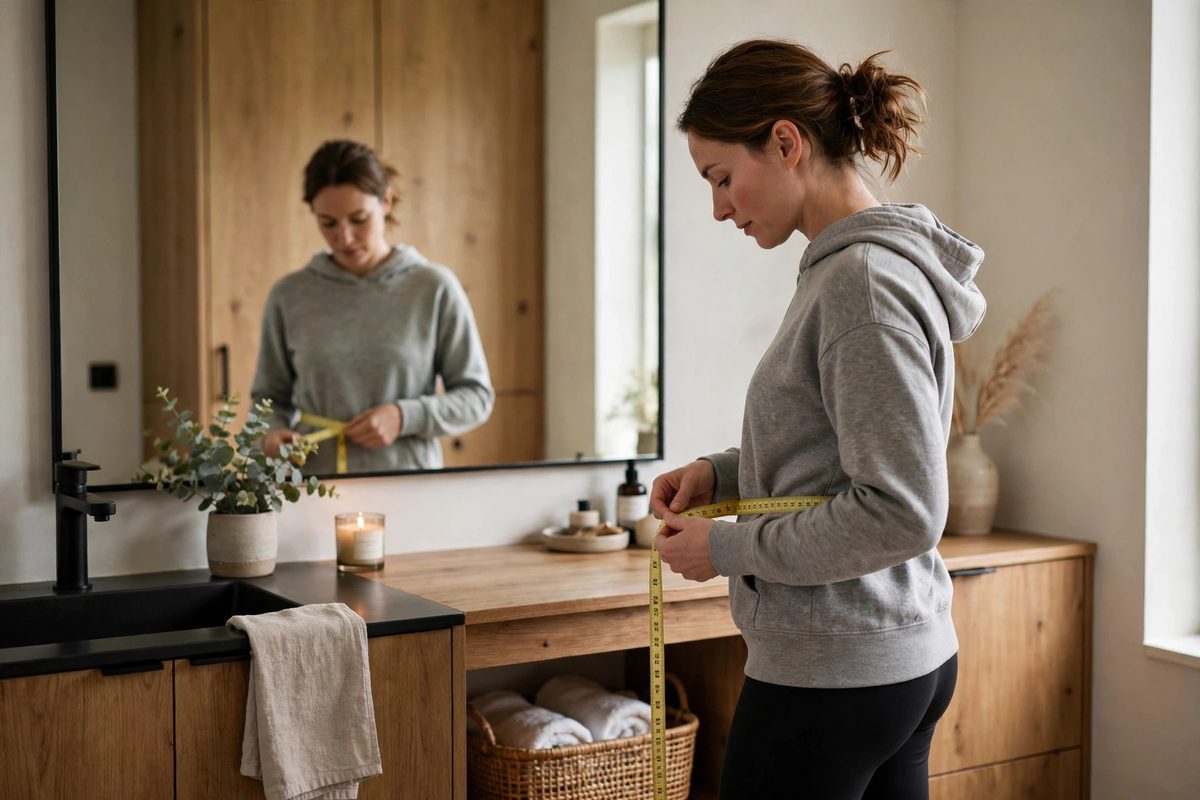
Age, waist circumference, resting heart rate, and how you actually train — the same four inputs behind the Norwegian HUNT fitness study. No treadmill, no lab, no guessing.
Fitness age is the age at which the average person in a healthy reference population has the same estimated VO2max as you. If your estimated VO2max matches the average 31-year-old's, your fitness age is 31, whatever your birth certificate says. It is a cardio-fitness measure only: it says nothing about your strength, mobility, or metabolic health, which age on their own schedules.
The equations below come from Nes and colleagues' non-exercise prediction model, built on 4,637 healthy Norwegian adults aged 20–90 in the HUNT3 Fitness Study who had their VO2peak measured directly on a treadmill (Medicine & Science in Sports & Exercise, 2011). This page uses that published model; it is not NTNU's exact calculator, and its reference averages are population estimates, not a medical diagnosis.
| Group | Estimated VO2max (ml/kg/min) |
|---|---|
| Men | 100.27 − (0.296 × age) − (0.369 × waist in cm) − (0.155 × resting heart rate) + (0.226 × activity index) |
| Women | 74.74 − (0.247 × age) − (0.259 × waist in cm) − (0.114 × resting heart rate) + (0.198 × activity index) |
The activity index is the HUNT questionnaire score: frequency × intensity × duration. Frequency scores never (or less than once a week) 0, once a week 1, 2–3 times a week 2.5, almost every day 5. Intensity scores no sweating 1, out of breath and sweating 2, near exhaustion 3. Duration scores under 15 minutes 0.1, 15–29 minutes 0.38, 30–60 minutes 0.75, over an hour 1. The index runs 0–15. Two consequences follow: exercising less than once a week scores the same as never, and the index rewards intensity more than duration — an hour of easy cycling scores lower than 30 hard minutes.
Example 1 — a fit 40-year-old man. Age 40, waist 35 in (88.9 cm), resting heart rate 60, training 2–3 times a week near exhaustion for 30–60 minutes (activity index 2.5 × 3 × 0.75 = 5.6). VO2max = 100.27 − 11.8 − 32.8 − 9.3 + 1.3 = 47.6 ml/kg/min. That beats the average for the youngest reference group, so the tool reports a fitness age of 20 — the floor of the reference range, meaning younger than the youngest group the table covers, not a literal age of 20.
Example 2 — a moderately active 45-year-old woman. Age 45, waist 31 in (78.7 cm), resting heart rate 72, training once a week, out of breath, 15–29 minutes (activity index 1 × 2 × 0.38 = 0.8). VO2max = 74.74 − 11.1 − 20.4 − 8.2 + 0.2 = 35.2 ml/kg/min, giving a fitness age of 29 — 16 years younger than her chronological age, because her resting heart rate and waist sit well below her age-group average.
Example 3 — an inactive 55-year-old man. Age 55, waist 40 in (101.6 cm), resting heart rate 78, activity index 0. VO2max = 100.27 − 16.3 − 37.5 − 12.1 + 0 = 34.4 ml/kg/min, giving a fitness age of 62 — 7 years older than his chronological age. This is the most fixable direction in the whole calculator: adding 2–3 weekly sessions moves the activity index from 0 to about 3.8 and lifts the estimate by nearly 1 ml/kg/min on its own, before any waist or heart-rate change.
These population-average estimates are the reference the fitness-age interpolation uses. Find your age row, compare your result, and you have your band. Averages fall roughly 2–4 ml/kg/min per decade — which is why a 10 ml/kg/min gap is worth about three decades of fitness age.
| Age group | Men (ml/kg/min) | Women (ml/kg/min) |
|---|---|---|
| 20s (midpoint 25) | 44 | 36 |
| 30s (midpoint 35) | 42 | 34 |
| 40s (midpoint 45) | 40 | 32 |
| 50s (midpoint 55) | 37 | 29 |
| 60s (midpoint 65) | 33 | 27 |
| 70s (midpoint 75) | 30 | 25 |
Your band: Excellent (8+ above your age-group average), Good (3–8 above), Average (within 3 either way), Below average (3–8 below), Low (8+ below). The model explains about 60% of the variation in measured VO2max, with a reported error of about 12.8% for men and 14.3% for women — so treat a single reading as a range, and the trend over months as the real signal.
A 2025 validation found Apple Watch VO2max estimates off by about 6 ml/kg/min (roughly 13%) on average versus lab testing. That error is larger than the gap between fitness-age bands. So if your watch says 38 and this calculator says 42, neither is "wrong" — both are estimates with wide error bars, and the number that matters is whether both move in the same direction over six months. Resting heart rate from a watch is usually the most reliable input here; its VO2max is the least.
1. Add one hard session a week. The activity index rewards intensity: moving from "out of breath" (2) to "near exhaustion" (3) at the same frequency and duration raises the estimate by about 0.4 ml/kg/min — and hard intervals are the fastest documented way to raise VO2max. One weekly interval session (for example 4 × 4 minutes hard with 3-minute recoveries) plus your existing easy sessions is the highest-yield change in this calculator. 2. Walk the waist down. Every 1 cm off the waist adds 0.37 ml/kg/min for men and 0.26 for women in the model — and unlike the activity score, waist change compounds with the calorie and protein habits in our TDEE calculator and protein calculator. 3. Retest in 12 weeks, same conditions. Morning resting heart rate, same tape position, same honest activity answers. Fitness age moves slowly — a 2–3 year improvement in a quarter is a big win — and retesting sooner mostly measures noise. Set your training zones first with our heart-rate-zones calculator so the hard session is actually hard.
Your share card shows your fitness age, the gap to your real age, and the three actions above, sized 1080 × 1350 for Instagram Stories, TikTok, and Pinterest. The share link points to the blank calculator — not your numbers — so a friend who clicks it takes their own test instead of seeing your result. If you want the full January plan behind the number, our Winter Arc Generator builds the daily tracker around it.
Add it to your site with one clean attribution link:
<iframe src="https://livefitnesscheck.com/fitness-age-calculator.php" width="100%" height="900" style="border:0"></iframe><p>Via <a href="https://livefitnesscheck.com/fitness-age-calculator.php">Fitness Age Calculator</a></p>Written by the Live Fitness Check editorial team · Reviewed against our calculator methodology · Last updated October 2026
Disclaimer: This calculator is for educational purposes only and is not medical advice. VO2max and fitness age here are estimates from a published non-exercise model, not lab measurements. If you have heart disease, chest pain, or have been inactive, talk to your doctor before starting or intensifying exercise.