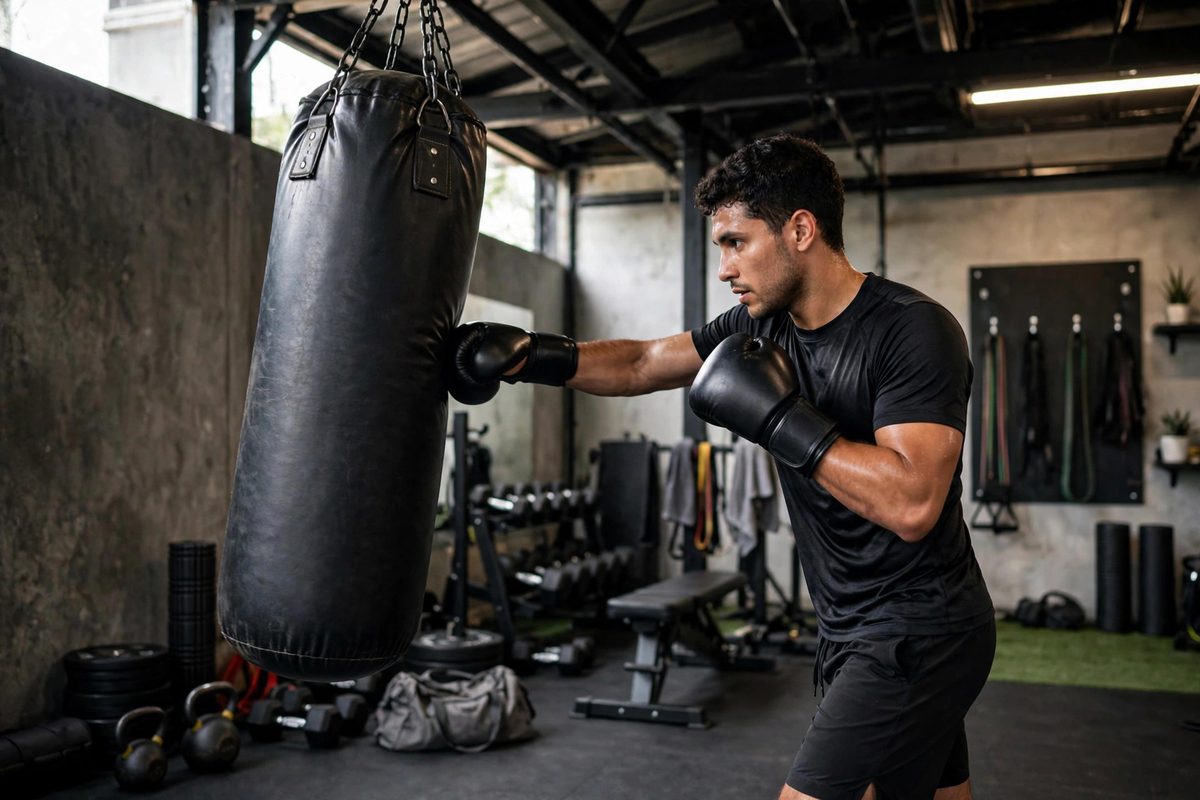
Boxing burns roughly 325 to 1,048 calories per hour, depending on your weight and what kind of boxing you are doing. Light shadow boxing at 130 lbs (59 kg) burns about 325 calories an hour, while hard sparring at 220 lbs (100 kg) burns about 1,048. That range is the whole story: boxing is not one activity, and your weight changes the number as much as your effort does. In this guide every cell is computed from the same MET formula, so you can trust the chart and scale it to your own weight and session — or estimate any workout with our calories burned calculator.
For a 160 lb (73 kg) person, one hour burns about 399 calories shadow boxing, about 653 on the heavy bag, and about 762 sparring. Heavier boxers burn more because they move more mass; harder formats burn more because the MET value is higher. Scale any cell to your session length — half the time, half the calories — with our calories burned calculator or TDEE calculator.
Calculate My Boxing BurnDirect answer: calories burned = MET value × body weight in kilograms × hours of activity. A MET (metabolic equivalent of task) is a multiple of your resting burn — sitting still is 1 MET, and boxing ranges from about 5.5 METs for shadow boxing to 9–12 METs for sparring. This guide uses 5.5 for shadow boxing, 9.0 (the midpoint of 8.0–10.0) for heavy-bag work, and 10.5 (the midpoint of 9.0–12.0) for sparring. Weights are converted exactly: 130 lbs is 59.0 kg, 160 lbs is 72.6 kg, 190 lbs is 86.2 kg, and 220 lbs is 99.8 kg. Every cell in the chart is that formula worked out for one hour.
| Activity (60 minutes) | 130 lbs (59 kg) | 160 lbs (72.6 kg) | 190 lbs (86.2 kg) | 220 lbs (99.8 kg) |
|---|---|---|---|---|
| Shadow boxing (5.5 MET) | ~325 | ~399 | ~474 | ~549 |
| Heavy bag (9.0 MET) | ~531 | ~653 | ~776 | ~898 |
| Sparring (10.5 MET) | ~620 | ~762 | ~905 | ~1,048 |
Check the arithmetic on three cells so you can trust the rest. Shadow boxing at 160 lbs: 5.5 × 72.6 kg × 1 hour = 399.3, rounded to 399. Heavy bag at 190 lbs: 9.0 × 86.2 × 1 = 775.8, rounded to 776. Sparring at 220 lbs: 10.5 × 99.8 × 1 = 1,047.9, rounded to 1,048. The same formula scales to any weight and any duration: a 180 lb (81.6 kg) person on the heavy bag for 45 minutes burns 9.0 × 81.6 × 0.75 = 551 calories. Note that these are gross calories, including what you would have burned sitting still for that hour — the extra burn above rest is roughly 90 percent of the figure, a distinction that matters for precise tracking but rarely changes a training decision.
Direct answer: shadow boxing (5.5 METs) is technique work against air, heavy-bag work (8.0–10.0 METs) is power punching against resistance, and sparring (9.0–12.0 METs) is live work against a partner, which is why it burns the most. The MET ranges are wide because effort varies enormously within each format: a lazy bag session at 8.0 METs burns about 11 percent less than the 9.0 midpoint, and an all-out bag session at 10.0 burns about 11 percent more. For a 160 lb person, that is a heavy-bag range of about 581 to 726 calories per hour around the 653 midpoint. Sparring ranges wider still — 653 to 871 calories per hour at 160 lbs — because a technical, light-contact round and a hard round are almost different sports. Use the midpoint for planning and the range for honesty: if you cruised, take the low end; if you emptied the tank, take the high end.
| Format | MET range | 160 lbs, 60 min range | What drives the range |
|---|---|---|---|
| Shadow boxing | ~5.5 | ~399 | Footwork speed, combination volume, added movement |
| Heavy bag | 8.0–10.0 | ~581–726 | Punch power, work rate, rest between flurries |
| Sparring | 9.0–12.0 | ~653–871 | Intensity, partner pace, defensive movement |
| Boxing class (mixed) | ~7.0–9.0 | ~508–653 | Class structure: drills, bag rounds, conditioning blocks |
A typical boxing class deserves its own note, because it is how most beginners actually train. A 60-minute class mixes warm-up, shadow work, bag rounds, and conditioning, so its average intensity lands around 7.0–9.0 METs — about 508–653 calories per hour for a 160 lb person. That is less than an hour of pure sparring and more than an hour of pure shadow boxing, which is exactly what you would expect from a mix. If your class felt easy, take the low end; if you left soaked, take the high end. And if your fitness tracker reports 1,200 calories for a casual class, it is almost certainly overestimating — compare it against this chart before logging it.
Direct answer: a real boxing session is not 60 minutes of punching — it is rounds of work separated by rest, and only the work counts at full METs. The classic structure is 3-minute rounds with 1 minute of rest: twelve rounds is 36 minutes of work and 11 minutes of rest (plus warm-up and cool-down), so a "one-hour session" typically holds about 36–45 minutes of actual boxing. That matters for the math: twelve bag rounds at 160 lbs burn about 9.0 × 72.6 × 0.6 hours = 392 calories for the work itself, plus roughly 100 calories for the rest periods and warm-up at light intensity — about 490 total, not the 653 of a full uninterrupted hour. Honest logging counts rounds, not wall-clock time.
| Session (160 lbs) | Work time | Estimated burn |
|---|---|---|
| 6 bag rounds (3 min on, 1 min off) | 18 min | ~196 (bag) + ~60 (rest/warm-up) ≈ 255 |
| 12 bag rounds | 36 min | ~392 (bag) + ~100 ≈ 490 |
| 60-min class (mixed) | ~45 min active | ~490–580 |
| Full 60 min continuous bag work | 60 min | ~653 (rare in practice) |
Gloves deserve a brief honesty note: heavier gloves (14–16 oz for training versus 10–12 oz for competition) add a small amount of effort per punch, but they do not transform the calorie burn — the effect is a few percent, well inside the MET range, and no glove choice turns a light session into a hard one. Hand wraps, glove weight, and bag weight matter for safety and technique, not for the calorie ledger. What does move the ledger is punch volume and footwork: a boxer who throws 100 punches a round and stays on their toes burns meaningfully more than one who throws 40 and stands flat, even in the same round structure. That is why two people in the same class can honestly report burns 20 percent apart.
Direct answer: three 45-minute bag sessions a week burn roughly 1,200–1,500 calories for a 160 lb person, which is a real but modest contribution to a calorie deficit — the diet still does most of the work. Three sessions of twelve bag rounds (about 490 calories each by the rounds math above) total about 1,470 calories a week, roughly equivalent to 0.4 lbs of fat (at 3,500 calories per pound) before any dietary change. Boxing's real weight-loss advantage is not the hourly burn, which running and cycling match or beat, but adherence: people who enjoy training keep training, and a sport with skill progression keeps people coming back longer than a treadmill they dread. Pair boxing with a measured calorie target from our TDEE calculator and a protein target from our protein calculator, and treat the boxing burn as a bonus, not a license to eat back double. Beginners should learn footwork and guard from a coach before sparring — sparring's high burn comes with contact risk that no calorie figure justifies skipping the basics for. Explore the rest of the training series on the Fitness & Performance hub.
Our calories burned calculator estimates any session in seconds.
Calculate My BurnWritten by the Live Fitness Check editorial team · Reviewed against our calculator methodology · Last updated October 2026
Disclaimer: This guide is for educational purposes only and is not medical advice. Calorie figures are MET-based estimates; actual burn varies with effort, fitness, and technique. Learn boxing from a qualified coach, and talk to your doctor before starting a contact sport.