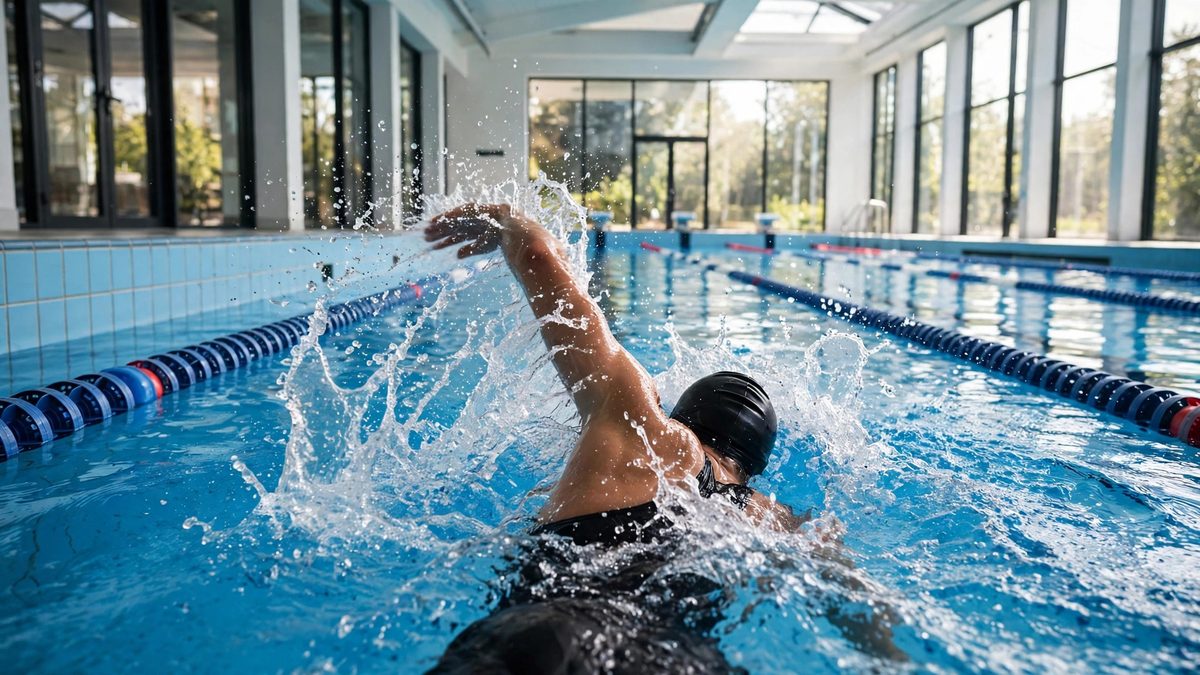
Swimming can burn anywhere from ~200 to ~470+ calories in 30 minutes — and the stroke you choose matters more than in almost any other exercise. Vigorous butterfly is one of the highest-burn activities a human can sustain (~13.8 METs), while leisurely paddling around is closer to a brisk walk. Most swimmers land in the middle: a steady freestyle burns roughly 280–330 calories in half an hour for a 150 lb person. In this guide you will see the full stroke-by-stroke chart by weight and time, how swimming compares to running and cycling, and why the pool feels harder than the numbers suggest — or get your personal estimate from our calories burned calculator.
Plug in your weight and activity into our calories burned calculator for a personalized estimate across dozens of exercises.
Calculate My BurnThe numbers below use MET values from the Compendium of Physical Activities — the research standard for exercise energy cost. Calories = MET × body weight (kg) × hours. A 150 lb swimmer weighs 68 kg, so 30 minutes of moderate freestyle (8.3 MET) is 8.3 × 68 × 0.5 = ~282 calories.
| Stroke (intensity) | MET | 30 min (150 lb) | 60 min (150 lb) |
|---|---|---|---|
| Butterfly (vigorous) | 13.8 | ~470 | ~939 |
| Breaststroke (vigorous) | 10.3 | ~350 | ~701 |
| Freestyle (fast, vigorous) | 9.8 | ~333 | ~667 |
| Backstroke (vigorous) | 9.5 | ~323 | ~646 |
| Freestyle (moderate) | 8.3 | ~282 | ~565 |
| Leisurely (not lap swimming) | 6.0 | ~204 | ~408 |
| Treading water (moderate) | 3.5 | ~119 | ~238 |
Spot checks: butterfly 13.8 × 68 × 0.5 = 469.2 ≈ 470 ✓; treading water 3.5 × 68 × 0.5 = 119 ✓. Butterfly is the standout — few recreational athletes can sustain it for long, which is why its hourly number looks almost unbelievable. For most lap swimmers, the moderate-to-fast freestyle rows are the honest reference.
| Body weight | 30 minutes | 60 minutes |
|---|---|---|
| 130 lb (59 kg) | ~245 | ~489 |
| 150 lb (68 kg) | ~282 | ~565 |
| 170 lb (77 kg) | ~320 | ~640 |
| 190 lb (86 kg) | ~358 | ~715 |
| 210 lb (95 kg) | ~396 | ~791 |
Math: 8.3 MET × kg × hours. For 190 lb (86.2 kg): 8.3 × 86.2 × 0.5 = 357.7 ≈ 358 ✓. Note that heavier swimmers are also more buoyant, which slightly offsets the weight penalty — the linear scaling is an approximation, but a good one.
Per hour, vigorous freestyle (~9.8 MET) burns about the same as running at 6 mph (also ~9.8 MET) — and far more than easy cycling (~7–8 MET at a moderate pace). The difference is joint impact: swimming delivers runner-level burn with essentially zero pounding, which is why it is the go-to cardio for bad knees, heavy runners, and anyone rehabbing an injury. Where running wins is convenience — no pool, no lane etiquette, no wet hair. If you can do both, alternating them is the classic cross-training split: our running-a-mile guide covers the land side of the equation.
New swimmers often feel wrecked after 20 minutes that "only" burned ~200 calories. Four reasons: (1) water is ~800× denser than air, so every movement fights resistance; (2) your body spends energy on thermoregulation — cool water pulls heat away constantly; (3) breathing is restricted to stroke rhythm, which spikes perceived effort even at moderate intensity; (4) poor technique wastes enormous energy — an efficient swimmer glides, a beginner fights the water. Technique is the cheat code: two lessons can cut your per-lap effort dramatically, which paradoxically lets you swim longer and burn more total.
Ask any regular swimmer: the pool makes you ravenous. Cold-water immersion appears to stimulate appetite more than equivalent land exercise — researchers have measured higher post-exercise calorie intake after swimming in cool water versus warm. The practical defense: decide what you will eat before you get in the pool. A planned post-swim meal with ~30–40 g of protein (see our protein-per-meal guide) turns the hunger into recovery fuel instead of a vending-machine detour. If your goal is a daily deficit, set it from your full-day burn with our TDEE calculator and treat the swim as a bonus.
New swimmers fixate on lap counts and burn out chasing them. Time is the better metric: start with 20–30 minutes of mixed strokes with rest intervals, and build toward continuous 30–45 minute sessions. A 30-minute session of moderate freestyle (~282 cal for 150 lb) done three times a week is ~850 calories — a genuine contribution to any weight-loss plan, with joints that will thank you for decades.
Pair this with how many calories running a mile burns and calories burned walking — pick your cardio by the numbers.
Our calories burned calculator covers swimming, running, lifting, and dozens more — find your best burn.
Calculate My BurnWritten by the Live Fitness Check editorial team · Reviewed against our calculator methodology · Last updated October 2026
Disclaimer: This guide is for educational purposes only and is not medical advice. Never swim alone, and if you have a heart condition or are new to exercise, check with your doctor before starting a swim program.