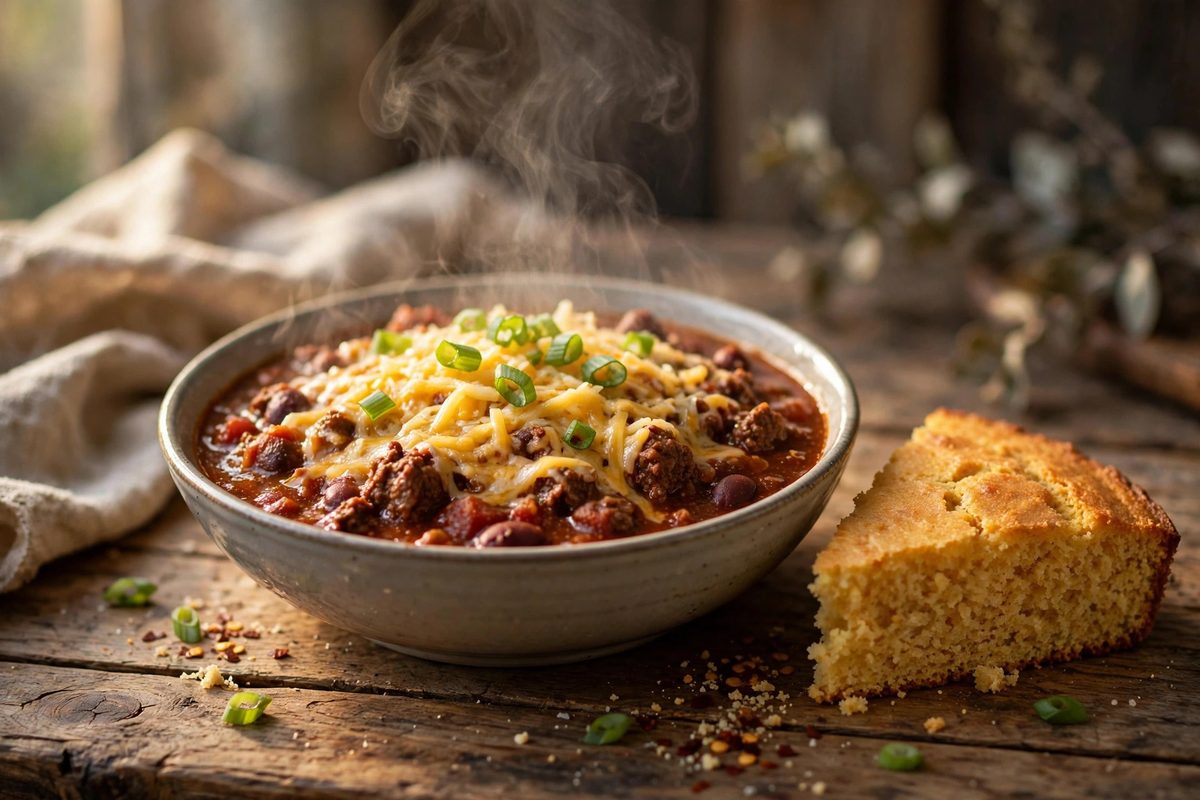
A bowl of chili is about 280 to 350 calories per cup for classic beef chili with beans, 220 to 280 for turkey chili, and 200 to 250 for vegetarian bean chili — and the toppings decide whether the bowl stays in that range or doubles. A cup of chili with a full topping load of cheese, sour cream, and crackers reaches about 550 calories, while a lighter turkey-chili bowl with Greek yogurt instead of sour cream lands near 270. Check where any bowl fits your day with our calorie calculator — this guide breaks down every common chili by type, counts the toppings one by one, and shows the swaps that keep chili filling without blowing the budget.
The USDA FoodData Central database lists chili con carne with beans at roughly 280 to 350 calories per cup (8 oz / 240 g), depending on the leanness of the beef and the amount of beans. A typical homemade beef chili lands near 300 calories a cup, with about 15 to 18 g of protein and 5 to 6 g of fiber. A "bowl" at a restaurant is usually 1.5 to 2 cups, so a restaurant bowl of beef chili is roughly 450 to 600 calories before toppings — 300 × 1.5 = 450 and 300 × 2 = 600. That portion size, not the recipe, is the first thing to check.
Check My Daily TargetChili is not one food — the meat, the beans, and the fat in the pan set the calories, and the range between the lightest and heaviest versions is wider than most people expect. Beef chili with beans is the classic: about 280 to 350 calories a cup, because ground beef brings both protein and fat, and the beans add fiber and slow carbohydrate. Turkey chili is lighter, about 220 to 280 calories a cup, since ground turkey breast is leaner than ground beef — a swap that saves roughly 60 calories a cup, or about 120 calories in a two-cup bowl. Vegetarian or bean-only chili is the lightest of the three at about 200 to 250 calories a cup, with the beans doing the heavy lifting on protein (about 10 to 12 g) and fiber (about 8 to 10 g), which is why it keeps you full on the fewest calories.
The regional styles are where the numbers climb. Cincinnati-style chili served three-way — chili over spaghetti with shredded cheddar — is about 550 to 650 calories a serving: roughly 250 for the chili, 220 for a cup of cooked spaghetti, and 110 for an ounce of cheese, totaling 250 + 220 + 110 = 580 calories. Texas-style chili con carne without beans is similar to beef chili, about 280 to 340 calories a cup, but it is easier to overeat because there are no beans to add bulk and fiber. Chili cheese fries are the outlier: a medium order of fries (about 365 calories) topped with a cup of chili (about 300) and an ounce of cheese (about 110) totals 365 + 300 + 110 = 775 calories — roughly 750 to 800 for the plate — which is a full meal, not a side.
| Chili type (1 cup / 8 oz) | Calories | Protein | Notes |
|---|---|---|---|
| Beef chili with beans | ~280–350 | ~15–18 g | The classic; use ~300 as a working number |
| Turkey chili with beans | ~220–280 | ~20 g | Leanest meat chili; about 60 fewer calories than beef |
| Vegetarian / bean chili | ~200–250 | ~10–12 g | Highest fiber, about 8–10 g per cup |
| Texas chili (no beans) | ~280–340 | ~18–20 g | More meat, less bulk; easy to over-serve |
| Cincinnati 3-way (chili + spaghetti + cheese) | ~550–650 | ~25 g | One serving: 250 + 220 + 110 = ~580 |
| Chili cheese fries (medium plate) | ~750–800 | ~22 g | Fries 365 + chili 300 + cheese 110 = ~775 |
| Restaurant bowl, beef chili (1.5–2 cups, no toppings) | ~450–600 | ~23–36 g | 300 × 1.5 = 450; 300 × 2 = 600 |
The protein is the reason chili punches above its weight as a meal. A cup of beef chili at about 300 calories carries roughly the same protein as a 4 oz (113 g) chicken breast, plus fiber from the beans that chicken does not have — and protein plus fiber is the combination that keeps hunger away for hours. That is why chili works so well for weight loss when the bowl is built right: it is a genuinely filling 300-calorie base, and the problem is almost never the chili itself. It is what goes on top, and what goes beside it.
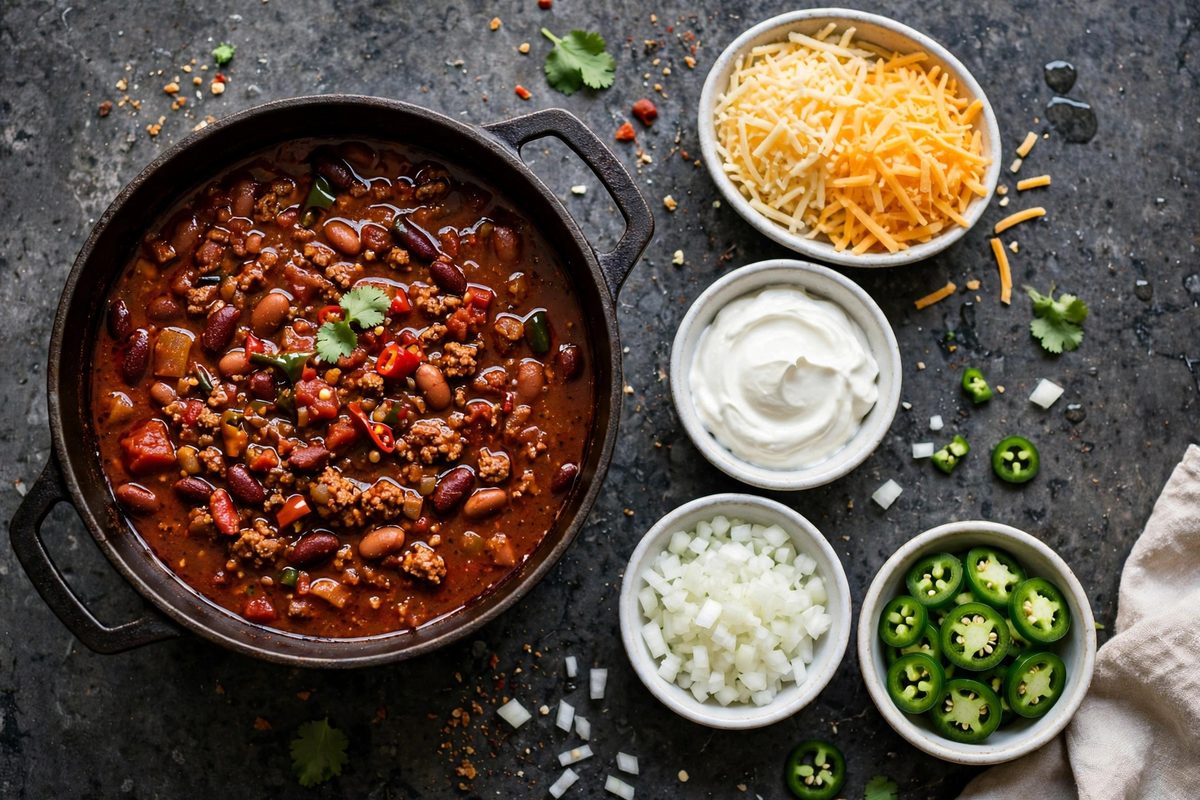
Toppings are the quiet calorie leak in chili, because each one looks small and they stack. An ounce of shredded cheddar (about a small handful, 28 g) adds about 110 calories. Two tablespoons of sour cream add about 60. A packet of saltine crackers (about 6 crackers) adds about 80. A small handful of corn chips or Fritos (1 oz / 28 g) adds about 150. Diced raw onion adds about 10 calories, and sliced jalapeños add about 5 — the fresh toppings are nearly free. A piece of cornbread beside the bowl adds about 190 calories, which is more than the cheese and the sour cream combined.
Do the build math on a loaded bowl and the swing is stark. Beef chili (300) + cheddar (110) + sour cream (60) + crackers (80) = 550 calories. That is 250 calories of toppings on a 300-calorie base — the toppings nearly double the bowl. The lighter version tells the other side of the story: turkey chili (240) + a dollop of plain Greek yogurt instead of sour cream (about 15 calories for 2 tablespoons) + diced onion (10) + jalapeños (5) = 270 calories, with the same warmth and nearly the same flavor. The difference between the two bowls is 550 − 270 = 280 calories, saved entirely on toppings, with the chili itself barely changed. If you want the full picture for your own build, run it through our macro calculator to see the protein, carbs, and fat behind each version.
| Topping (typical serving) | Calories | Swap it for | Swap cost |
|---|---|---|---|
| Shredded cheddar, 1 oz (28 g) | ~110 | Reduced-fat cheddar, 1 oz | ~80 |
| Sour cream, 2 tbsp | ~60 | Plain nonfat Greek yogurt, 2 tbsp | ~15 |
| Saltine crackers, 1 packet | ~80 | Oyster crackers, small handful | ~60 |
| Corn chips / Fritos, 1 oz | ~150 | Diced onion + jalapeño | ~15 |
| Cornbread, 1 piece | ~190 | Whole-wheat roll, 1 small | ~80 |
| Diced onion + jalapeño | ~15 | — | — |
| Loaded bowl (beef + cheese + sour cream + crackers) | ~550 | Light bowl (turkey + yogurt + onion + jalapeño) | ~270 |
Canned chili is not dramatically higher in calories than homemade — a cup of canned beef chili with beans runs about 280 to 320 calories, squarely in the homemade range — but it is a different food in two ways that matter. First, the serving size on the label is usually half a cup, so the "280 calories per serving" on the can is really 560 calories for the full cup most people eat; always multiply the label by the number of servings you actually serve. Second, the sodium is much higher: canned chili typically carries 800 to 1,000 mg of sodium per cup, against about 400 to 600 mg for a homemade pot where you control the salt, and the daily recommended limit is 2,300 mg — with the American Heart Association's ideal target at 1,500 mg. One cup of canned chili at 900 mg is about 39% of the 2,300 mg daily limit (900 ÷ 2,300 = 0.39), and a two-cup bowl is about 78% of it before anything else that day.
Homemade chili wins on more than sodium. You choose the meat — lean ground beef or ground turkey instead of the fattier blends in many cans — you control the oil in the pan, and you can double the beans, which adds fiber and bulk at about 120 calories a cup while letting you cut back the meat. A homemade turkey-and-bean chili at about 240 calories a cup with 8 g of fiber beats a canned beef chili at 300 calories with 4 g of fiber on every measure that matters for fullness. Canned chili is still a reasonable pantry meal, especially the lower-sodium varieties, but check the label twice: once for the serving size, and once for the sodium. If you are watching your weight, our calorie deficit calculator shows how a 270-calorie light bowl compares with a 550-calorie loaded one against your daily target.
Yes — chili is one of the better comfort foods for weight loss, because it is high in protein and fiber at a moderate calorie count. A 300-calorie cup of beef chili with 15 to 18 g of protein and 5 to 6 g of fiber is more filling than most 300-calorie meals, and the bean version at 220 calories with 8 to 10 g of fiber is better still. The fiber matters more than people think: beans slow digestion, steady blood sugar, and feed gut bacteria, and a two-cup bowl of bean chili delivers about 16 to 20 g of fiber — more than half the daily target for many adults — at roughly 400 to 500 calories. That is a large, warm, genuinely satisfying meal for under 500 calories, which is hard to say about most comfort food.
The rules for keeping chili a weight-loss food are simple and they are all about the bowl around the chili. Keep the portion to one cup if it is a side and 1.5 cups if it is the meal — a two-cup restaurant bowl at 600 calories is fine if it is the meal, but not if it is followed by cornbread and dessert. Load the free toppings (onion, jalapeño, a little hot sauce) and measure the expensive ones (cheese by the ounce, sour cream by the tablespoon). And pick the base wisely: turkey or bean chili saves 60 to 80 calories a cup over beef chili, which is 120 to 160 calories across a two-cup bowl, with no loss of satisfaction. For a full-day view of where chili fits, our protein calculator shows how much protein a chili-based meal contributes toward your daily target.
First, swap the meat: ground turkey breast for ground beef saves about 60 calories a cup, and half-beans, half-meat saves about 40 calories a cup while doubling the fiber. Second, swap the sour cream for plain nonfat Greek yogurt — same tang, same white dollop, about 15 calories instead of 60, plus a few grams of protein. Third, measure the cheese with a scale or a quarter-cup measure instead of grabbing a handful: an ounce is 110 calories and a heavy hand easily doubles it. Fourth, skip the cornbread or split it: a piece of cornbread at 190 calories is a second side dish hiding next to the bowl, and half a piece (about 95 calories) gives you the same flavor. Fifth, go heavy on the beans and the vegetables — extra kidney beans, black beans, diced peppers, and onions add volume and fiber at very few calories, so the bowl looks and feels bigger while the calorie count stays put. Together, the turkey base (240) plus Greek yogurt (15) plus measured cheese (80 for reduced-fat) plus extra beans and vegetables lands a fully loaded bowl at about 335 calories — lighter than a plain cup of beef chili with no toppings at all.
Our calorie calculator shows where any bowl — loaded or light — fits your day.
Calculate My Daily TargetWritten by the Live Fitness Check editorial team · Reviewed against our calculator methodology · Last updated November 2026
Disclaimer: This guide is for general information only and is not medical advice. Calorie figures are standard averages and published values, and vary by brand, recipe, and serving size. Talk to your doctor or a registered dietitian before starting a weight-loss or restricted diet.