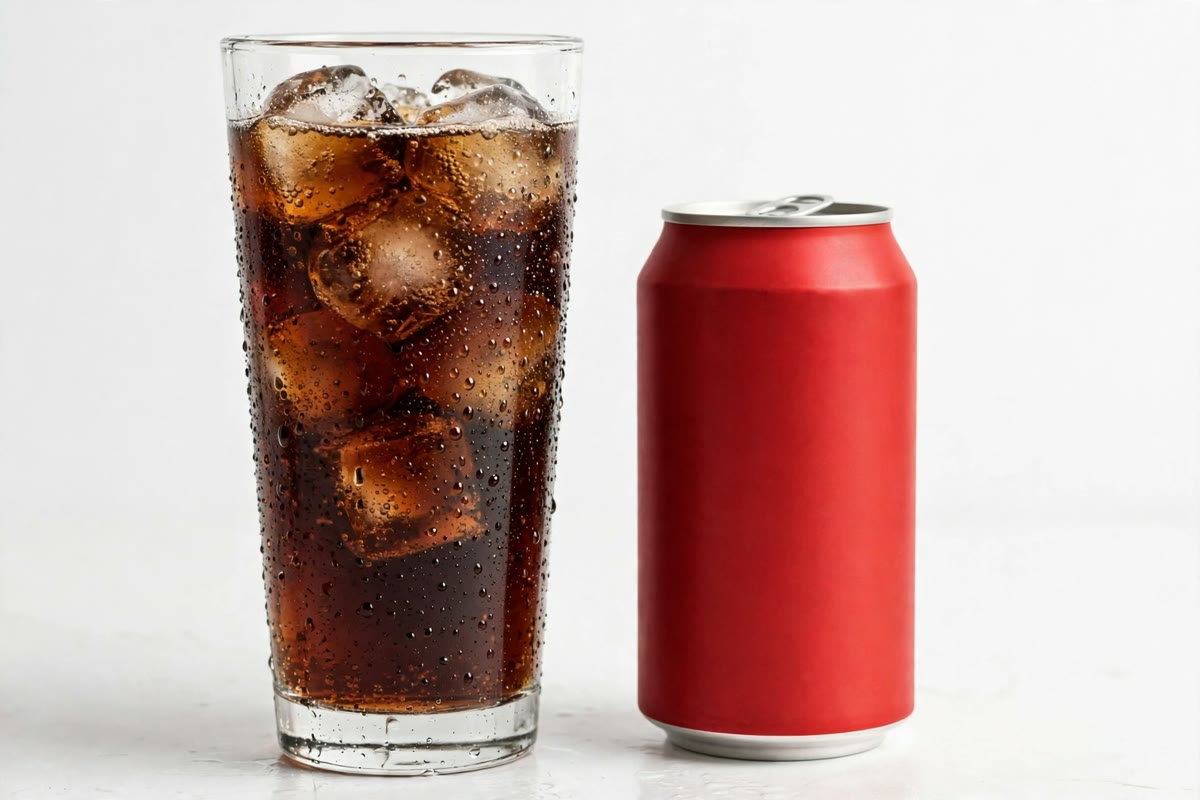
Here is the short answer: a standard 12 oz (355 ml) can of Coca-Cola has 140 calories and 39 grams of sugar — roughly 10 teaspoons. There is no fat, no protein, and nothing else in the can doing anything useful; it is flavored sugar water with caffeine. The real story is the size ladder: the mini can is 90 calories, the 20 oz bottle is 240, and the 2-liter is 800. In this guide you will see every common size, the sugar-cube math that makes those numbers visceral, how diet and zero compare, and what one can a day actually costs over a year — or check any drink instantly with our calorie calculator.
Drinks are the easiest calories to miss. Log yours with our calorie calculator and see your full daily target with the water intake calculator — water is the free replacement.
Check My DrinksCoca-Cola's published nutrition makes the pattern obvious: the calories scale almost perfectly with volume, because the product is the same sugar concentration everywhere. The same ladder applies to Pepsi, Dr Pepper, and most regular colas within a few calories:
| Serving | Volume | Approx. calories | Sugar |
|---|---|---|---|
| Mini can | 7.5 oz (222 ml) | ~90 | ~25 g |
| Standard can | 12 oz (355 ml) | ~140 | ~39 g |
| Bottle | 16.9 oz (500 ml) | ~200 | ~55 g |
| Bottle | 20 oz (591 ml) | ~240 | ~65 g |
| 2-liter bottle | 67.6 oz (2 L) | ~800 | ~216 g |
| Fountain, small | 16 oz | ~190 | ~52 g |
| Fountain, large | 30–32 oz | ~350–380 | ~96–104 g |
Two things to notice. First, the fountain trap: a large fountain soda at a fast-food restaurant can carry more calories than the fries beside it — and free refills make it unbounded. Second, the 2-liter math: 800 calories in one bottle is more than a third of most people's entire daily energy needs, in a container designed to be finished in a day or two.
Grams are abstract; teaspoons are not. One sugar cube (or one teaspoon of sugar) is about 4 grams. So that 12 oz can holds roughly 10 teaspoons of sugar — picture spooning ten teaspoons into a glass of water and drinking it. The 20 oz bottle is about 16 teaspoons. The large fountain soda is about 25.
For context, the American Heart Association suggests a daily added-sugar limit of about 36 g for men and 25 g for women. One 12 oz can (39 g) exceeds the women's daily limit and nearly hits the men's — from a single drink, with zero satiety. Liquid sugar does not trigger the fullness signals that solid food does, which is why soda is the textbook example of calories that fail to satisfy. If you drink soda alongside meals, our guide on how much water to drink shows how much plain water your body actually wants.
Diet sodas and zero-sugar versions contain effectively 0 calories — the sweeteners (aspartame, acesulfame-K, sucralose depending on product) are used in milligram amounts. The calorie math is unambiguous: switching from regular to diet removes 140 calories per can.
The honest caveats: diet soda is not water. Some research associates heavy diet-soda consumption with maintained sweet cravings and, in observational studies, with weight patterns that do not improve — though those studies cannot prove the soda causes it (people struggling with weight may simply choose diet drinks more). The practical hierarchy for someone cutting liquid calories is: water first, diet soda as a transition tool, regular soda as the thing being replaced. Sparkling water with lime gives the fizz and ritual with zero sweetener debate.
This is where soda's danger lives — not in one can, but in the habit. One 12 oz can a day is 140 × 365 = 51,100 calories a year. Using the 3,500-calorie-per-pound rule from our pound-of-fat guide, that is roughly 14.6 pounds of energy equivalent per year — if every other calorie stayed exactly the same, which is the important hedge (bodies adapt; the real-world number varies). The point stands either way: a daily soda habit is one of the highest-leverage single changes in all of nutrition. Cutting it is worth more than most exercise routines — see our latte calorie guide for the same math applied to sugary coffee drinks.
Cola is the reference point, but it is not the worst offender per serving. How the usual suspects stack up at typical single servings:
| Drink (typical serving) | Approx. calories | Sugar |
|---|---|---|
| Cola, 12 oz can | ~140 | ~39 g |
| Sweet tea, 16 oz bottle | ~160–180 | ~40–44 g |
| Lemonade, 16 oz | ~200–220 | ~50–55 g |
| Energy drink, 16 oz can | ~200–220 | ~50–56 g |
| Sports drink, 20 oz bottle | ~130–140 | ~34 g |
| Frappé-style blended coffee, 16 oz | ~380–500+ | ~50–80 g |
| Orange juice, 8 oz glass | ~110–120 | ~22 g |
The pattern: anything built on syrup or juice concentrate lands in the same 100–200 calorie band — the differences between them are rounding compared with the gap between any of them and water. The blended coffee drinks are the true outliers, carrying two to three cans' worth of sugar in one cup. If you are working through your drink habits one by one, our latte calorie guide covers the coffee-shop side in the same format.
Soda, coffee drinks, juice — our calorie calculator totals them all in seconds.
Calculate My DrinksWritten by the Live Fitness Check editorial team · Reviewed against our calculator methodology · Last updated October 2026
Disclaimer: This guide is for educational purposes only and is not medical advice. Calorie figures are estimates from published manufacturer nutrition data; actual values vary. If you are managing diabetes or another condition affected by sugar intake, talk to your doctor.