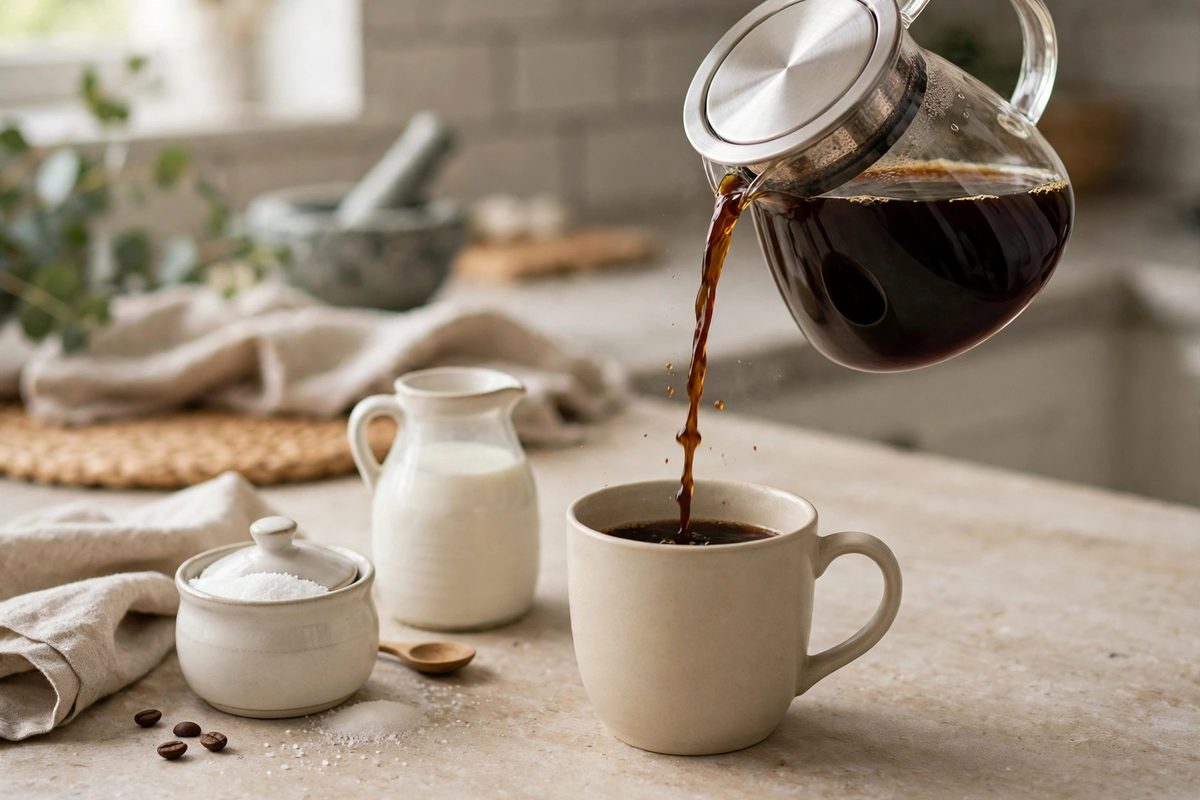
A cup of black coffee is about 2 calories per 8 fl oz (237 ml) — so a standard 12 fl oz mug is about 3 calories and a large 16 fl oz mug is about 4 calories. Black coffee is, for practical purposes, a zero-calorie drink: you would need to drink 25 eight-ounce cups to reach even 50 calories. The calories only appear when you add things to it — sugar, milk, cream, or syrup — and this guide prices every common addition, or check where your coffee fits your day with our calorie calculator.
The USDA FoodData Central database, at USDA FoodData Central, lists brewed coffee at about 2 calories per 8 fl oz (237 ml), with essentially no fat, sugar, or protein — the 2 calories come from trace oils and dissolved solids in the bean. A 16 fl oz mug is therefore about 4 calories (2 × 2 = 4), and even a 20 fl oz mug is about 5 calories (2 × 2.5 = 5). Add 2 teaspoons of sugar, though, and the same mug becomes 4 + 32 = 36 calories; add a quarter cup of whole milk as well and it becomes 4 + 32 + 37 = 73 calories. The coffee was never the issue. See how any version fits your target in our calorie deficit calculator.
Check My Daily TargetBlack coffee scales perfectly with size, because the calorie density is constant at about 0.25 calories per fluid ounce (2 ÷ 8 = 0.25). That makes the ladder simple: a 4 fl oz demitasse-style serving is about 1 calorie, an 8 fl oz standard cup is about 2 calories, a 12 fl oz mug is about 3 calories, a 16 fl oz large mug is about 4 calories, and a 20 fl oz travel mug is about 5 calories. Even the largest common serving is less than a single stick of chewing gum in calorie terms, which is why diet plans universally treat black coffee as free.
Espresso deserves a note because it confuses people: a single 1 fl oz shot of espresso is about 3 calories, which looks higher than drip coffee per ounce — and it is, because espresso is far more concentrated. But a double shot (2 fl oz) is still only about 6 calories, and an Americano (espresso plus hot water) returns to drip-coffee territory at about 5 to 10 calories for a 12 to 16 fl oz drink. Cold brew is also about 2 calories per 8 fl oz when served black; the smooth taste that makes cold brew feel richer comes from lower acidity and a longer steep, not from added calories. What changes cold brew's math is the same thing that changes hot coffee's: sweet cream, milk, and syrup, which coffee shops add generously.
| Black coffee serving | Size | Calories |
|---|---|---|
| Espresso, single shot | 1 fl oz (30 ml) | ~3 |
| Espresso, double shot | 2 fl oz (59 ml) | ~6 |
| Standard cup | 8 fl oz (237 ml) | ~2 |
| Regular mug | 12 fl oz (355 ml) | ~3 |
| Large mug | 16 fl oz (473 ml) | ~4 |
| Travel mug | 20 fl oz (591 ml) | ~5 |
| Americano, 16 fl oz | 16 fl oz (473 ml) | ~10 |
| Cold brew, black, 16 fl oz | 16 fl oz (473 ml) | ~4 |
Every addition below is priced per typical serving, so you can build your own drink by adding up the parts. Granulated sugar is 16 calories per teaspoon and 48 per tablespoon, so 2 teaspoons cost 32 calories and 1 tablespoon costs 48. Honey is 21 calories per teaspoon and 64 per tablespoon. Whole milk is about 9 calories per tablespoon and 37 per quarter cup (2 fl oz); skim milk is about 21 per quarter cup. Half-and-half is about 20 calories per tablespoon, so 2 tablespoons cost 40; heavy cream is about 52 per tablespoon. A standard flavored syrup pump (vanilla, caramel, hazelnut) is about 20 calories, so 2 pumps cost 40 and 3 pumps cost 60. Sugar-free syrup is about 0 calories per pump, which is why it is the standard swap at coffee shops.
Worked builds show how fast a "coffee" becomes a snack. A 16 fl oz black coffee with 2 teaspoons of sugar is 4 + 32 = 36 calories. The same coffee with a quarter cup of whole milk and no sugar is 4 + 37 = 41 calories. With both sugar and milk it is 4 + 32 + 37 = 73 calories. With 2 tablespoons of half-and-half and 2 pumps of vanilla syrup it is 4 + 40 + 40 = 84 calories. And a coffee-shop "black coffee" that the barista sweetens with 3 pumps of syrup and a splash of cream can quietly reach 4 + 60 + 40 = 104 calories before you add anything yourself. None of these is a disaster — but none of them is black coffee either, and the difference matters if you drink three a day.
| Addition (typical serving) | Calories | Notes |
|---|---|---|
| Granulated sugar, 1 tsp | 16 | 2 tsp = 32; 1 tbsp = 48 |
| Honey, 1 tsp | 21 | 1 tbsp = 64 |
| Whole milk, 1/4 cup (2 fl oz) | 37 | 1 tbsp = about 9 |
| Skim milk, 1/4 cup (2 fl oz) | 21 | Saves 16 vs whole milk |
| Half-and-half, 2 tbsp | 40 | 1 tbsp = about 20 |
| Heavy cream, 1 tbsp | 52 | Richest common addition |
| Flavored syrup, 2 pumps | 40 | 1 pump = about 20 |
| Sugar-free syrup, 2 pumps | ~0 | Sweetener, not sugar |
| Artificial sweetener packet | ~0–4 | Negligible either way |
Readers sometimes ask why black coffee gets its own guide when the site already covers lattes and mochas. The answer is that those are different drinks with different math: our latte guide covers steamed-milk drinks that run 60 to 400+ calories depending on milk and size, and our mocha guide covers chocolate-and-milk drinks that run higher still. Black coffee with a splash of milk is not a latte — a latte is mostly milk, while a black coffee with milk is mostly coffee — and conflating them overstates a splash by hundreds of calories. This guide exists so that the person who drinks black coffee, or black coffee with one addition, gets an honest number instead of a latte number.
The distinction also matters for fasting and calorie counting. Many intermittent-fasting guides use a rough rule that drinks under about 50 calories do not meaningfully break a fast, and plain black coffee at 2 to 5 calories sits far below that line, as does black coffee with a splash of milk (a tablespoon of whole milk at about 9 calories plus the coffee's 4, totaling roughly 13). A 2-pump syrup coffee at about 44 calories sits near the line, and a sweetened, creamed coffee at 84 calories sits above it. If fasting is your reason for asking, black is safe, a splash is almost certainly fine, and syrup plus cream is where you should check your own fasting rules.
Calories are only half the black-coffee story; caffeine is the other half. The U.S. Food and Drug Administration (FDA) notes that an 8 fl oz cup of brewed coffee typically contains about 95 milligrams of caffeine, and cites 400 milligrams per day as an amount not generally associated with dangerous effects in healthy adults — see the FDA's caffeine guidance. That means about four 8 fl oz cups (4 × 95 = 380 milligrams) approaches the daily reference, while a 16 fl oz mug at about 190 milligrams is roughly half of it. Decaf coffee, for comparison, contains about 2 to 5 milligrams per cup — genuinely low, though not literally zero.
The yearly math is where small additions earn attention. Two teaspoons of sugar in every daily coffee cost 32 calories a day, which is 32 × 365 = 11,680 calories a year — about 3.3 lb of body weight at the rough 3,500-calories-per-pound rule (11,680 ÷ 3,500 = 3.34). A daily syrup habit of 2 pumps costs 40 × 365 = 14,600 calories a year, or about 4.2 lb (14,600 ÷ 3,500 = 4.17). Black coffee itself, at 4 calories for a 16 fl oz mug, costs 4 × 365 = 1,460 calories a year, or about 0.4 lb — noise. Nobody gains weight from black coffee; people gain weight from the sugar habit that rides along with it, one teaspoon at a time.
The best black coffee is good coffee brewed well, and the cheapest upgrade is freshness: beans ground within two weeks of roasting, water just off the boil (about 200°F / 93°C), and a clean brewer beat any sweetener for flavor. A pinch of salt in the grounds — literally a pinch, not a teaspoon — softens bitterness for some palates without adding calories, and cinnamon in the grounds adds aroma for zero calories. If you are stepping down from sweetened coffee, halve the sugar for two weeks (2 teaspoons to 1, saving 16 calories a cup, or 5,840 calories a year at one cup a day: 16 × 365 = 5,840), then halve it again, rather than quitting cold turkey and rebounding.
For coffee-shop orders, the script that saves the most calories is short: "black, no syrup, no cream." If you want milk, ask for a splash rather than a pour — a splash is roughly a tablespoon (about 9 calories for whole milk), while a free pour can easily be a quarter cup (37 calories) or more. And if you genuinely love a sweetened coffee, keep it as a deliberate treat rather than a default: a 73-calorie sugar-and-milk coffee once a day is a fine part of most diets, but the same drink three times a day is 219 calories of sugar and milk that could have been food.
Our calorie deficit calculator shows where your version fits your day.
Check My Daily TargetWritten by the Live Fitness Check editorial team · Reviewed against our calculator methodology · Last updated November 2026
Disclaimer: This guide is for educational purposes only and is not medical advice. Calorie and caffeine figures are approximations; actual values vary by bean, brew method, and portion. If you have a heart condition, anxiety, insomnia, or take medication that interacts with caffeine, talk to your doctor about your intake.