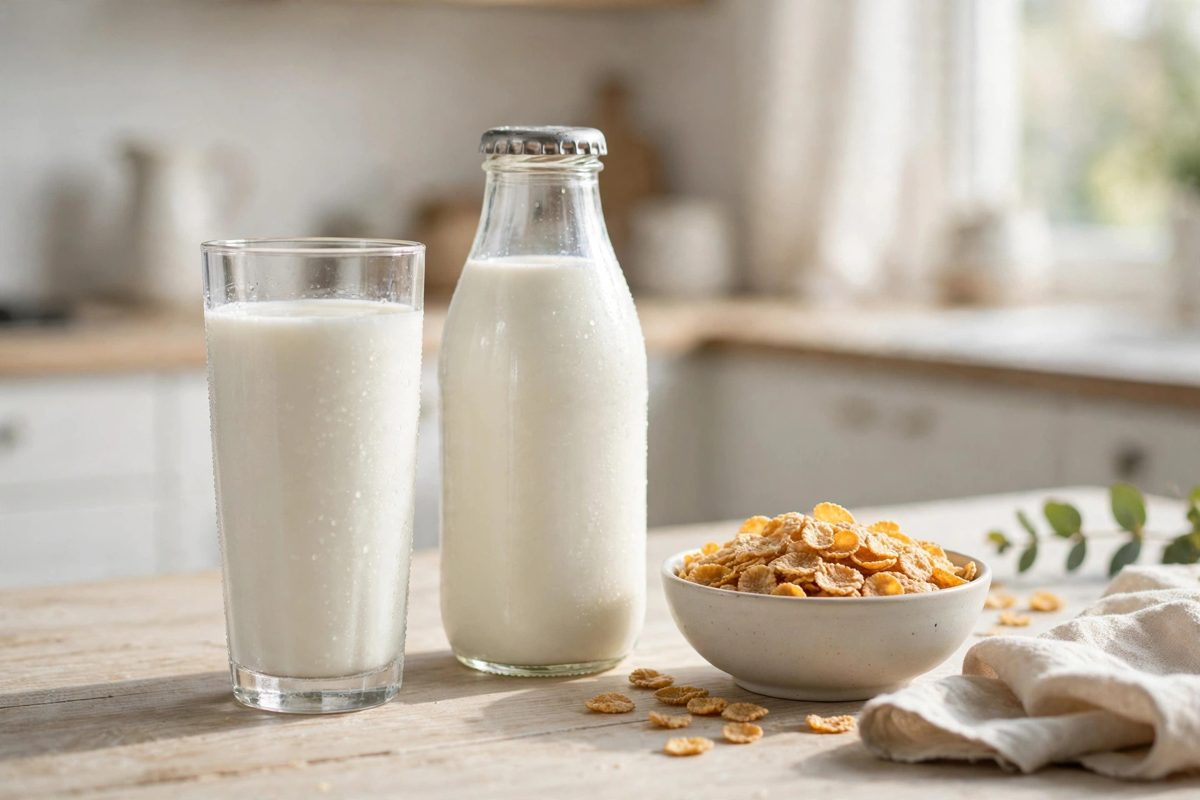
A glass of whole milk (8 fl oz / 240 ml) is about 150 calories, 2% milk is about 120 calories, 1% milk is about 105 calories, and skim milk is about 90 calories. The surprise for most people is that the difference between whole and skim is only about 60 calories per glass — the fat content changes, but the protein, lactose, and minerals stay almost exactly the same. Below you will see the milk-type ladder, price every glass size, compare chocolate milk and plant-based alternatives, and learn what a daily glass adds up to over a year — or check where any glass fits your day with our calorie calculator.
Every type of cow's milk in this guide carries about 8 grams of protein and about 12 grams of lactose sugar per 8 oz (240 ml) cup — what changes is the fat, from 0 grams in skim to about 8 grams in whole milk. That fat gap is the whole calorie story: whole milk at about 150 calories minus skim milk at about 90 calories equals about 60 calories per glass, which is the price of the creaminess. See how any glass fits your target in our calorie deficit calculator or macro calculator.
Check My Daily TargetEvery total in this guide starts from the same serving: 1 cup, which is 8 fl oz (240 ml), the serving on every US milk label. All figures are USDA FoodData Central-style approximations for typical US supermarket milk, not laboratory measurements of one specific brand, so treat them as planning numbers. The pattern is beautifully simple: each step down in fat removes roughly 15 to 30 calories, and nothing else of note changes.
| Milk type (1 cup / 8 fl oz / 240 ml) | Calories | Fat | Protein |
|---|---|---|---|
| Skim (fat-free) milk | ~90 | 0 g | ~8 g |
| 1% low-fat milk | ~105 | ~2.5 g | ~8 g |
| 2% reduced-fat milk | ~120 | ~5 g | ~8 g |
| Whole milk | ~150 | ~8 g | ~8 g |
| Low-fat chocolate milk | ~210 | ~2.5 g | ~8 g |
| Whole chocolate milk | ~250 | ~8 g | ~8 g |
The chocolate milk rows deserve a second look, because they break the pattern in an instructive way. Low-fat chocolate milk is about 210 calories, which is 210 − 120 = 90 calories above plain 2% milk — the added sugar, roughly 20 extra grams, costs more than the entire fat gap between skim and whole. Whole chocolate milk, at about 250 calories, is the most calorie-dense milk in this guide, and it is worth remembering that its extra calories are sugar, not nutrition: the protein and calcium are the same 8 grams and roughly 300 milligrams as plain milk.
A glass of milk is not a fixed unit, and the pour is where most calorie counting goes wrong. A small juice glass holds about 6 oz (180 ml), a standard drinking glass holds about 8 oz (240 ml), a large glass holds about 12 oz (355 ml), and a tall diner glass holds about 16 oz (473 ml) — double the standard serving. Because milk scales perfectly with volume, every size is simple multiplication: a 12 oz glass is one-and-a-half times the 8 oz figure, and a 16 oz glass is exactly double.
| Glass size | Whole milk | 2% milk | Skim milk |
|---|---|---|---|
| 6 oz (180 ml), small glass | ~115 | ~90 | ~70 |
| 8 oz (240 ml), standard glass | ~150 | ~120 | ~90 |
| 12 oz (355 ml), large glass | ~225 | ~180 | ~135 |
| 16 oz (473 ml), tall glass / pint | ~300 | ~240 | ~180 |
Worked from the table, the tall-glass trap is real: a 16 oz glass of whole milk is 150 × 2 = 300 calories, the same as a small meal, and many people drink it alongside a full dinner without counting it as food at all. The fix is boring but effective — use an 8 oz glass for milk, and pour a second glass only if you actually want one. A 12 oz glass of skim milk, at 90 × 1.5 = 135 calories, is a useful middle ground: more milk than the standard glass, fewer calories than an 8 oz glass of whole milk.
Milk's calorie count only makes sense alongside what those calories carry, and on that measure milk is unusually efficient. One 8 oz cup of any cow's milk delivers about 8 grams of complete protein, about 300 milligrams of calcium (roughly 30% of the daily value), plus vitamin D in fortified US milk, vitamin B12, riboflavin, and potassium. That is why a glass of milk with a sandwich is a better lunch than the sandwich alone: the milk adds protein and micronutrients that the bread cannot supply.
The lactose question matters for a large share of readers. One cup of milk contains about 12 grams of lactose, and people with lactose intolerance may feel discomfort from a full glass while tolerating half a glass, or tolerating lactose-free milk, which has the same calories and nutrition with the lactose already broken down. Lactose-free whole milk is still about 150 calories per cup, and lactose-free skim is still about 90 — the enzyme changes digestion, not energy. If milk consistently causes symptoms, the honest answer is to switch to a tolerated option rather than to push through a daily glass.
Plant-based milks are not one food but a whole spectrum, and their calories per cup range from about 30 to about 130 — a wider spread than all four types of cow's milk combined. The rule is simple: sweetened versions cost roughly double their unsweetened versions, because the added sugar, not the nut or oat, supplies most of the calories. Always check whether the carton says sweetened or unsweetened before comparing it with cow's milk.
| Alternative (1 cup / 8 fl oz) | Calories | Notes |
|---|---|---|
| Unsweetened almond milk | ~30–40 | Very low calorie, but only about 1 g protein |
| Sweetened almond milk | ~60–90 | Added sugar roughly doubles the total |
| Unsweetened oat milk | ~90 | Closest to skim milk in calories |
| Sweetened oat milk | ~120–130 | Nearly matches 2% cow's milk |
| Soy milk, sweetened | ~80–100 | The only alternative near cow's milk protein, about 7–8 g |
| Coconut milk beverage (carton) | ~45–80 | Not canned coconut milk, which is far richer |
The protein gap is the honest caveat on every alternative except soy. Unsweetened almond milk at 30 to 40 calories looks like a clear winner until you notice its 1 gram of protein against cow's milk's 8 grams — if the glass of milk is part of your protein plan, almond milk does not replace it. Soy milk is the exception, matching cow's milk at about 7 to 8 grams of protein per cup, which is why it is the standard recommendation for people who need a true milk replacement. Canned coconut milk, sometimes confused with the carton beverage, is a different food at roughly 400 calories per cup and belongs in cooking, not in a drinking glass.
Milk rarely arrives as a lone glass, and its supporting roles add up quietly. A bowl of cereal with 1 cup of whole milk adds 150 calories before the cereal is counted, and with skim milk adds 90 — a 60-calorie difference per bowl, or 60 × 365 = 21,900 calories per year for a daily bowl, which is about 6.3 pounds of energy at the 3,500-calories-per-pound rule of thumb. A splash of milk in coffee, at about 2 tablespoons, is only about 20 calories for whole milk and about 10 for skim — genuinely negligible — but a 12 oz latte made with whole milk carries about 225 calories of milk alone, which is why coffee drinks deserve their own count.
The yearly math cuts both ways, and it is worth stating plainly. A daily 8 oz glass of whole milk is 150 × 365 = 54,750 calories per year, while a daily glass of skim is 90 × 365 = 32,850 calories — a difference of 21,900 calories, about 6.3 pounds, for the same protein, calcium, and volume. That does not make whole milk "bad": for children, teenagers, and anyone trying to gain weight, those extra 60 calories per glass are useful energy with real nutrition attached. It simply means the choice between whole and skim is the highest-leverage milk decision most people will ever make, and it is worth making deliberately rather than by habit.
Our calorie deficit calculator shows where any glass fits your target.
Check My Daily TargetWritten by the Live Fitness Check editorial team · Reviewed against our calculator methodology · Last updated November 2026
Disclaimer: This guide is for educational purposes only and is not medical advice. Calorie figures are USDA-style approximations for typical products; actual values vary by brand, portion, and preparation. Talk to your doctor or a registered dietitian before making significant changes to your diet.