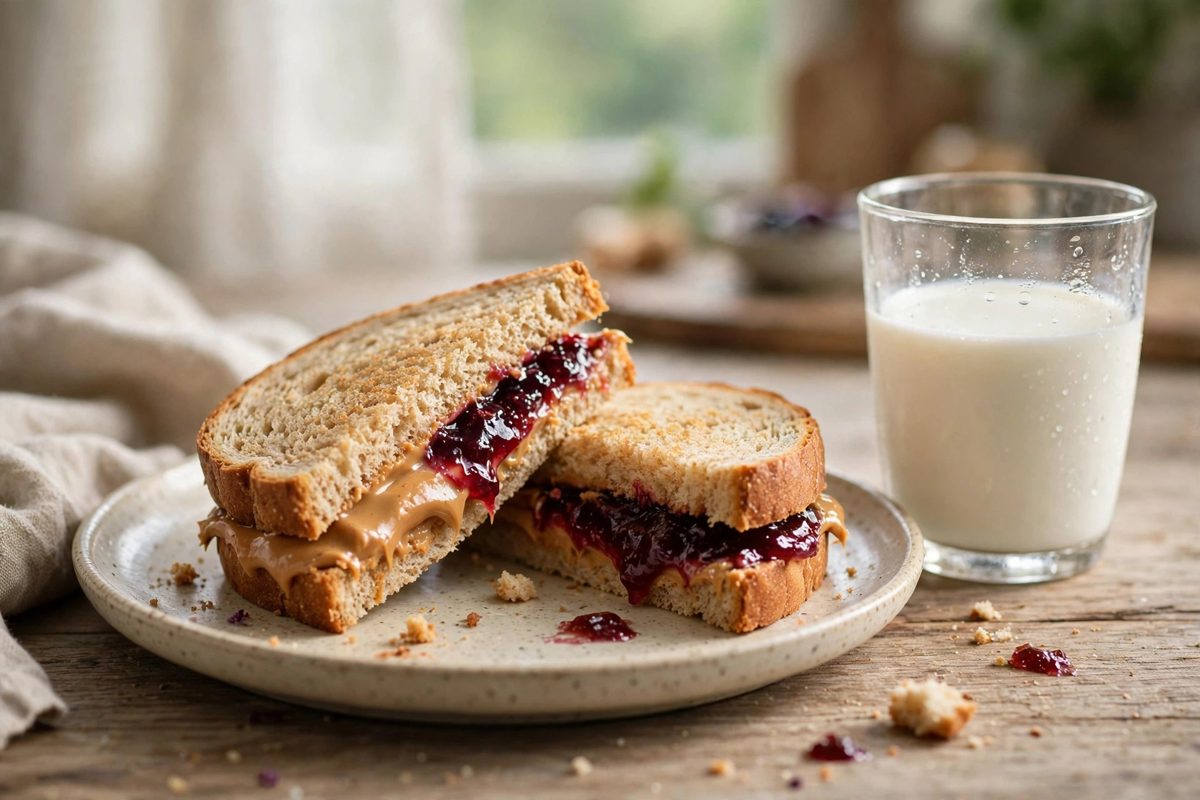
A classic peanut butter and jelly sandwich is about 450 calories, a peanut butter-only sandwich is about 350 calories, and a lighter peanut butter sandwich is about 305 calories. The surprise for most people is that the peanut butter alone costs more than the bread — 2 tablespoons alone are about 190 calories — so the spread, not the bread, decides whether this sandwich is a snack or a meal. Below you will see the bread, peanut butter, and spread math, compare classic, banana, honey, and grilled builds, and learn the lighter swaps — or check where any sandwich fits your day with our calorie calculator.
A classic peanut butter and jelly sandwich builds as 2 slices of bread (about 160 calories) plus 2 tablespoons of peanut butter (about 190 calories) plus 2 tablespoons of jelly (about 100 calories) — 160 + 190 + 100 = 450 calories. Cut the peanut butter to 1 tablespoon and the jelly to 1 tablespoon and the same sandwich is 160 + 95 + 50 = 305 calories. See how any build fits your target in our calorie deficit calculator or protein calculator.
Check My Daily TargetEvery total in this guide comes from the same simple addition: bread plus peanut butter plus spread. All figures are USDA FoodData Central-style approximations for typical US supermarket products, not laboratory measurements of one specific brand, so treat them as planning numbers. Peanut butter brands vary a little — natural peanut butter and regular peanut butter are nearly identical in calories — but the tablespoon is the unit that matters, because most people spread far more than they think.
| Component (typical serving) | Calories | Notes |
|---|---|---|
| White bread, 2 slices | ~160 | About 80 calories per slice |
| Whole wheat bread, 2 slices | ~160 | Same calories, about 4 g more fiber |
| Sourdough bread, 2 slices | ~190 | Slices run thicker, about 95 each |
| Peanut butter, 1 tbsp | ~95 | Smooth or crunchy, nearly identical |
| Peanut butter, 2 tbsp | ~190 | The standard sandwich portion |
| Grape jelly or jam, 1 tbsp | ~50 | Mostly sugar; 2 tbsp is about 100 |
| Honey, 1 tbsp | ~60 | About 64 by the label, rounded here |
| Banana, medium, whole | ~105 | Half a banana is about 55 |
| Butter, 1 tbsp (for grilling) | ~100 | Spread across both outer slices |
| Marshmallow creme, 2 tbsp | ~80 | The fluffernutter addition |
Worked from the chart, the peanut butter-only sandwich is 160 + 190 = 350 calories, and the classic with jelly is 160 + 190 + 100 = 450 calories. Those two numbers are the anchors for everything else in this guide: every fancier build adds to the 350-calorie peanut butter base, and every lighter build subtracts from it.
Peanut butter is about 95 calories per tablespoon, which makes it one of the most calorie-dense sandwich fillings in an American kitchen — denser per bite than cheese, and nearly twice the calories of the bread it sits on. The trap is that a tablespoon is a small unit and a knife-load is a large one: most people spread what looks like 2 tablespoons and actually use 3, which costs 285 calories instead of 190, a silent extra 95 calories on every sandwich.
That is why measuring once is the single most effective peanut butter trick. Measure 2 level tablespoons into a small dish, spread it, and look at the coverage — then repeat the same coverage by eye next time. Natural peanut butter and regular peanut butter differ by only a few calories per tablespoon, so choose on taste and ingredients, not on a calorie claim. Powdered peanut butter is the genuine exception: reconstituted at about 45 calories per 2 tablespoons of powder, it can halve the spread cost, but it tastes thinner and drier, so it works best mixed half-and-half with regular peanut butter.
Bread choice changes a peanut butter sandwich by surprisingly little in calories and by a lot in staying power. Two slices of white bread are about 160 calories and two slices of whole wheat are also about 160 calories — the difference is fiber, about 1 gram in white versus about 5 grams in whole wheat, which makes the whole wheat version noticeably more filling for the same energy. Sourdough runs higher at about 190 calories for two slices, simply because sourdough slices are usually cut thicker.
Thick-cut and Texas-toast style breads are the bread trap: two thick slices can run 200 to 240 calories, adding 40 to 80 calories before any spread. Bagels are a different food entirely — a bagel with peanut butter is about 280 calories of bagel plus 190 calories of peanut butter, about 470 calories before jelly, which is why a bagel version feels like a meal. For a lunchbox sandwich, standard sliced whole wheat is the best value: same calories as white, more fiber, and a sturdier slice that holds up to a generous spread without tearing.
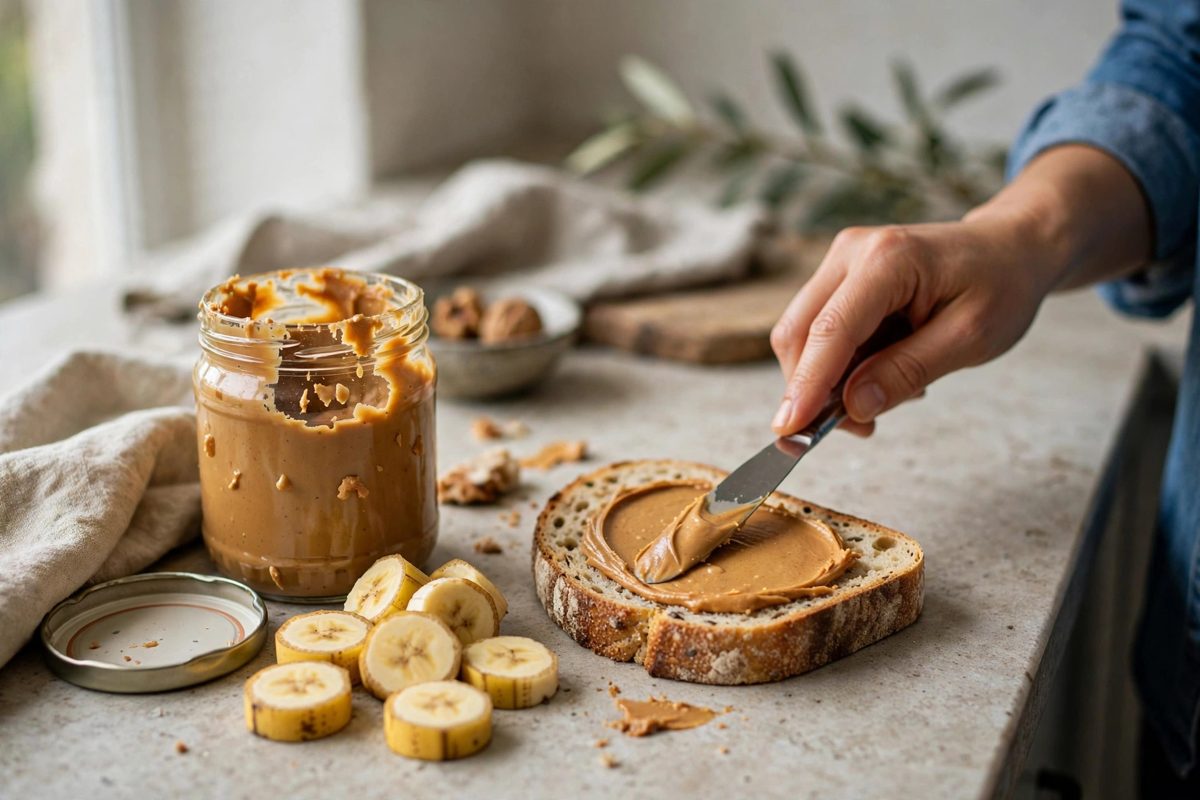
A classic peanut butter and jelly sandwich is about 450 calories, a peanut butter banana sandwich is about 455 calories, a peanut butter honey sandwich is about 410 calories, and a grilled peanut butter sandwich is about 450 calories — a spread of only about 45 calories between builds that taste completely different. The table below shows exactly where each version's calories come from, so you can pick the one that matches your goal.
| Build (white bread unless noted) | Math | Total |
|---|---|---|
| Peanut butter only | Bread 160 + PB 190 | ~350 (160 + 190 = 350) |
| Classic PB&J | Bread 160 + PB 190 + jelly 100 | ~450 (160 + 190 + 100 = 450) |
| Peanut butter banana | Bread 160 + PB 190 + banana 105 | ~455 (160 + 190 + 105 = 455) |
| Peanut butter honey | Bread 160 + PB 190 + honey 60 | ~410 (160 + 190 + 60 = 410) |
| Grilled peanut butter only | Bread 160 + PB 190 + butter 100 | ~450 (160 + 190 + 100 = 450) |
| Fluffernutter | Bread 160 + PB 190 + creme 80 | ~430 (160 + 190 + 80 = 430) |
| Lighter PB&J | Bread 160 + PB 95 + jelly 50 | ~305 (160 + 95 + 50 = 305) |
The peanut butter banana sandwich deserves attention because it is the best trade in the whole guide: at about 455 calories it costs only 5 calories more than the classic, yet it adds potassium, fiber, and a whole piece of fruit, and the banana's sweetness lets many people skip jelly entirely. The grilled version is the opposite lesson — grilling adds a full 100 calories of butter to a sandwich that is already 350 calories, so a grilled peanut butter-only sandwich costs the same as a classic PB&J without any of the fruit. If you love grilled sandwiches, grill the lighter build instead: 1 tablespoon of peanut butter, half a banana, and a light buttering lands around 310 calories with the warm, melty texture intact.
A peanut butter sandwich rarely travels alone, and the pairings decide whether lunch is 450 calories or 750. The classic pairing, a classic PB&J (450 calories) with an 8 oz (240 ml) glass of whole milk (about 150 calories), is 450 + 150 = 600 calories — a solid lunch for most adults. Swap the milk for water and lunch is 450 calories; swap the sandwich for the lighter build (305 calories) and keep the milk, and lunch is 305 + 150 = 455 calories, nearly the same as the classic sandwich alone.
Chips are the lunchbox trap: a single-serving bag of potato chips adds about 150 calories, taking a classic PB&J lunch to about 600 calories before any drink, and a full-size bag adds about 300. An apple, at about 95 calories, is the better side in every direction — fiber, crunch, and a sweetness that pairs with peanut butter. Two classic PB&J sandwiches, the amount a hungry teenager may genuinely eat, are 450 + 450 = 900 calories, which is a full meal by any measure and worth knowing before the second sandwich disappears.
A peanut butter sandwich is healthier than its calorie count suggests, and less healthy than its reputation suggests — both things are true at once. Peanut butter itself is genuinely nutritious: about 8 grams of protein and 16 grams of mostly unsaturated fat per 2 tablespoons, plus vitamin E, magnesium, and fiber. On whole wheat bread with banana, a peanut butter sandwich is a balanced, filling meal with protein, healthy fats, fiber, and fruit. On white bread with jelly and marshmallow creme, the same sandwich is mostly refined carbohydrate and sugar with the peanut butter along for the ride.
The protein question matters for anyone counting macros. A classic PB&J has about 13 grams of protein (about 8 from peanut butter and about 5 from bread) — respectable for a sandwich, but well short of the 25 to 40 grams most people target at a main meal. Pairing the sandwich with a glass of milk adds about 8 grams of protein and brings the meal to about 21 grams, which is why the sandwich-and-milk lunchbox endures. One caution applies to everyone: peanut allergy is common and can be severe, so never pack a peanut butter sandwich for a shared classroom or nut-free setting without checking the rules first.
Our calorie deficit calculator shows where any sandwich fits your target.
Check My Daily TargetWritten by the Live Fitness Check editorial team · Reviewed against our calculator methodology · Last updated November 2026
Disclaimer: This guide is for educational purposes only and is not medical advice. Calorie figures are USDA-style approximations for typical products; actual values vary by brand, portion, and preparation. Talk to your doctor or a registered dietitian before making significant changes to your diet.
