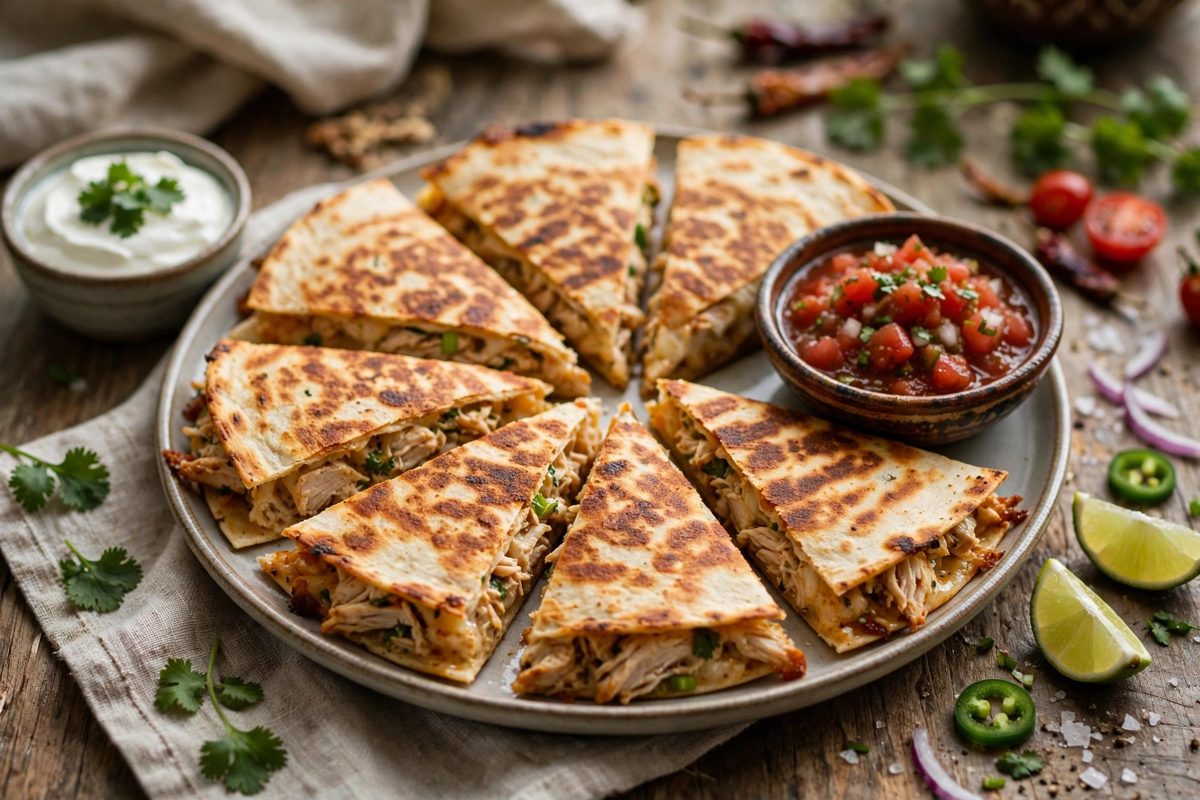
A cheese-only quesadilla is about 465 calories and a chicken quesadilla is about 650 calories, when both are made with a large 10-inch flour tortilla, a half cup of shredded cheese, and a teaspoon of butter or oil for the pan. A quesadilla is not one food — it is a build, and every extra handful of cheese or spoonful of sour cream changes the total. Below you will price each part, compare cheeses and proteins, see why restaurant versions run much higher, and build a lighter version — or check where any meal fits your day with our calorie deficit calculator.
A large flour tortilla (about 210 calories) plus a half cup of shredded cheese (about 220 calories) plus a teaspoon of pan butter or oil (about 35 calories) already totals 465 calories before any filling. Add 4 oz (113 g) of grilled chicken (about 185 calories) and you reach 650 calories; add sour cream and guacamole and you reach 755 calories. Try your own target in our calorie deficit calculator or macro calculator.
Check My Daily TargetEvery total in this guide comes from the same simple addition: tortilla plus cheese plus pan fat plus filling plus toppings. Change one part and the total changes by exactly that part's calories. All figures below are USDA-style approximations for typical US supermarket products, not laboratory measurements of one specific brand, so treat them as planning numbers.
| Component (typical serving) | Calories | Notes |
|---|---|---|
| Large flour tortilla, 10-inch (1) | ~210 | The single biggest fixed cost; smaller tortillas cost less |
| Shredded cheese, 1/2 cup | ~220 | Cheddar-style cheese; see the cheese ladder below |
| Butter or oil for the pan, 1 tsp | ~35 | Just enough to crisp the tortilla, not to fry it |
| Grilled chicken, 4 oz (113 g) | ~185 | Skinless breast, grilled without breading |
| Salsa, 2 tbsp | ~10 | The cheapest flavor you can add, calorie-wise |
| Sour cream, 2 tbsp | ~60 | Full-fat; light versions run lower |
| Guacamole, 2 tbsp | ~45 | Nutritious fats, but still real calories |
Worked from the chart, a cheese-only quesadilla is 210 + 220 + 35 = 465 calories. A chicken quesadilla is 210 + 220 + 185 + 35 = 650 calories. Add both dips to the chicken version and you get 650 + 60 + 45 = 755 calories. Two modest spoonfuls add 105 calories, about 16% on top of the chicken quesadilla, without making it feel like a bigger meal. Salsa is the exception — at about 10 calories for 2 tablespoons, it adds brightness and moisture for almost nothing.
Swapping the cheese is the easiest single change you can make, because it costs nothing in effort and barely anything in flavor. Part-skim mozzarella runs about 50 calories lighter per half cup than cheddar-style cheese, while pepper jack and Monterey Jack sit in the same range as cheddar. Low-fat cheddar lands in between but melts less smoothly, so it works best mixed half-and-half with regular cheese.
| Cheese, 1/2 cup shredded | Calories | Cheese-only quesadilla total |
|---|---|---|
| Part-skim mozzarella | ~170 | ~415 (210 + 170 + 35) |
| Low-fat cheddar | ~180 | ~425 (210 + 180 + 35) |
| Cheddar or Monterey Jack | ~220 | ~465 (210 + 220 + 35) |
| Pepper jack | ~220 | ~465 (210 + 220 + 35) |
The practical lesson is about portion as much as variety. Most home cooks do not measure shredded cheese — they grab a handful, and a generous handful is easily three-quarters of a cup rather than a half cup, which pushes cheddar from about 220 calories to about 330 calories and a cheese-only quesadilla from 465 to about 575 calories. Measuring the cheese once, seeing what a half cup actually looks like in your hand, and then cooking by eye from there is the single most useful habit in this guide. You do not need to weigh cheese forever; you need to calibrate your handful once.
Chicken is the middle of the protein ladder, steak sits above it, and black beans sit well below both while adding fiber that meat does not provide. The differences are 35 to 110 calories — meaningful over a week, but smaller than the cheese and tortilla decisions.
| Filling | Calories | Full quesadilla total* |
|---|---|---|
| Black beans, 1/2 cup | ~110 | ~575 (210 + 220 + 110 + 35) |
| Grilled chicken, 4 oz (113 g) | ~185 | ~650 (210 + 220 + 185 + 35) |
| Grilled steak, 4 oz (113 g) | ~220 | ~685 (210 + 220 + 220 + 35) |
*Full total uses a large flour tortilla, a half cup of cheddar-style cheese, and a teaspoon of pan fat.
Beans deserve a closer look because they change the meal in more than calories. A half cup of black beans brings roughly 7 to 8 grams of fiber and about 7 grams of protein, so a bean quesadilla at 575 calories tends to keep you full longer than a cheese-only quesadilla at 465 calories. Steak brings the richest flavor and the highest total at 685 calories, and restaurant portions of 6 oz (170 g) instead of 4 oz would add roughly another 110 calories. For a closer look at another Mexican favorite built the same way, see how many calories are in a taco.
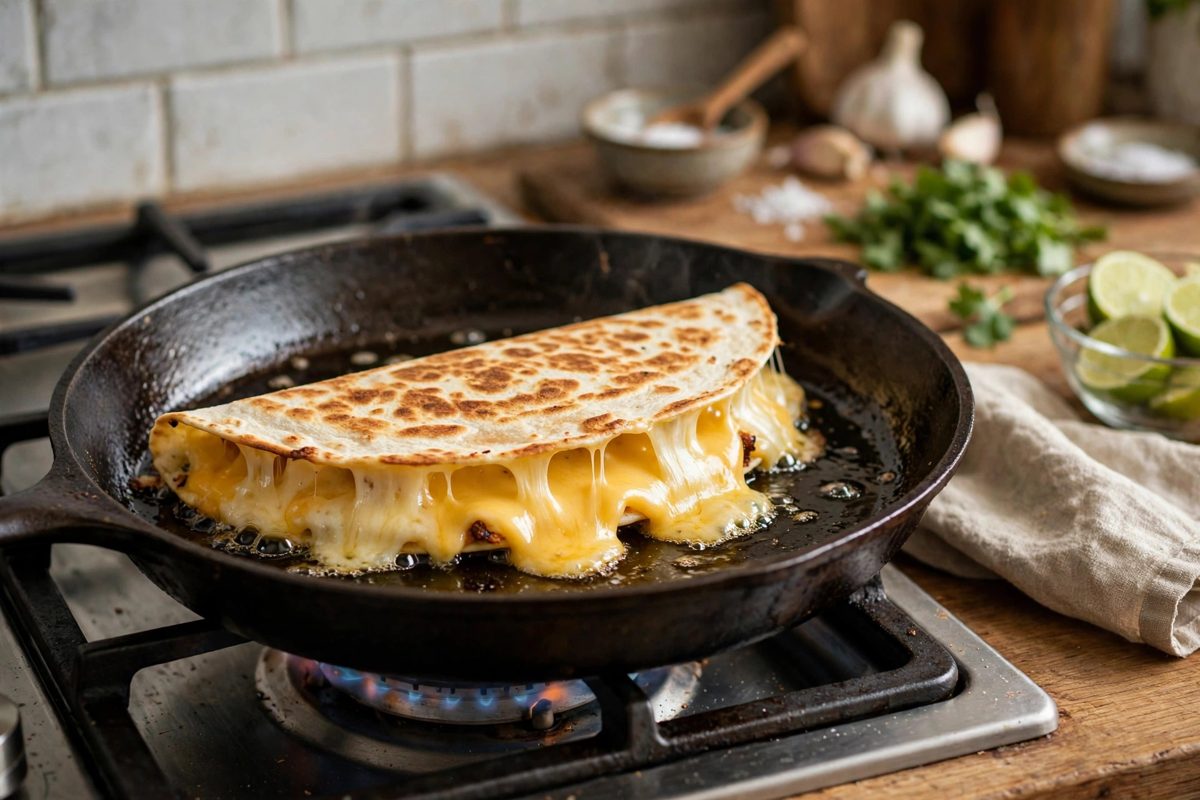
A restaurant quesadilla commonly runs 900 to 1,100 calories, roughly 250 to 450 calories above a homemade chicken quesadilla at 650 calories. Restaurants typically use a larger tortilla, a more generous hand with cheese, more oil on the flat-top, and a bigger protein portion, plus full portions of sour cream and guacamole on the side rather than the 2 tablespoons priced here.
| Version | Typical calories | Why |
|---|---|---|
| Homemade cheese-only | ~465 | Measured cheese, 1 tsp pan fat |
| Homemade chicken | ~650 | 4 oz chicken, measured cheese |
| Homemade chicken with dips | ~755 | Adds sour cream (60) + guacamole (45) |
| Restaurant chicken, typical | ~900–1,100 | Larger tortilla, extra cheese and oil, larger protein portion, full dip servings |
That does not make restaurant quesadillas off-limits; it makes them a portion decision. Ordering one to share, eating half with a salad, or asking for dips on the side are all reasonable responses. The worst version of this meal is the restaurant one eaten while believing it is the homemade one — use the menu figure when published and the 900 to 1,100 range when it is not.
A lighter chicken quesadilla lands around 575 calories without giving up what makes a quesadilla a quesadilla: keep the large tortilla and the chicken, switch to part-skim mozzarella, crisp the tortilla in a nonstick pan with cooking spray instead of butter or oil, and dip in salsa instead of sour cream and guacamole.
The math is 210 (tortilla) + 170 (mozzarella) + 185 (chicken) + 0 (spray, negligible) + 10 (salsa) = 575 calories, which is 75 calories below the standard 650-calorie chicken quesadilla and 180 calories below the 755-calorie version with both dips. Add peppers, onions, and spinach and the meal gets bigger and more filling for only a few extra calories. If you want guacamole back, keep it to 2 tablespoons (about 45 calories); a 620-calorie quesadilla with guacamole still beats a 755-calorie one with both dips. Check the effect on your daily totals with our macro calculator.
Half a large chicken quesadilla is 325 calories, because half of 650 is 325 — the simplest portion trick in this guide and the most useful one at restaurants. A half quesadilla plus a side salad is a satisfying lunch in the 450 to 550 calorie range, while a whole restaurant quesadilla plus chips and a sugary drink can pass 1,400 calories before you notice.
Two more worked examples cover the most common home variations. A bean quesadilla with mozzarella instead of cheddar is 210 + 170 + 110 + 35 = 525 calories, a high-fiber option under the standard chicken version. A steak quesadilla with both dips is 685 + 60 + 45 = 790 calories. In every case, the method is the same — price the tortilla, cheese, protein, and dips — and you will land within a reasonable margin of the true total for your exact build.
Our calorie deficit calculator shows where any quesadilla fits your target.
Check My Daily TargetWritten by the Live Fitness Check editorial team · Reviewed against our calculator methodology · Last updated November 2026
Disclaimer: This guide is for educational purposes only and is not medical advice. Calorie figures are USDA-style approximations for typical products; actual values vary by brand, portion, and preparation. Talk to your doctor or a registered dietitian before making significant changes to your diet.