
A slice of white bread is about 75 to 80 calories — typically 77 calories for a standard 1 oz (28 g) slice — and a two-slice sandwich starts at 154 calories before any filling. Whole wheat bread is nearly identical in calories, at about 80 per slice, but brings roughly four times the fiber. Toasting changes nothing: toast has the same calories as the bread it came from. The real calorie decisions happen in the fillings, and this guide builds the sandwiches to prove it — or check where any sandwich fits your day with our calorie calculator.
The USDA FoodData Central database, at USDA FoodData Central, lists a standard slice of white bread (about 1 oz / 28 g) at roughly 77 calories, with about 14 grams of carbohydrate, 2 to 3 grams of protein, and under 1 gram of fiber. Two slices are therefore 77 × 2 = 154 calories. A whole 20-slice loaf is 77 × 20 = 1,540 calories before anything is spread on it. That is the honest baseline: bread is not a high-calorie food per slice, but it is a refined carbohydrate with little fiber, so it rarely fills you up for long. See how any sandwich fits your target in our calorie deficit calculator.
Check My Daily TargetWhite bread slices are not all the same size, and that explains almost every number you will see quoted. A thin "sandwich size" slice at about 0.8 oz (23 g) runs about 65 calories, a standard slice at 1 oz (28 g) runs about 77, and a thick "Texas toast" slice at about 1.5 oz (43 g) runs about 120 calories — roughly 77 × 1.5 = 115.5, rounded to about 120 for the thicker cut and denser crumb. Bakery and artisan loaves are denser still, so a thick bakery slice can reach 130 to 150 calories. If your bread looks noticeably thicker than supermarket sandwich bread, count it as 1.5 slices.
The nutrition label is your friend here, and it is more reliable than any guide: calories per slice are printed on the bag, and the serving size tells you whether that number is for one slice or two. Some brands list a serving as 2 slices, which makes the bread look like 150 calories "per serving" when it is actually 75 per slice. Always divide by the slices in the serving. And note the weight: a loaf that yields 20 slices at 77 calories each and a loaf that yields 16 thicker slices at about 96 calories each contain nearly the same total (1,540 versus 1,536 calories) — you are just cutting the same loaf differently.
| Bread type (1 slice) | Calories | Fiber | Notes |
|---|---|---|---|
| White, standard (1 oz / 28 g) | ~77 | ~0.8 g | Refined flour; the baseline of this guide |
| White, thin sandwich slice | ~65 | ~0.6 g | About 0.8 oz (23 g) |
| White, Texas toast thick slice | ~120 | ~1.2 g | About 1.5 oz (43 g); count as 1.5 slices |
| Whole wheat, standard | ~80 | ~3.9 g | Same calories, about 5× the fiber of white |
| Whole grain / multigrain | ~80 | ~3 g | Varies with seeds and grains |
| Sourdough, standard | ~90 | ~1 g | Denser crumb; slightly larger slice |
| Rye, standard | ~83 | ~2 g | Between white and whole wheat on fiber |
Whole wheat bread is about 80 calories per slice versus white's 77 — a difference of 3 calories that means nothing — but the fiber gap is large: about 3.9 grams per slice for whole wheat versus about 0.8 grams for white. For a two-slice sandwich that is 7.8 grams of fiber versus 1.6 grams, a difference of 6.2 grams, or roughly a fifth of the daily fiber target for many adults (the U.S. Dietary Guidelines suggest about 25 grams a day for women and 38 grams for men under 50). Fiber slows digestion, feeds gut bacteria, and keeps you full longer, which is why the same-calorie sandwich on whole wheat is genuinely more satisfying than on white.
That does not make white bread "bad" — it makes it incomplete. White bread is refined flour with the bran and germ removed, which is why it is soft, mild, and low in fiber but also why it digests quickly and spikes blood sugar faster than whole wheat. Pairing white bread with protein, fiber, and fat — turkey plus vegetables plus a spread — slows that spike considerably, which is why a turkey sandwich on white bread behaves very differently in your body than white bread eaten alone with jam. If you love white bread, keep it and upgrade the fillings; if you are indifferent, whole wheat is a free upgrade in fiber for the same calories.
Two slices of white bread (154 calories) are the floor, and every filling adds its own cost. Deli turkey at 3 oz (85 g) adds about 90 calories; a slice of cheddar adds about 113; a tablespoon of mayonnaise adds about 90; mustard adds about 10; lettuce and tomato together add about 10. A classic turkey-and-cheese sandwich with mayonnaise is therefore 154 + 90 + 113 + 90 = 447 calories, stated as about 450. Drop the cheese and swap mayonnaise for mustard and it becomes 154 + 90 + 10 + 10 = 264 calories, stated as about 265 — a saving of about 185 calories from two swaps, with the same bread and the same turkey.
The lighter build on whole wheat is nearly identical in bread cost: 2 slices of whole wheat at about 80 each is 160 calories, plus turkey 90, mustard 10, and lettuce and tomato 10, totaling 160 + 90 + 10 + 10 = 270 calories — only about 5 calories more than the white-bread version, but with 6.2 grams more fiber. A BLT shows the other direction: 2 slices of white bread (154) plus 3 slices of bacon (about 42 each, 126 total) plus mayonnaise (90) plus lettuce and tomato (10) totals 154 + 126 + 90 + 10 = 380 calories. And a peanut butter sandwich on white bread, 2 slices (154) plus 2 tablespoons of peanut butter (about 190), totals 344 calories before jelly — jelly at 2 tablespoons adds about 100 more, for 444 calories total.
| Sandwich (2 slices white unless noted) | Build math | Total |
|---|---|---|
| Plain bread only | 77 + 77 | 154 |
| Turkey, mustard, lettuce, tomato | 154 + 90 + 10 + 10 | ~265 |
| Turkey + cheese + mayonnaise (classic) | 154 + 90 + 113 + 90 | ~450 |
| Turkey on whole wheat, mustard | 160 + 90 + 10 + 10 | ~270 |
| BLT with mayonnaise | 154 + 126 + 90 + 10 | ~380 |
| Peanut butter + jelly | 154 + 190 + 100 | ~445 |
| Butter on toast, 2 slices | 154 + 100 (1 tbsp butter) | ~255 |
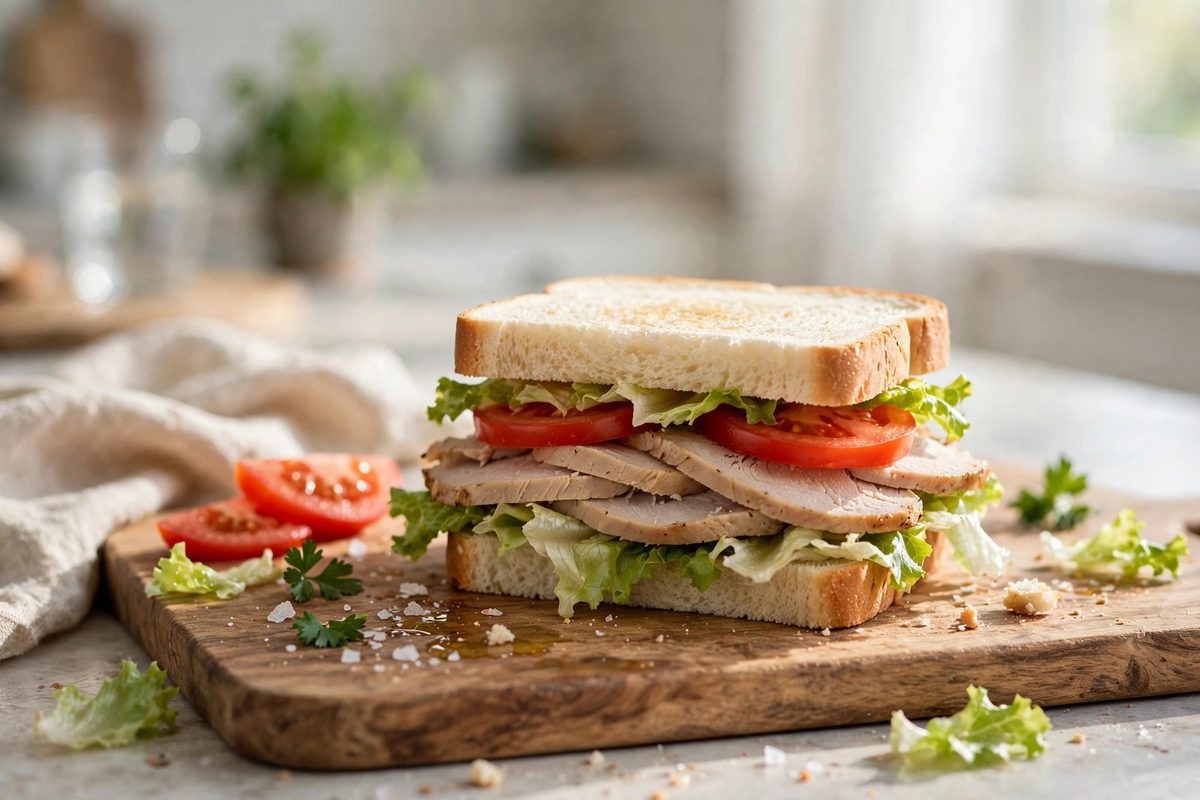
Toasting does not change the calories in bread, and this is one of the most persistent food myths worth killing plainly. Toasting drives off water and browns the surface through the Maillard reaction, but it does not remove carbohydrate, protein, or fat — the energy-bearing parts of the bread stay put. A slice of white bread at 77 calories untoasted is 77 calories toasted, and a two-slice sandwich base at 154 calories stays 154 whether the bread is soft or crisp. The only thing that changes is weight: a toasted slice weighs slightly less because it lost water, which is why it feels lighter and crunchier.
What toasting does change is what you put on the bread afterward. Melted butter soaks into hot toast far more readily than it spreads on cold bread, so a "lightly buttered" slice of toast often carries a full tablespoon of butter (about 100 calories) without looking it — turning a 77-calorie slice into a 177-calorie one. Toast also pairs with jam, honey, and spreads that add 50 to 100 calories per serving. So the rule is: toast itself is free, toppings on toast are not. If you butter toast, measure the butter once with a tablespoon so you know what "a little" actually costs, and consider that a slice of toast with butter (77 + 100 = 177 calories) costs more than a slice of toast with jam (77 + 50 = 127 calories for a tablespoon of jam).
First, count slices, not sandwiches: a sandwich is 2 slices (154 calories), a toast breakfast is usually 2 slices (154), and a dinner roll is roughly 1 slice (about 77). People who "only had a sandwich" often had 154 calories of bread plus 300 calories of filling, and blaming the bread misses the point. Second, make the bread work harder by pairing it with protein and fiber: turkey, chicken, tuna, eggs, or beans plus vegetables turn refined bread into a balanced meal, while bread plus jam or bread plus butter is mostly fast carbohydrate. Third, if you eat bread daily, try the whole-wheat swap for one meal a day: at the same calories, you gain about 6.2 grams of fiber per sandwich, which is a meaningful step toward the daily fiber target without changing anything else you eat.
Storage matters too, though not for calories: bread stales fastest at refrigerator temperature, so keep it at room temperature for a few days or freeze it for longer storage, toasting slices straight from frozen. Freezing does not change calories either, and some evidence suggests cooled and reheated starches form a small amount of resistant starch — but the effect is small and inconsistent, so do not count on frozen bread as a calorie hack. The honest version is simpler: white bread at 77 calories a slice is a fine, ordinary food, and the sandwich you build on it is where your calories — and your health — are actually decided.
Our calorie calculator shows where any sandwich fits your day.
Check My Daily TargetWritten by the Live Fitness Check editorial team · Reviewed against our calculator methodology · Last updated November 2026
Disclaimer: This guide is for educational purposes only and is not medical advice. Calorie figures are approximations based on USDA data; actual values vary by brand, slice size, and preparation. Talk to your doctor or a registered dietitian before making significant changes to your diet.