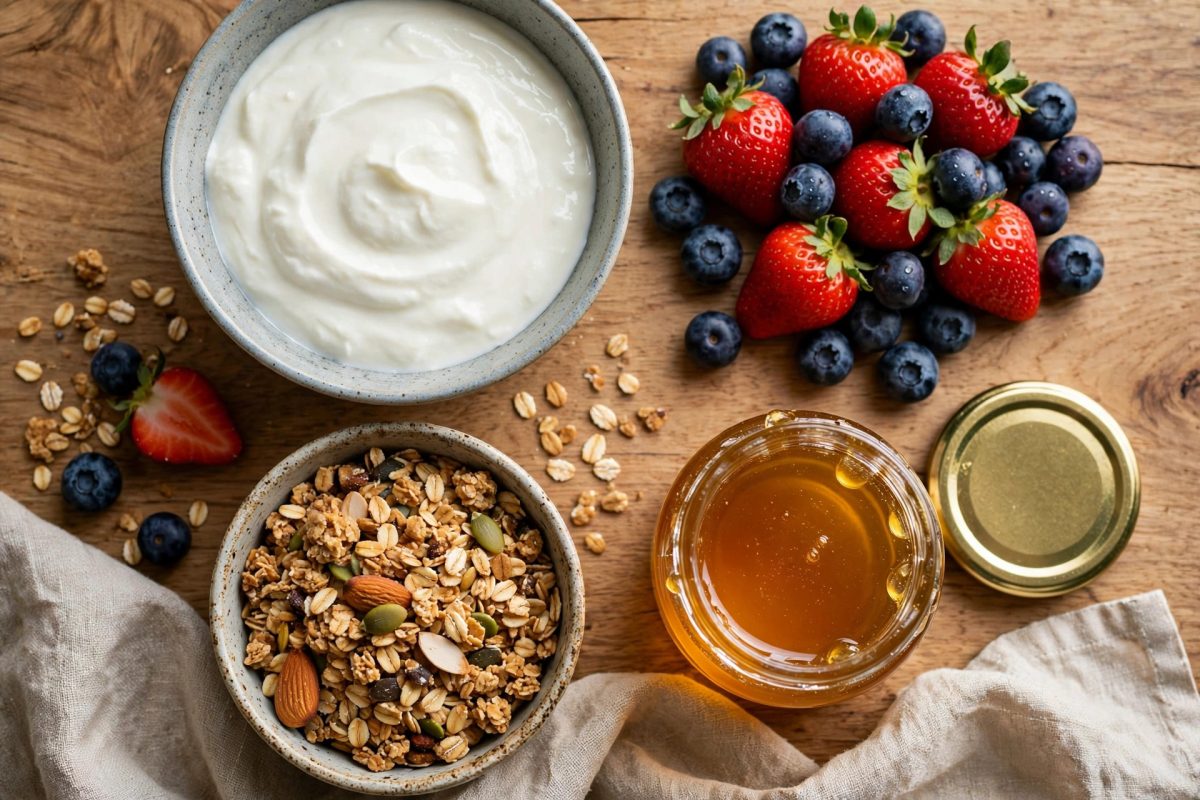
A homemade Greek yogurt parfait is about 285 calories; a café parfait runs 340 to 450 calories, depending on the yogurt, the granola, and how much honey goes in. The yogurt is the light part — the granola and honey are where the calories hide. Use our calorie calculator to see what a 285-calorie breakfast means against your daily target — this guide builds the parfait layer by layer, compares homemade and café versions, and shows the lighter swaps.
A standard homemade build — 1 cup of nonfat Greek yogurt (100), a quarter-cup of low-sugar granola (120), half a cup of mixed berries (40), and a teaspoon of honey (21) — totals about 281 calories with about 20 g of protein. Café parfaits are bigger and sweeter: a 12 oz university dining parfait is 343 calories, and large café parfaits reach 450, mostly from extra granola and flavored yogurt.
Check My Daily TargetA parfait is only four ingredients, and each one is easy to count — which is exactly why the total swings so widely. The yogurt is the base: a cup of nonfat Greek yogurt is about 100 calories with 17 g of protein, a cup of low-fat yogurt is about 150, a cup of whole-milk yogurt is about 200 to 250, and a cup of flavored yogurt adds 50 to 100 calories of sugar on top of the plain version. The granola is the calorie bomb: a quarter-cup is 120 to 200 calories depending on the brand, and cafés routinely use a third of a cup or more — granola is about 420 to 490 calories per 100 g, so a heavy hand costs 200 calories before you notice. The fruit is nearly free: half a cup of mixed berries is about 40 calories, a sliced banana about 105. The honey is small but real: a teaspoon is 21 calories, a tablespoon is 64, and the drizzle on a café parfait is usually a tablespoon.
| Layer | Serving | Calories |
|---|---|---|
| Nonfat Greek yogurt | 1 cup (170 g) | ~100 |
| Low-fat yogurt | 1 cup | ~150 |
| Whole-milk yogurt | 1 cup | ~200–250 |
| Flavored yogurt (adds sugar) | 1 cup | ~150–250 |
| Granola | 1/4 cup | ~120–200 |
| Mixed berries | 1/2 cup | ~40 |
| Banana, sliced | 1 medium | ~105 |
| Honey | 1 tsp / 1 tbsp | ~21 / ~64 |
| Homemade parfait (build below) | 1 parfait | ~285 |
| Large café parfait | 1 parfait | ~340–450 |
The build math is worth doing once, because it shows where the control is. Homemade: 1 cup nonfat Greek yogurt (100) + a quarter-cup of low-sugar granola (120) + half a cup of berries (40) + a teaspoon of honey (21) = 281 calories, which rounds to the published 285-calorie Greek yogurt parfait recipe with 20 g of protein. Swap the nonfat yogurt for whole-milk yogurt (+100 to 150) and double the granola (+120 to 200) and the same glass is suddenly 500 calories — and that is exactly what a café serves, because a bigger glass with more granola looks like better value. The protein is the reason the parfait works as breakfast: 20 g of protein at 285 calories is a better ratio than most breakfasts, and it is why the parfait keeps you full until lunch while a 285-calorie pastry does not.
The gap between homemade and café is not the yogurt — it is the portion and the sweetness. A homemade parfait in a small glass is about 285 calories. A café parfait in a 12 oz cup is 343 calories at a university dining hall and up to 450 at a coffee chain, and the difference is a third of a cup of granola instead of a quarter-cup, flavored yogurt instead of plain, and a tablespoon of honey instead of a teaspoon. The sugar tells the same story: a homemade parfait with plain yogurt and berries carries about 22 g of sugar, mostly from the fruit and a little honey, while a large café parfait can carry 41 g of sugar — more than a can of soda — because the yogurt is flavored and the granola is sweetened. The café version is not a bad breakfast, but it is a 450-calorie breakfast that looks like a 250-calorie one, and that is the trap.
Start with the yogurt, because it is the biggest layer and the easiest win: nonfat Greek yogurt at 100 calories a cup gives you the same protein as whole-milk yogurt for 100 to 150 fewer calories, and it is the only swap that costs nothing in flavor once the berries and honey are on top. Measure the granola — a quarter-cup, about 30 g, is the serving, and it is smaller than it looks in the jar, so use a measuring cup the first few times instead of pouring. Pick the berries over the banana if calories matter: half a cup of berries is 40 calories against 105 for a banana, and the berries bring more fiber per calorie. Use a teaspoon of honey, not a tablespoon, and let the berries do the sweetening — or skip the honey entirely and the parfait drops to about 260 calories. And if you want more crunch without more calories, swap half the granola for a tablespoon of chopped nuts (about 50 calories) or a spoonful of high-fiber cereal: you keep the texture and cut the sugar.
Yes, if you build it yourself. A 285-calorie parfait with 20 g of protein, 4 g of fiber, and real fruit is one of the best breakfasts for weight loss: high protein, moderate calories, and genuinely filling. The café version is a different story — at 450 calories with 41 g of sugar, it is closer to a dessert than a diet breakfast, and it is easy to eat it on top of a normal breakfast because it feels light. The rule is simple: if you can see the layers and you measured the granola, it is a weight-loss breakfast; if it came in a tall cup with a lid and a spoon, check the label before assuming it is light. For a grab-and-go option, a small tub of nonfat Greek yogurt (100) with a handful of berries (40) is 140 calories and 17 g of protein — the parfait without the granola, and the lightest version of the same idea.
Our calorie calculator sets your daily target — then you can see whether a 285-calorie parfait leaves room for lunch, or whether the café version eats into it.
Calculate My Daily TargetWritten by the Live Fitness Check editorial team · Reviewed against our calculator methodology · Last updated November 2026
Disclaimer: This guide is for general information only and is not medical advice. Calorie figures are standard averages and published values, and vary by brand, recipe, and serving size. Talk to your doctor or a registered dietitian before starting a weight-loss or restricted diet.