
It takes roughly 60,000 to 90,000 steps to burn one pound of body fat through walking alone, depending on your weight — about 87,500 steps for a 150 lb (68 kg) person and about 64,000 for a 200 lb (91 kg) person, because heavier bodies burn more calories per step. At 10,000 steps a day, that is roughly 6 to 9 days per pound, before food is counted at all. Want your exact number? Our steps to calories calculator converts your steps, weight, and pace into calories — this guide shows the math behind it, why the famous 3,500-calorie rule is only a starting point, and how to ramp up without wrecking your knees.
One pound of body fat stores roughly 3,500 calories. Walking burns about 0.04 calories per step for a 150 lb (68 kg) person and about 0.055 calories per step for a 200 lb (91 kg) person, so the steps per pound are 3,500 ÷ 0.04 = 87,500 and 3,500 ÷ 0.055 = 63,636. At 10,000 steps a day, the 150 lb walker needs about 9 days per pound and the 200 lb walker about 6 days — and that assumes no extra food. Check your own numbers in our walking calories calculator.
Calculate My Steps BurnThe rule that one pound of fat equals 3,500 calories comes from 1950s research by Max Wishnofsky, who calculated that a pound of adipose tissue contains about 3,500 calories of stored energy — and it is still a useful benchmark, but only a benchmark. Real weight loss does not follow a straight line: as you get lighter, your body burns fewer calories doing the same walk, your appetite rises, and your metabolism adapts downward. Kevin Hall's dynamic model of weight change, developed at the National Institutes of Health and published in The Lancet, shows that a fixed 500-calorie daily deficit produces roughly half the weight loss in the first year that the old 3,500 rule predicts, because the deficit shrinks as the body shrinks. In practice that means the steps-per-pound math in this guide is accurate for the first pound or two, and optimistic after that — you will need slightly more steps, or slightly less food, for each subsequent pound. The honest version: steps are a reliable, measurable way to create a deficit, and the 3,500 rule is the right way to size that deficit, as long as you re-check your numbers every few weeks as your weight changes. See the background at the NIH energy metabolism section, and pair walking with a food-side target from our calorie deficit calculator.
The other limit is that steps burn gross calories, and your body was already burning some of them. Standing still, breathing, and keeping your organs running — your basal metabolic rate — costs roughly 1 calorie per minute for an average adult, so a 30-minute walk that burns 130 calories includes about 30 calories you would have burned sitting on the couch. The net extra burn from the walk is therefore closer to 100 calories, not 130. This does not change the steps-per-pound math much — the per-step figures in this guide are already net walking estimates based on metabolic equivalents (METs), which measure the cost of the activity above rest — but it is why "I walked 10,000 steps, so I earned a 500-calorie snack" is a trap: the walk earned you about 350 to 550 calories of extra burn, and a single large muffin can erase it.
Walking costs about 3.5 METs at a brisk 3 mph (4.8 km/h) pace — meaning it burns about 3.5 times as many calories as resting — and the calories per minute follow a simple formula: METs × 3.5 × body weight in kilograms ÷ 200. At 3 mph most people take about 100 steps a minute, so dividing the per-minute burn by 100 gives the per-step figure. For a 125 lb (57 kg) person: 3.5 × 3.5 × 57 ÷ 200 = 3.49 calories per minute, or about 0.035 per step. For a 150 lb (68 kg) person: 3.5 × 3.5 × 68 ÷ 200 = 4.17 calories per minute, or about 0.042 per step. For a 175 lb (79 kg) person: 3.5 × 3.5 × 79 ÷ 200 = 4.84 per minute, or about 0.048 per step. For a 200 lb (91 kg) person: 3.5 × 3.5 × 91 ÷ 200 = 5.57 per minute, or about 0.056 per step. For a 250 lb (113 kg) person: 3.5 × 3.5 × 113 ÷ 200 = 6.92 per minute, or about 0.069 per step. Heavier walkers burn more per step because they are moving more mass with every stride — which is also why walking is such an effective starting exercise at higher weights, and why the steps-per-pound number falls as weight rises.
| Body weight | Calories per step (3 mph) | Calories per 10,000 steps | Steps to burn 3,500 kcal (1 lb) |
|---|---|---|---|
| 125 lbs (57 kg) | ~0.035 | ~350 | ~100,000 |
| 150 lbs (68 kg) | ~0.042 | ~420 | ~83,000 |
| 175 lbs (79 kg) | ~0.048 | ~480 | ~73,000 |
| 200 lbs (91 kg) | ~0.056 | ~560 | ~63,000 |
| 250 lbs (113 kg) | ~0.069 | ~690 | ~51,000 |
Pace changes the per-step number only slightly but changes the per-minute number a lot. A slow stroll at 2 mph (3.2 km/h) is about 2.8 METs, so a 150 lb person burns about 0.033 calories per step — but takes longer to cover the same distance, so the total for a fixed route is similar. A fast walk at 4 mph (6.4 km/h) is about 5 METs, or about 0.06 calories per step for the same person, and a 4 mph walker covers a mile in 15 minutes instead of 20. The practical takeaway: distance and weight decide the calories, pace decides how fast you collect them. A hilly route adds more than a faster pace does — walking uphill at a 5% grade raises energy cost by roughly 30 to 50 percent, which is why the same 10,000 steps on a hilly trail burns noticeably more than 10,000 steps on flat pavement. Our running calories calculator shows the same weight-based math for runners, where the per-mile burn is higher still.
Take two walkers, both aiming for 10,000 steps a day at a brisk 3 mph. The 150 lb (68 kg) walker burns about 0.042 calories per step, so 10,000 steps is 10,000 × 0.042 = 420 calories a day. Over a week that is 420 × 7 = 2,940 calories, and a pound of fat at 3,500 calories takes 3,500 ÷ 420 = 8.3 days — call it 8 to 9 days per pound from walking alone, with no diet change. The 200 lb (91 kg) walker burns about 0.056 per step, so 10,000 steps is 10,000 × 0.056 = 560 calories a day, 560 × 7 = 3,920 a week, and 3,500 ÷ 560 = 6.25 days per pound — call it about 6 days. The heavier walker loses faster from the same step count, which is one reason early weight loss feels encouraging and then slows: as the pounds come off, each step burns less, and the same 10,000 steps buys fewer calories.
Now add food to the picture, because walking alone is the slow road. If the 150 lb walker also trims 300 calories a day from food — a smaller dinner portion, a sugary drink swapped for water — the daily deficit becomes 420 + 300 = 720 calories, and the time per pound falls to 3,500 ÷ 720 = 4.9 days, or about a pound a week. That combination is the realistic plan: walking provides a steady, joint-friendly deficit you can sustain for years, and a modest food change doubles its speed. The math also shows why steps alone rarely produce dramatic results: even 15,000 steps a day for the 150 lb walker is 15,000 × 0.042 = 630 calories, which is about 1.3 lbs a month — real, but slow without the food side. For the full picture of your daily burn, check our TDEE calculator, and set the food target with our weight loss calculator.
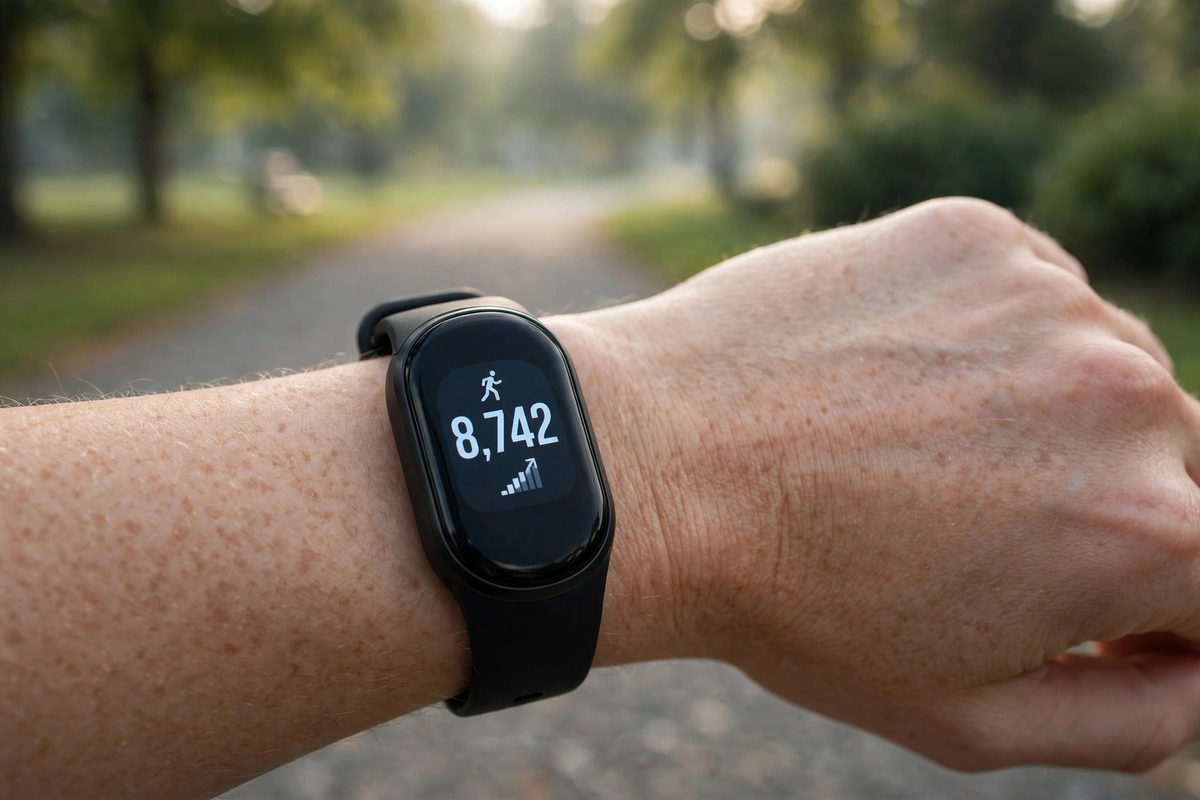
The timeline depends on your daily step count and your weight, and the table below assumes walking alone, no diet change, and the 3,500-calorie pound. A 150 lb person at 5,000 steps a day burns about 210 calories daily, needing about 17 days per pound; at 7,500 steps, about 315 calories a day and 11 days per pound; at 10,000 steps, about 420 a day and 8 to 9 days; at 12,500 steps, about 525 a day and 7 days; at 15,000 steps, about 630 a day and 5 to 6 days. A 200 lb person moves faster through the same table: 5,000 steps is about 280 calories a day and 12 to 13 days per pound; 7,500 steps is 420 a day and about 8 days; 10,000 steps is 560 a day and about 6 days; 12,500 steps is 700 a day and 5 days; 15,000 steps is 840 a day and about 4 days. Remember the dynamic-model caveat: these are first-pound figures, and each pound after the first takes slightly longer as your weight — and your per-step burn — drops.
| Daily steps | 150 lb walker: kcal/day | Days per pound (150 lb) | 200 lb walker: kcal/day | Days per pound (200 lb) |
|---|---|---|---|---|
| 5,000 | ~210 | ~17 | ~280 | ~13 |
| 7,500 | ~315 | ~11 | ~420 | ~8 |
| 10,000 | ~420 | ~8–9 | ~560 | ~6 |
| 12,500 | ~525 | ~7 | ~700 | ~5 |
| 15,000 | ~630 | ~5–6 | ~840 | ~4 |
One more honest note about the timeline: water weight makes the scale lie in the first two weeks. Starting a walking routine fills your muscles with glycogen and water, and each gram of glycogen holds about 3 g of water, so many people gain 1 to 3 lbs (0.5 to 1.4 kg) of water in the first week of walking more — even while losing fat. That is not failure; it is your muscles adapting. Judge progress by the four-week trend, not the daily number, and take waist measurements alongside scale weight: a waist that is shrinking while the scale is flat is fat loss hiding under water.
The 10,000-step target was not born in a laboratory — it was born in a marketing campaign. Ahead of the 1964 Tokyo Olympics, a Japanese company sold a pedometer called the Manpo-kei, which translates to "10,000 steps meter," and the round number stuck because it was memorable, not because researchers had found a magic threshold at exactly 10,000. The science caught up later and, to everyone's surprise, mostly vindicated the number. A 2021 study by Amanda Paluch and colleagues, published in JAMA Network Open, followed more than 2,000 middle-aged adults and found that taking at least 7,000 steps a day was associated with a 50 to 70 percent lower risk of death compared with fewer than 7,000, with benefits leveling off above about 10,000 steps for most adults. The study is at JAMA Network Open (Paluch et al., 2021).
The step-count bands researchers actually use come from Catrine Tudor-Locke's classification: under 5,000 steps a day is sedentary, 5,000 to 7,499 is low active, 7,500 to 9,999 is somewhat active, 10,000 to 12,499 is active, and 12,500 and above is highly active. The useful insight is that the biggest health jump comes from moving out of the sedentary band — going from 3,000 to 7,000 steps a day buys more health than going from 10,000 to 14,000. For weight loss specifically, 10,000 is a good target because it is high enough to matter (about 420 to 560 calories a day, depending on weight) and low enough to fit into a normal day with a couple of deliberate walks. But if 10,000 feels out of reach today, 7,000 is not a failure — it is where the mortality benefit in the Paluch study was already large, and it is a far better starting line than zero.
Start by measuring your baseline for three ordinary days — no extra walks, no trying — and take the average. Most desk workers land between 3,000 and 5,000 steps a day, and that number is your floor, not your shame. Then add 1,000 steps a day each week: if your baseline is 4,000, aim for 5,000 in week one, 6,000 in week two, and so on until you reach your target. The weekly bump is small enough that your feet, knees, and shins adapt without protesting, and the habit has time to form. A 1,000-step walk takes about 10 minutes at a brisk pace, so each bump is one extra 10-minute walk — a lap around the block after lunch, parking farther away, or getting off the bus one stop early.
Build the steps into routines you already have rather than adding a separate workout. A 20-minute walk after lunch is about 2,000 steps and also blunts the post-meal blood sugar spike, which is a genuine health win on its own. Walking meetings, phone calls taken on foot, and a short evening walk after dinner are the three easiest places to find steps without finding extra time. Wear comfortable walking shoes with real cushioning — not flat fashion sneakers — and if your knees or shins complain, slow down before you stop: a slower 10,000 steps beats a fast 3,000 steps followed by three days on the couch. Track with a phone or a fitness tracker, but check the weekly average rather than obsessing over any single day; life happens, and a 6,000-step Tuesday is fixed by a 12,000-step Saturday, not by guilt.
Our steps to calories calculator turns your daily steps, weight, and pace into an exact burn.
Calculate My Steps BurnWritten by the Live Fitness Check editorial team · Reviewed against our calculator methodology · Last updated November 2026
Disclaimer: This guide is for general information only and is not medical advice. Calorie figures are estimates based on standard MET formulas and individual results vary by pace, terrain, and fitness level. Talk to your doctor before starting a new exercise program, especially if you have a heart condition, joint problems, or any medical condition.