Most adults need about 90 to 110 oz (2.7 to 3.3 L) of total water a day — more than the famous 8 glasses, and far less than the gallon-a-day hype. Your exact number depends on your body weight, how much you sweat, and the weather. The quick rule is half an ounce to 1 oz per pound of body weight, and our water intake calculator turns that rule into your personal daily target in seconds — this guide shows the math, the official intake figures, and how to adjust for workouts.
The National Academies of Sciences, Engineering, and Medicine (NASEM) set adequate intakes of total water at 3.7 liters (125 oz) a day for men and 2.7 liters (91 oz) a day for women — and that includes the roughly 20% of water that comes from food. So the fluid you actually need to drink is about 100 oz for men and 73 oz for women, before exercise. A 150 lb (68 kg) person using the body-weight rule lands at 75 to 150 oz, with a practical target of about 90 to 110 oz of total water a day.
Calculate My Daily Water TargetEight 8 oz glasses — 64 oz (1.9 L) a day — is the most quoted health rule in America, and it is also mostly made up. There is no solid scientific study behind it: the number traces to a 1945 Food and Nutrition Board recommendation of about 2.5 liters a day, which was misread as a drinking target even though the original text said most of that water comes from food. The 8-glasses rule treats a 120 lb woman and a 240 lb man as if they had identical needs, which they plainly do not, and it ignores exercise, heat, and diet entirely.
That does not make 64 oz useless — it is a reasonable floor for a small, sedentary person in a cool climate. For most adults it is simply too low. The NASEM adequate intakes (3.7 L for men, 2.7 L for women) are about 125 oz and 91 oz of total water, roughly double the 8-glasses figure for men and about 40% higher for women. And a large iced tea, a bowl of soup, or a plate of watermelon all count toward the total: about 20% of daily water comes from food, and most of the rest comes from any beverage, not just plain water. Coffee and tea count too — their mild diuretic effect does not cancel out their water content. The honest upgrade to the old rule is a personal number, not a bigger round number, and the two formulas below give you one.
The simplest personal formula is half an ounce to 1 oz of water per pound of body weight per day. A 150 lb (68 kg) person therefore needs 75 to 150 oz (2.2 to 4.4 L) of total water a day, and a practical everyday target sits in the middle of that range — about 90 to 110 oz (2.7 to 3.3 L). The range is wide on purpose: the low end fits a cool, sedentary day, and the high end fits a hot day or a long workout. Start in the middle and adjust by thirst and urine color, which this guide covers below.
Here is the math for common body weights. Multiply your weight in pounds by 0.5 for the low end and by 1.0 for the high end, then aim for the middle on an ordinary day. A 120 lb (54 kg) person: 60 to 120 oz, practical target about 75 to 90 oz. A 150 lb (68 kg) person: 75 to 150 oz, practical target about 90 to 110 oz. A 180 lb (82 kg) person: 90 to 180 oz, practical target about 110 to 130 oz. A 200 lb (91 kg) person: 100 to 200 oz, practical target about 120 to 145 oz. A 220 lb (100 kg) person: 110 to 220 oz, practical target about 130 to 155 oz. Note that these are total water figures, including the roughly 20% that comes from food — so a 150 lb person eating a normal diet needs to drink about 72 to 88 oz of fluids to hit the 90 to 110 oz total.
| Body weight | Range (0.5–1 oz per lb) | Practical daily target (total water) | Fluids to drink (after food) |
|---|---|---|---|
| 120 lb (54 kg) | 60–120 oz | ~75–90 oz (2.2–2.7 L) | ~60–72 oz |
| 150 lb (68 kg) | 75–150 oz | ~90–110 oz (2.7–3.3 L) | ~72–88 oz |
| 180 lb (82 kg) | 90–180 oz | ~110–130 oz (3.3–3.8 L) | ~88–104 oz |
| 200 lb (91 kg) | 100–200 oz | ~120–145 oz (3.6–4.3 L) | ~96–116 oz |
| 220 lb (100 kg) | 110–220 oz | ~130–155 oz (3.8–4.6 L) | ~104–124 oz |
If you prefer metric, the same rule is about 30 to 65 ml per kilogram of body weight, with a practical target near 40 to 50 ml per kilogram — a 68 kg person therefore aims for about 2.7 to 3.3 liters a day. Hydration also interacts with your overall energy needs: if you are tracking calories, our calorie calculator and TDEE calculator set your daily intake target, and the water target above sits alongside it — drinking enough water will not change your calorie burn much, but mild dehydration is one of the most common reasons people mistake thirst for hunger and overeat.
The most authoritative numbers come from the National Academies' 2005 Dietary Reference Intakes for Water, which set adequate intakes of 3.7 liters (125 oz) of total water a day for adult men and 2.7 liters (91 oz) for adult women. Those figures cover all sources — drinking water, other beverages, and the water in food — and they are adequate intakes, not minimums: they describe the amount that covers the needs of nearly all healthy adults in a temperate climate, based on observed intakes in the U.S. population. The report is published by the National Academies Press at nap.nationalacademies.org.
Two details in that report matter for real life. First, about 20% of total water comes from food — fruits, vegetables, soups, and yogurt are mostly water — so the drinking-water portion of the adequate intake is roughly 3.0 liters (101 oz) for men and 2.2 liters (74 oz) for women. Second, the figures assume a temperate climate and moderate activity: heat, humidity, altitude, illness, pregnancy, and breastfeeding all raise needs. Pregnant women are advised to aim for about 3.0 liters (101 oz) of total water a day, and breastfeeding women about 3.8 liters (128 oz), because milk production alone costs roughly an extra liter. The CDC's guidance on water and healthier drinks, at cdc.gov, makes the same practical point: water is the healthiest drink choice, and replacing sugary drinks with water is one of the simplest calorie cuts available.
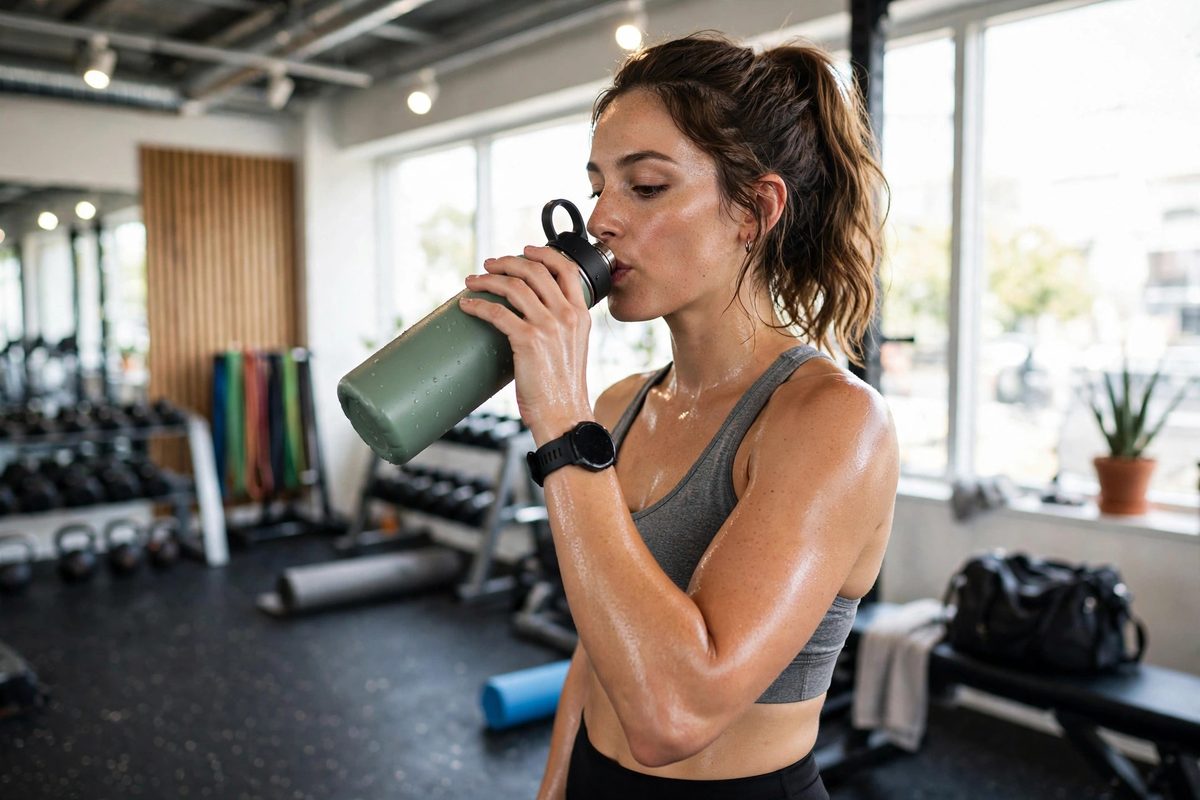
Exercise adds a separate water bill on top of your daily target, and the size of that bill depends on how much you sweat. A typical adult sweats about 0.5 to 1 liter (17 to 34 oz) per hour of moderate exercise, and heavy sweaters in heat can lose 1.5 to 2 liters (51 to 68 oz) per hour. The American College of Sports Medicine's position stand on exercise and fluid replacement, published in Medicine & Science in Sports & Exercise at journals.lww.com, recommends drinking to limit body-weight loss during exercise to under 2% — losing more than 2% of body weight as sweat measurably impairs performance and raises core temperature.
The practical ACSM rule is to replace about 16 to 24 oz (0.5 to 0.7 L) of fluid for every pound of body weight lost during a workout. Weigh yourself before and after a training session once, and you will know your personal sweat rate: if you lose 2 lb in an hour-long run, that is about 32 to 48 oz (1 to 1.4 L) to replace afterward, on top of your normal daily intake. During the workout itself, small regular sips beat occasional big gulps — about 4 to 8 oz (120 to 240 ml) every 15 to 20 minutes for most sessions under an hour. Sessions longer than 60 to 90 minutes, or workouts in serious heat, are where electrolytes start to matter, which is the next section. If you train most days, our protein calculator can set your post-workout protein target while the water calculator above sets your fluid target — the two together cover recovery basics.
For most people, on most days, plain water is all you need — electrolytes only matter when you sweat heavily or for a long time. Sweat is not pure water: it carries sodium (about 0.5 to 1 gram per liter of sweat), plus smaller amounts of potassium, magnesium, and calcium. On a normal day, food replaces those salts easily. But during exercise lasting more than 60 to 90 minutes, or in extreme heat, drinking large volumes of plain water without replacing sodium dilutes the sodium in your blood — and that is exactly the mechanism behind exercise-associated hyponatremia, covered in the next section.
The fix is simple and cheap: for long or very sweaty sessions, use a sports drink, an electrolyte tablet, or a pinch of salt (about a quarter teaspoon, roughly 500 mg of sodium) in a liter of water, plus a salty snack afterward. You do not need a sports drink for a 30-minute gym session or a walk — water is fine, and the sugar in sports drinks adds calories you probably do not want. A good rule is that if your workout is under an hour and you are eating normally, water alone is enough; if it is over 90 minutes, if you are drenched in sweat, or if you are training twice a day in summer, add electrolytes. People on low-sodium diets or blood-pressure medication should talk to their doctor before adding salt to their drinks.
Yes, you can drink too much water, and the condition — hyponatremia, or low blood sodium — is a genuine medical risk, though it is rare outside endurance events. Healthy kidneys can excrete about 0.8 to 1 liter (27 to 34 oz) of water per hour, so problems arise when intake far exceeds that rate for hours: drinking 3 to 4 liters in a couple of hours, or forcing fluids far beyond thirst during a marathon, can dilute blood sodium below safe levels. Symptoms start with nausea, headache, and confusion and can progress to seizures — it is a medical emergency, not a mild discomfort.
The risk is concentrated in specific situations: marathon and ultramarathon runners, military recruits, and people following "drink as much as possible" advice during long events. For everyday life the safeguard is simple: drink to thirst, spread intake through the day, and do not force a gallon on top of a normal diet. If your urine is consistently completely clear and you are urinating very frequently, you are probably drinking more than you need — pale straw is the target, not clear. Anyone with kidney disease, heart failure, or liver disease, or anyone taking medication that affects fluid balance, should follow their doctor's fluid guidance rather than any general target in this article.
Pale straw or light yellow urine means you are well hydrated; dark yellow or amber means drink more; completely clear urine most of the time means you may be drinking too much. Urine color is the cheapest hydration test there is, and it works because the kidneys concentrate urine when the body needs to conserve water and dilute it when there is water to spare. Check the color of your first morning urine — it will be the darkest of the day — and then midday, when it should be pale straw.
Two caveats keep the test honest. First, B vitamins, some medications, and foods like beets can change urine color, so treat one odd reading as noise and look at the pattern across the day. Second, thirst is a useful signal but a lagging one: by the time you feel clearly thirsty you are already mildly dehydrated, which is why keeping a bottle at your desk or in your gym bag matters more than willpower. Practical habits that work: a glass of water with each meal (three glasses is about 24 oz before you try), a bottle you refill twice during the workday, and water before coffee in the morning. And if fiber is part of your health plan, remember that fiber needs water to work — increasing fiber without increasing fluids is a common cause of bloating, so check our fiber calculator alongside your water target.
Our water intake calculator turns your weight and activity level into a daily target you can actually use.
Calculate My Daily Water TargetWritten by the Live Fitness Check editorial team · Reviewed against our calculator methodology · Last updated November 2026
Disclaimer: This guide is for general information only and is not medical advice. Fluid needs vary with health conditions, medication, climate, and activity level. If you have kidney disease, heart failure, or liver disease, or take medication that affects fluid balance, follow your doctor's guidance on fluid intake. Talk to your doctor or a registered dietitian before making significant changes to your diet or hydration habits.