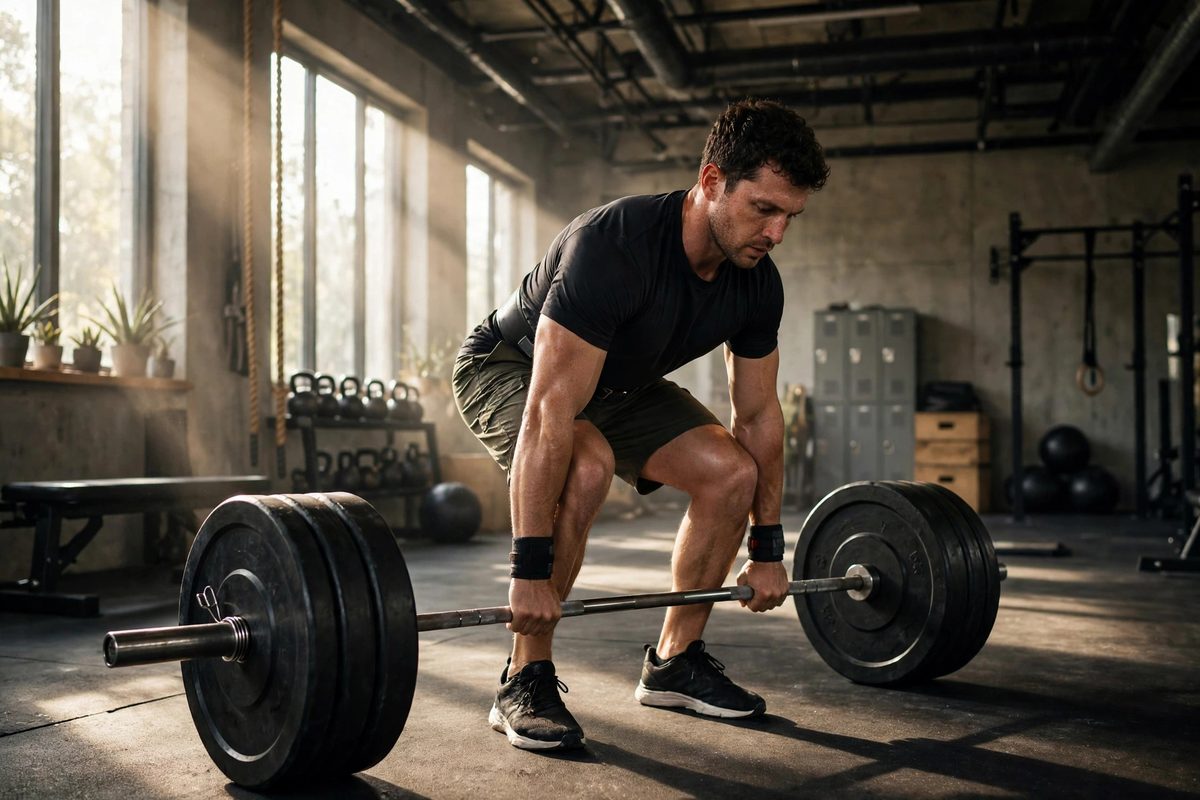
For a 180 lb (82 kg) man, the intermediate benchmarks in this guide are a 180 lb bench press, a 270 lb squat, and a 360 lb deadlift — a 810 lb total. For a 140 lb (64 kg) woman, the intermediate benchmarks are an 85 lb bench press, a 140 lb squat, and a 195 lb deadlift — a 420 lb total. Those numbers are commonly used gym standards, not official records or medical norms, and they exist to tell you where you stand and what to train next — or find your single-rep max first with our one rep max calculator.
Strength standards work as multiples of body weight because a 220 lb lifter should lift more than a 140 lb lifter, and raw pounds alone hide that. This guide uses three levels: novice (lifting consistently for roughly 3 to 9 months), intermediate (roughly 1 to 2 years of consistent training), and advanced (roughly 3 or more years, approaching genetic potential for a recreational lifter). The multiples are the commonly cited gym benchmarks popularized by strength-coaching resources such as ExRx.net and the powerlifting community — useful yardsticks, not governing-body records. Check your own maxes with our one rep max calculator before you compare.
Estimate My 1-Rep MaxNovice, intermediate, and advanced describe training age and rate of progress, not worth. A novice is someone who can still add weight to the bar almost every session; an intermediate needs weekly progression; an advanced lifter needs monthly or longer cycles to move a lift. That is why the same person can be intermediate on the deadlift and novice on the bench press — lifts progress at different speeds, and upper-body lifts almost always lag lower-body lifts. The American College of Sports Medicine (ACSM) recommends resistance training for all major muscle groups on 2 to 3 nonconsecutive days per week for healthy adults, and these standards assume roughly that kind of consistent program, not sporadic gym visits.
Two warnings keep the standards honest. First, they assume a full range of motion: a squat to at least parallel, a bench press touching the chest with a controlled pause or touch-and-go, and a deadlift locked out with hips through. A half-squat "intermediate" number is not an intermediate squat. Second, they assume body weight is stable and the lifter is not cutting aggressively; a lifter who has just lost 20 lb (9 kg) will usually test below their old standards until their strength catches up. Compare yourself to your own past numbers first, and to these tables second.
For men, the intermediate benchmarks used here are a bench press of 1.0 times body weight, a squat of 1.5 times body weight, and a deadlift of 2.0 times body weight. Novice multiples are 0.75, 1.0, and 1.25; advanced multiples are 1.25, 1.75, and 2.25. Every figure in the table is the body weight multiplied by the level multiple, rounded to the nearest 5 lb — for example, a 180 lb intermediate man benches 180 × 1.0 = 180 lb, squats 180 × 1.5 = 270 lb, and deadlifts 180 × 2.0 = 360 lb, for a total of 180 + 270 + 360 = 810 lb.
| Body weight | Level | Bench press | Squat | Deadlift | Total |
|---|---|---|---|---|---|
| 140 lb (64 kg) | Novice | 105 lb | 140 lb | 175 lb | 420 lb |
| 140 lb (64 kg) | Intermediate | 140 lb | 210 lb | 280 lb | 630 lb |
| 140 lb (64 kg) | Advanced | 175 lb | 245 lb | 315 lb | 735 lb |
| 160 lb (73 kg) | Novice | 120 lb | 160 lb | 200 lb | 480 lb |
| 160 lb (73 kg) | Intermediate | 160 lb | 240 lb | 320 lb | 720 lb |
| 160 lb (73 kg) | Advanced | 200 lb | 280 lb | 360 lb | 840 lb |
| 180 lb (82 kg) | Novice | 135 lb | 180 lb | 225 lb | 540 lb |
| 180 lb (82 kg) | Intermediate | 180 lb | 270 lb | 360 lb | 810 lb |
| 180 lb (82 kg) | Advanced | 225 lb | 315 lb | 405 lb | 945 lb |
| 200 lb (91 kg) | Novice | 150 lb | 200 lb | 250 lb | 600 lb |
| 200 lb (91 kg) | Intermediate | 200 lb | 300 lb | 400 lb | 900 lb |
| 200 lb (91 kg) | Advanced | 250 lb | 350 lb | 450 lb | 1,050 lb |
| 220 lb (100 kg) | Novice | 165 lb | 220 lb | 275 lb | 660 lb |
| 220 lb (100 kg) | Intermediate | 220 lb | 330 lb | 440 lb | 990 lb |
| 220 lb (100 kg) | Advanced | 275 lb | 385 lb | 495 lb | 1,155 lb |
Notice how the total scales: a 140 lb intermediate man totals 630 lb, while a 220 lb intermediate man totals 990 lb — a 360 lb gap for the same level, which is exactly why body-weight multiples beat raw numbers for comparison. Also notice that the deadlift carries the total: at every level it is roughly double the bench press, so a weak deadlift drags a total down more than a weak bench. If your deadlift lags, check grip, hip-hinge technique, and hamstring strength before adding bench volume.
For women, the intermediate benchmarks used here are a bench press of 0.6 times body weight, a squat of 1.0 times body weight, and a deadlift of 1.4 times body weight. Novice multiples are 0.4, 0.65, and 0.85; advanced multiples are 0.85, 1.3, and 1.75. Figures are rounded to the nearest 5 lb — for example, a 140 lb intermediate woman benches 140 × 0.6 = 84 lb, rounded to 85 lb, squats 140 × 1.0 = 140 lb, and deadlifts 140 × 1.4 = 196 lb, rounded to 195 lb, for a total of 85 + 140 + 195 = 420 lb.
| Body weight | Level | Bench press | Squat | Deadlift | Total |
|---|---|---|---|---|---|
| 120 lb (54 kg) | Novice | 50 lb | 80 lb | 100 lb | 230 lb |
| 120 lb (54 kg) | Intermediate | 70 lb | 120 lb | 170 lb | 360 lb |
| 120 lb (54 kg) | Advanced | 100 lb | 155 lb | 210 lb | 465 lb |
| 140 lb (64 kg) | Novice | 55 lb | 90 lb | 120 lb | 265 lb |
| 140 lb (64 kg) | Intermediate | 85 lb | 140 lb | 195 lb | 420 lb |
| 140 lb (64 kg) | Advanced | 120 lb | 180 lb | 245 lb | 545 lb |
| 160 lb (73 kg) | Novice | 65 lb | 105 lb | 135 lb | 305 lb |
| 160 lb (73 kg) | Intermediate | 95 lb | 160 lb | 225 lb | 480 lb |
| 160 lb (73 kg) | Advanced | 135 lb | 210 lb | 280 lb | 625 lb |
| 180 lb (82 kg) | Novice | 70 lb | 115 lb | 155 lb | 340 lb |
| 180 lb (82 kg) | Intermediate | 110 lb | 180 lb | 250 lb | 540 lb |
| 180 lb (82 kg) | Advanced | 155 lb | 235 lb | 315 lb | 705 lb |
Women's lower-body strength is proportionally closer to men's than upper-body strength is, which is why the squat multiple (1.0 at intermediate) matches a larger share of body weight than the bench multiple (0.6) does. That pattern shows up in powerlifting data too: trained women routinely squat and deadlift multiples that surprise people who only watch bench press. If your bench lags far behind these tables while your squat is on track, that is normal anatomy and training history, not a flaw — upper-body volume, triceps work, and bench frequency close the gap over months, not weeks.
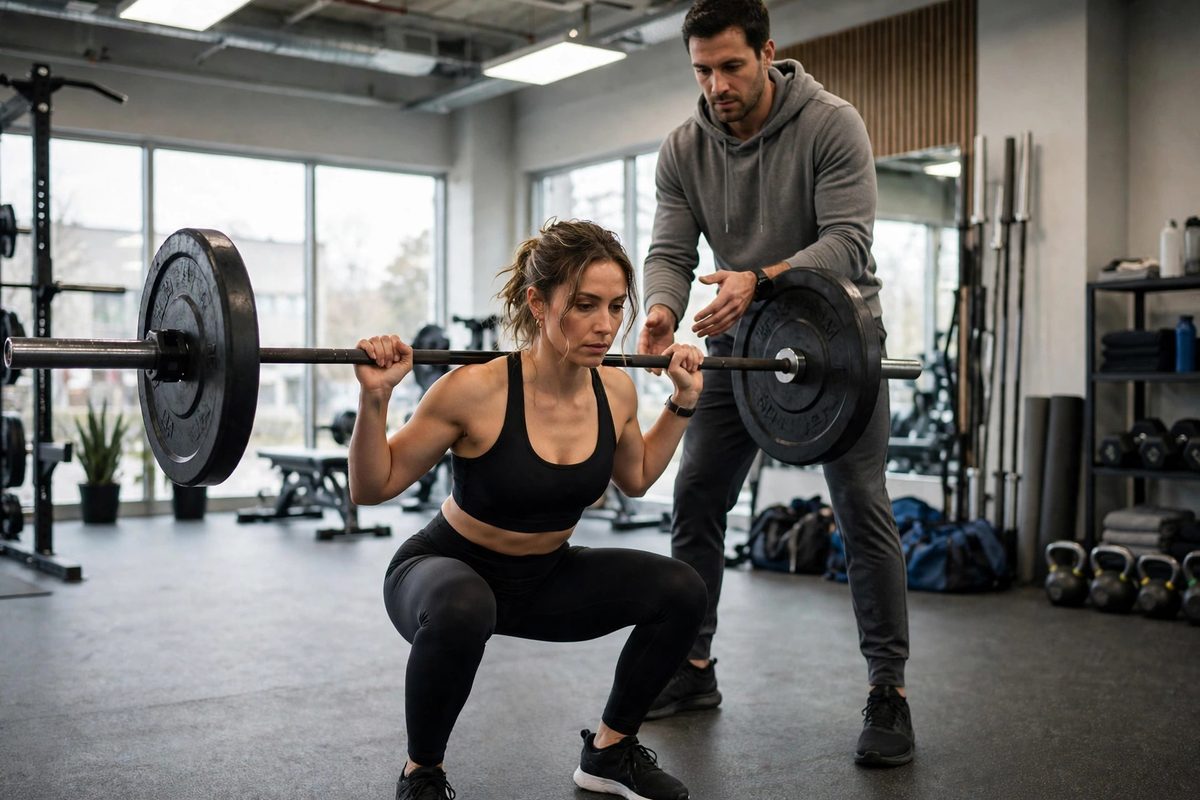
Example 1: a 180 lb man benches 200 lb, squats 250 lb, and deadlifts 330 lb. Against the men's table, his bench is between intermediate (180 lb) and advanced (225 lb), his squat is below intermediate (270 lb), and his deadlift is below intermediate (360 lb). His total is 200 + 250 + 330 = 780 lb, just under the 810 lb intermediate total. The verdict is clear: he is an intermediate lifter with a lower-body gap, and his next program should prioritize squat and deadlift frequency over more bench volume.
Example 2: a 140 lb woman benches 95 lb, squats 150 lb, and deadlifts 210 lb. Her bench beats the intermediate mark (85 lb), her squat beats it (140 lb), and her deadlift beats it (195 lb). Her total is 95 + 150 + 210 = 455 lb, above the 420 lb intermediate total and on the road to advanced (545 lb). The verdict: she is a solid intermediate lifter, and her next goal could be the advanced squat of 180 lb, which needs only 30 lb more.
Example 3: a 200 lb man benches 150 lb, squats 200 lb, and deadlifts 250 lb — exactly the novice row for his weight, total 600 lb. That is not a bad result; it is a precise diagnosis. Novice progression (adding 5 lb per session on the main lifts) should carry him toward the 900 lb intermediate total over the next year if he trains 3 times a week and eats enough protein — roughly 0.7 to 1.0 grams per pound (1.6 to 2.2 grams per kilogram) of body weight, or 140 to 200 grams daily at 200 lb: 200 × 0.7 = 140 and 200 × 1.0 = 200.
If you are below novice, your job is technique and consistency, not a fancy program. Learn the squat, bench, deadlift, overhead press, and row with good form, train 3 times a week on a full-body routine, and add a little weight whenever you complete all sets with good form. Most people reach novice numbers within 3 to 9 months this way. Film a set from the side once a month: depth, bar path, and back position matter more at this stage than any accessory exercise.
If you are at intermediate, your job is structured progression and recovery. Weekly progression programs — adding weight each week rather than each session — plus attention to sleep (the CDC recommends 7 or more hours per night for adults) and protein intake carry most lifters from intermediate toward advanced. This is also the stage where comparing lifts across weight classes becomes useful: our Wilks calculator scores your powerlifting total against your body weight so you can compare fairly with lifters in other weight classes, which body-weight multiples alone cannot do precisely.
If you are at advanced, your job is patience and specialization. Progress now comes in 5 lb increments over months, not weeks, and it usually requires a coach or a periodized program with planned heavy, light, and deload weeks. Advanced lifters should also watch the other side of strength: mobility, joint health, and conditioning, because a 1,155 lb total at 220 lb body weight is no help if a shoulder injury ends training for six months. A deload week every 4 to 8 weeks is not laziness at this level; it is how advanced lifters stay lifters.
These tables are recreational gym standards, and they sit far below competitive powerlifting records — the men's raw world-record totals exceed 2,000 lb, and elite women total well over 1,000 lb. That gap is the point: "advanced" here means advanced for a recreational lifter with a job and a life outside the gym, not elite. Age also shifts expectations: lifters over 50 often test 10 to 20 percent below these tables even with good training, because muscle mass and recovery decline with age, while lifters under 25 may reach intermediate faster. Masters lifters should compare against their own age-group peers and their own past numbers, and should treat joint-friendly technique as non-negotiable.
Body composition changes the comparison too. A 220 lb lifter at 12 percent body fat and a 220 lb lifter at 30 percent body fat share a body weight but not a muscle mass, so the leaner lifter should expect higher multiples. That is why the tables pair well with a body-composition check: if your multiples look low, find out whether the gap is muscle or fat before you decide what to fix. Strength standards tell you where you stand; they do not tell you why, and the why is where the training plan lives.
Our one rep max calculator estimates your max from a submaximal set.
Estimate My MaxWritten by the Live Fitness Check editorial team · Reviewed against our calculator methodology · Last updated November 2026
Disclaimer: This guide is for educational purposes only and is not medical advice. Strength standards are recreational benchmarks, not qualifications or medical norms. Use a spotter for heavy bench pressing, learn proper form before lifting heavy, and talk to your doctor before starting a new training program.