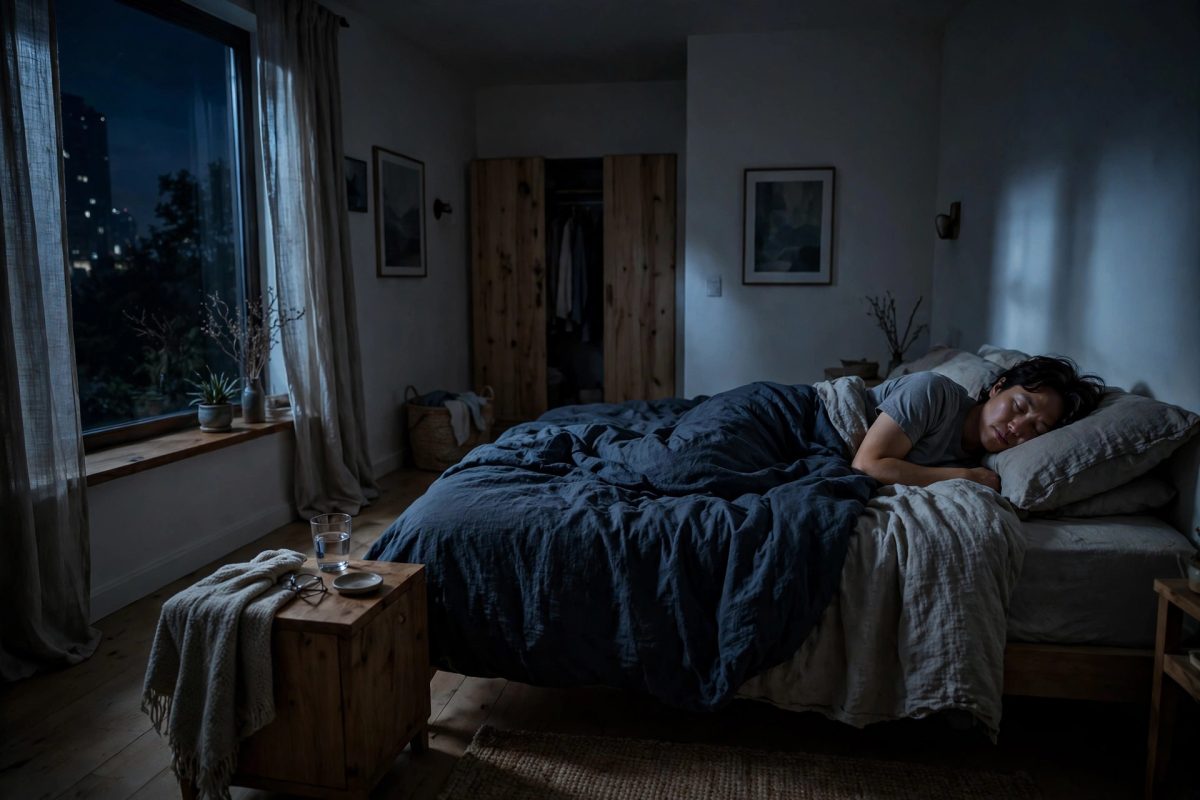
Some people spring out of bed at 5:30 am and fade by 9 pm. Others do their best thinking at midnight and dread the alarm. That difference is your chronotype — your body's built-in preference for when to sleep, wake, and focus — and working with it, instead of against it, makes the same hours feel easier. Answer 8 quick questions below to find whether you are a Lion, a Bear, a Wolf, or a Dolphin, plus your best sleep window and focus hours. If your sleep is the problem rather than your timing, our sleep calculator can plan your bedtime around your wake-up call.
Think about how you feel on days with no alarm, no deadlines, and no caffeine rescue — not how you wish you felt. The quiz scores what you actually do, so the "ideal morning person" answer only helps if it is true.
Your chronotype is your body's preferred timing for sleep, waking, and peak alertness, driven largely by your circadian rhythm — the roughly 24-hour internal clock that regulates hormones like melatonin and cortisol. About half of people fall in the middle (Bears), roughly 15–20% are early types (Lions), roughly 15–20% are late types (Wolves), and about 10% are light, irregular sleepers (Dolphins). Chronotype is partly genetic, shifts earlier as people age — teenagers skew Wolf, older adults skew Lion — and can be nudged by light exposure, work schedules, and lifestyle, but it cannot be forced into its opposite overnight.
| Chronotype | Natural sleep window | Wake time | Best focus hours | Typical share |
|---|---|---|---|---|
| Lion (early) | 9:00–10:00 pm → 5:30–6:00 am | 5:30–6:00 am | 8:00 am – noon | 15–20% |
| Bear (mid) | 11:00 pm → 7:00 am | 7:00 am | 10:00 am – 2:00 pm | ~50% |
| Wolf (late) | Midnight–1:00 am → 8:00–9:00 am | 8:00–9:00 am | 4:00–8:00 pm | 15–20% |
| Dolphin (light/irregular) | ~11:30 pm → 6:30 am, often broken | ~6:30 am | 10:00 am – noon, in bursts | ~10% |
The popular four-animal framing comes from sleep specialist Dr. Michael Breus, who built it on clinical observation rather than a single lab test — so treat the labels as a useful shorthand for tendencies, not a diagnosis. The more rigorous research tool is the Morningness-Eveningness Questionnaire, which scores the same early-to-late spectrum without animals. This quiz borrows the animal labels because they are memorable and shareable, but its scoring underneath is the same idea: count how many answers point early, middle, late, or irregular, and the highest count wins.
Each of the 8 questions has four answers, one pointing to each chronotype, and each answer is worth 2 points to its type. That gives a maximum of 16 points and a clean, deterministic result: the type with the most points is your dominant chronotype, and the second-highest is your runner-up. Ties are broken in the order Lion, Bear, Wolf, Dolphin — so a 6–6 tie between Lion and Bear reports Lion with Bear as runner-up, and the quiz says so openly rather than hiding the tie. There is no hidden weighting and no answer that secretly counts double: a quiz you can audit is a quiz you can trust.
Profile 1 — all early answers. A person who picks the first option on all 8 questions scores Lion 16, Bear 0, Wolf 0, Dolphin 0. Dominant: Lion, with no runner-up of substance — the quiz reports the next type at 0 and notes the result is unambiguous. Recommended window: 9:00–10:00 pm to 5:30–6:00 am, focus 8:00 am to noon.
Profile 2 — all late answers. A person who picks the third option on all 8 questions scores Wolf 16, everything else 0. Dominant: Wolf. Recommended window: midnight–1:00 am to 8:00–9:00 am, focus 4:00–8:00 pm. This is the profile most punished by a 7:00 am alarm: a Wolf forced onto a Lion schedule is not lazy, they are jet-lagged every single morning.
Profile 3 — all middle answers. A person who picks the second option throughout scores Bear 16. Dominant: Bear, window 11:00 pm to 7:00 am, focus 10:00 am to 2:00 pm — the schedule the standard 9-to-5 workday was effectively built around, which is one reason Bears rarely notice their chronotype at all.
Profile 4 — a realistic mixed profile. Suppose someone answers Lion on questions 1, 3, 4, and 8 (4 × 2 = 8 points), Bear on questions 2, 6, and 7 (3 × 2 = 6 points), and Wolf on question 5 (2 points). Totals: Lion 8, Bear 6, Wolf 2, Dolphin 0. Dominant: Lion, runner-up Bear. The advice follows the dominant type but borrows the runner-up's flexibility: an early schedule with a slightly later focus window than a pure Lion's. Most real results look like this one — a clear winner with a meaningful second place — and that is a feature, not a flaw: few people are pure types.
Start with the one change that costs nothing: put your hardest task inside your focus window. Lions should protect the morning and stop scheduling deep work after dinner; Wolves should negotiate late starts or evening deep-work blocks where they can, and stop apologizing for a brain that wakes up at 4:00 pm; Bears should guard late morning and avoid the post-lunch dip by walking or working on lighter tasks from 2:00–4:00 pm; Dolphins should fix the sleep basics first — a dark, cool room, no screens in bed, and a strict caffeine cutoff — because for light sleepers, sleep quality matters more than sleep timing. For everyone, the highest-yield habit is the same: bright light within an hour of waking, and dim light for the last hour before bed. Light is the strongest signal your circadian clock reads, stronger than willpower, and it shifts your rhythm a little every day.
This quiz describes tendencies; it does not diagnose a sleep disorder, a circadian rhythm disorder, or anything else medical. If you snore loudly, stop breathing in your sleep, cannot fall asleep for months despite good habits, or feel sleepy all day no matter how long you sleep, that is a conversation for your doctor or a sleep clinic — not a quiz result. Separately, remember that chronotype moves: teenagers run late and drift earlier through their twenties and thirties, night-shift work pushes it later, and consistent morning light plus a fixed wake time can pull a Wolf an hour or so earlier over several weeks. If you retake this quiz in a year and get a different animal, that is normal — retest, adjust your schedule, and keep the habits that work. For a deeper look at sleep timing and duration, see our sleep calculator and our sleep debt calculator.
Written by the Live Fitness Check editorial team · Reviewed against our calculator methodology · Last updated November 2026
Disclaimer: This quiz is for educational purposes only and is not medical advice or a diagnosis. Chronotype describes sleep-timing tendencies, not a medical condition. If you have persistent insomnia, loud snoring with breathing pauses, or excessive daytime sleepiness, talk to your doctor or a sleep clinic.