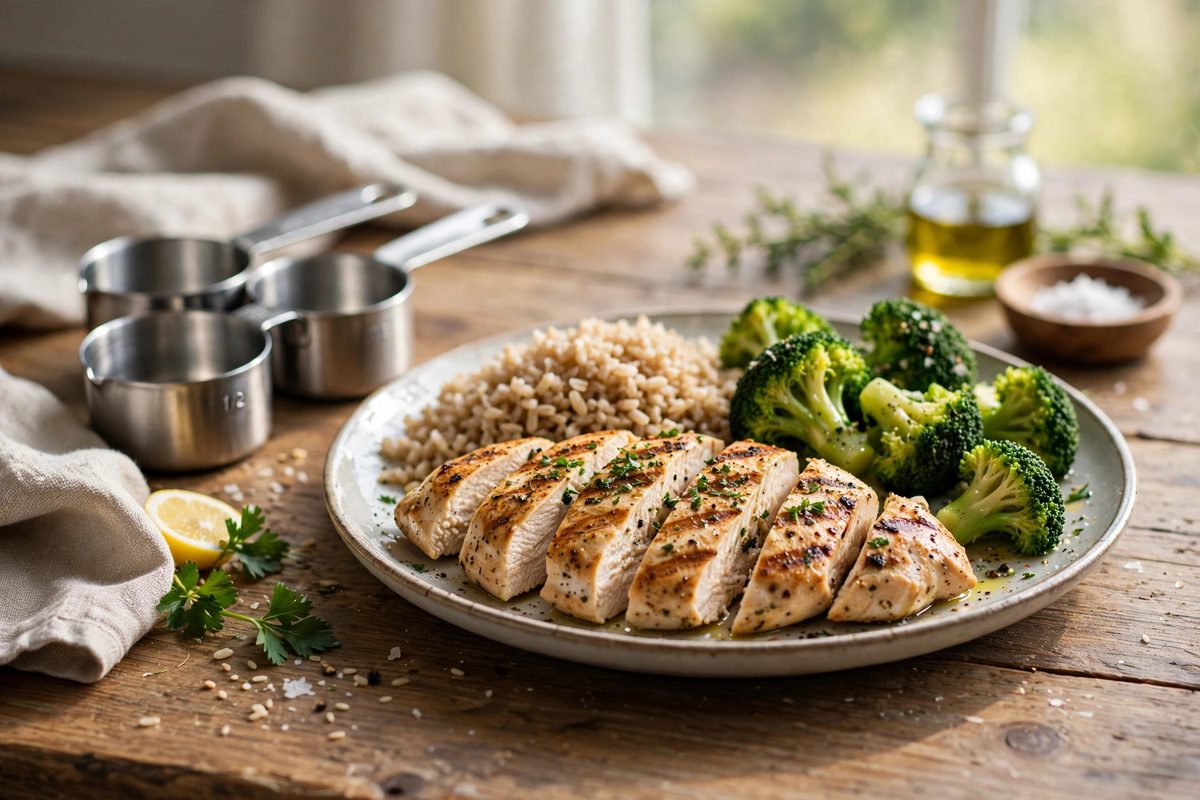
How many calories are actually on your plate? Pick your foods and servings below and this calculator totals the meal — chicken, rice, salmon, avocado, olive oil, and a dozen more everyday foods, with standard USDA-based values per serving. A typical plate of grilled chicken, brown rice, and broccoli with a drizzle of olive oil comes to 574 calories; swap the chicken for salmon and the rice for a sweet potato and it is 405. If you want the full method behind weighing and counting a home-cooked meal, our guide to counting calories in a home-cooked meal walks through it with a worked recipe.
A food's calories come from its serving size, not from the name on the menu. One serving of grilled chicken breast (4 oz) is 185 calories, one cup of cooked brown rice is 215, and one tablespoon of olive oil is 119 — the oil alone is nearly as much as the chicken. Pick up to four foods below and the calculator does the addition, then shows the total as a share of your daily target.
Every value in the list is a standard serving from USDA FoodData Central figures, rounded to the nearest calorie. Proteins are the cooked weights people actually serve: grilled chicken breast 4 oz is 185 calories, salmon fillet 4 oz is 233, ground beef 90/10 4 oz cooked is 199, and one large egg is 72. Carbohydrates are cooked cups unless noted: brown rice 1 cup cooked is 215, white rice 1 cup cooked is 205, a medium sweet potato is 112, and one slice of whole wheat bread is 81. Vegetables and fats: broccoli 1 cup is 55, black beans 1/2 cup is 114, half an avocado is 120, one tablespoon of olive oil is 119, one ounce of almonds is 164, plain nonfat Greek yogurt 3/4 cup is 100, a medium banana is 105, and a medium apple is 95. Those are the numbers the calculator adds — and the same table is below so you can check any total by hand.
| Food (one serving) | Calories |
|---|---|
| Grilled chicken breast, 4 oz | 185 |
| Salmon fillet, 4 oz | 233 |
| Ground beef 90/10, 4 oz cooked | 199 |
| Egg, 1 large | 72 |
| Brown rice, 1 cup cooked | 215 |
| White rice, 1 cup cooked | 205 |
| Sweet potato, 1 medium | 112 |
| Whole wheat bread, 1 slice | 81 |
| Broccoli, 1 cup | 55 |
| Black beans, 1/2 cup | 114 |
| Avocado, 1/2 | 120 |
| Olive oil, 1 tablespoon | 119 |
| Almonds, 1 oz | 164 |
| Greek yogurt, plain nonfat, 3/4 cup | 100 |
| Banana, 1 medium | 105 |
| Apple, 1 medium | 95 |
Two cautions before you trust any total. First, cooking changes weight but not calories much: 4 oz of raw chicken cooks down to about 3 oz, so weigh meat cooked if the value says cooked, and raw if it says raw — mixing the two is the most common way a plate total goes wrong. Second, the fats and sauces you do not count are usually the biggest calories on the plate: a tablespoon of olive oil is 119 calories, and a restaurant salad dressing can add 150 to 300 calories that never appear on the menu board. If your plate total looks too low to explain your weight, the oil, butter, dressing, or second helping is almost always the answer.
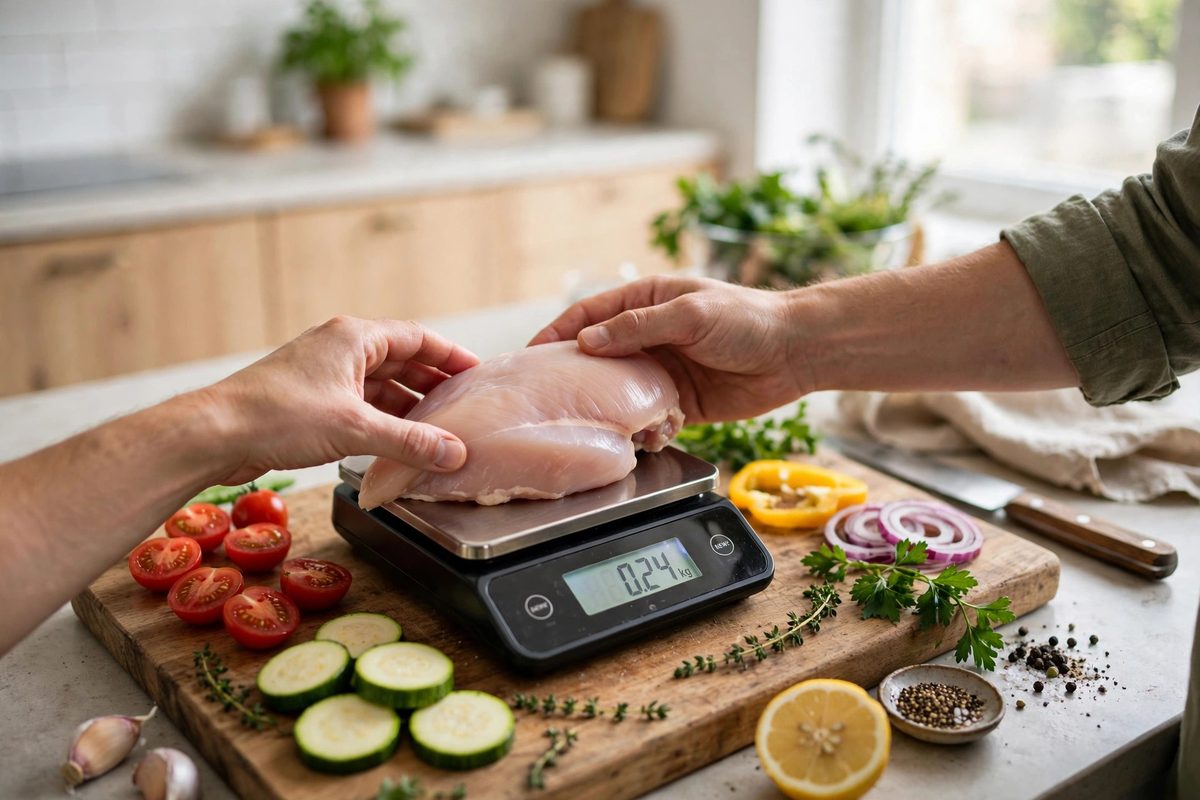
Example 1 — The classic fitness plate. Grilled chicken breast, 1 serving (185) + brown rice, 1 cup (215) + broccoli, 1 cup (55) + olive oil, 1 tablespoon (119) = 574 calories. Against a 2,000-calorie day that is 574 ÷ 2,000 = 28.7% of the day. Notice the oil: it is the second-biggest item on the plate, and it is the one most people forget to count.
Example 2 — A lighter salmon plate. Salmon fillet, 1 serving (233) + sweet potato, 1 medium (112) + avocado, half (60) = 405 calories. Against a 2,000-calorie day that is 405 ÷ 2,000 = 20.3% of the day. The half avocado is 0.5 × 120 = 60 calories — servings can be fractions, and the calculator accepts quarters.
Example 3 — A quick breakfast plate. Eggs, 2 large (2 × 72 = 144) + whole wheat bread, 2 slices (2 × 81 = 162) + banana, 1 medium (105) = 411 calories. Against a 2,000-calorie day that is 411 ÷ 2,000 = 20.5% of the day. Three foods, one addition, and the same number an app would show — the difference is that you can see every line.
Use the total to build the rest of the day around it. If your plate is 574 calories and your target is 2,000, you have 1,426 left for the other meals and snacks — roughly two 550-calorie meals and a 300-calorie snack. A simple plate rule keeps the totals sensible without weighing everything forever: half the plate vegetables, a palm-sized protein, a fist-sized carbohydrate, and a thumb-sized fat. That pattern lands most plates between 400 and 700 calories, which fits a 2,000-calorie day in three meals plus a snack. If your total is over 800 for one meal, look first at the fats and the carbohydrate serving — one extra tablespoon of oil is 119 calories and a second cup of rice is 215, and together they are most of the excess. For a full day, pair this tool with our calorie calculator to set your target, our macro calculator to split it into protein, carbs, and fat, and our protein calculator to check the protein side of the plate. And if you cook for the family, the recipe version of this math — total the pot, divide by servings — is in our guide to counting calories in a home-cooked meal.
Written by the Live Fitness Check editorial team · Reviewed against our calculator methodology · Last updated November 2026
Disclaimer: This calculator is for general information only and is not medical advice. Food values are standard USDA-based averages and vary by brand, cut, and preparation. Talk to your doctor or a registered dietitian before starting a weight-loss or restricted diet, especially if you are pregnant, take medication, or have diabetes, heart disease, or a history of disordered eating.