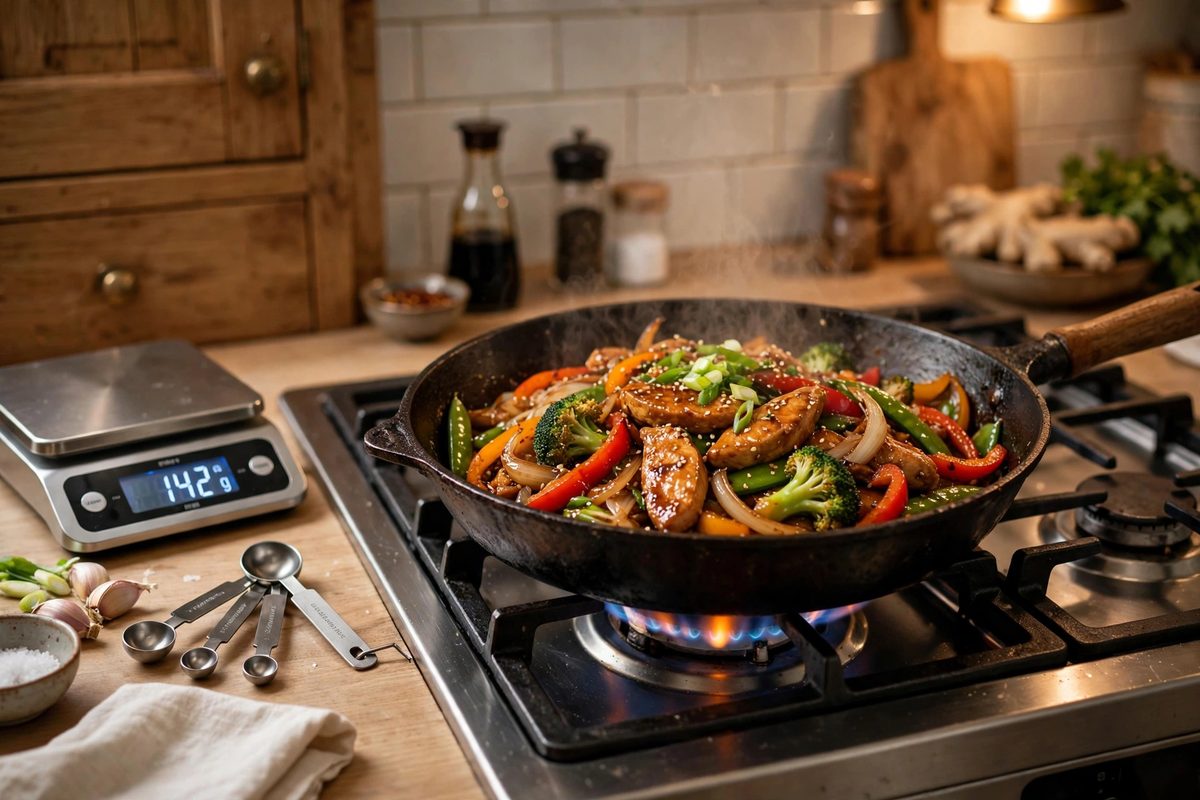
Counting calories in a home-cooked meal takes three steps: weigh the ingredients, add up the recipe, divide by servings. No app can do it for you, because no app knows how much oil went in your pan or how big your chicken breast was — but the math itself is simple, and one worked example teaches it for good. A chicken stir-fry pot for two totals about 1,300 calories, or 650 per serving, and this guide shows every line of that total. If you want to total a single plate instead of a whole recipe, our build-a-meal calculator adds up the foods on your plate in seconds.
Weigh each ingredient before it goes in the pan, look up its calories (USDA FoodData Central is the reference), add everything together, then divide by the number of servings the pot makes. The oil, butter, and sauces are the ingredients people skip — and they are usually the biggest calories in the recipe. A food scale costs about $15 and is the single most useful weight-loss tool most people will ever buy.
Total My PlateGuessing is the enemy, and the research on it is blunt: people underestimate what they eat by 20 to 50%, and the error is biggest for the foods they like most. A food scale fixes it. Weigh the meat raw, the rice dry or the pasta dry, the vegetables as they go in, and — most importantly — the oil and butter. A tablespoon of olive oil is 119 calories, and a "splash" from the bottle is often two tablespoons, or 238 calories, before the food even starts cooking. Weighing takes about two extra minutes per meal and removes the single largest source of error in home cooking. Two rules make it work: weigh raw when the value you use is raw (meat loses about a quarter of its weight as water when cooked, so 4 oz raw becomes about 3 oz cooked), and weigh dry when the value is dry (rice triples in weight when cooked, so a cup of cooked rice is a very different number from a cup of dry rice). If a recipe says "one onion" or "two carrots," weigh them anyway — onions range from about 30 to 60 calories depending on size, and "medium" is doing a lot of work in that sentence.
The reference for ingredient calories is the USDA's FoodData Central, the database behind most food labels and tracking apps — search it free at USDA FoodData Central. Use the generic entries ("chicken breast, raw") rather than brand entries when you can, and match the state: raw chicken breast is about 120 calories per 100 g, cooked is about 165 per 100 g, because cooking drives off water and concentrates the calories per gram. The values below are the ones this guide uses, all per standard amounts, and they are the same values in our build-a-meal calculator: chicken breast 4 oz cooked 185, brown rice 1 cup cooked 215, white rice 1 cup cooked 205, olive oil 1 tablespoon 119, broccoli 1 cup 55, soy sauce 1 tablespoon about 9. For packaged foods, the label wins over the database — a label is a legal claim about that exact product, while the database is an average. And for sauces and dressings, check the label twice: a "tablespoon" of ranch is 140 calories, and a ladle of it is three tablespoons.
| Ingredient (amount used) | Calories |
|---|---|
| Chicken breast, 1 lb raw (16 oz) | 544 |
| White rice, 2 cups cooked | 410 |
| Olive oil, 2 tablespoons | 238 |
| Mixed vegetables, 3 cups | 90 |
| Soy sauce, 2 tablespoons | 18 |
| Pot total | 1,300 |
| Per serving (2 servings) | 650 |
Here is the whole method on one recipe: a chicken stir-fry for two. The pot holds 1 lb of raw chicken breast (16 oz × about 34 calories per oz raw = 544 calories), 2 cups of cooked white rice (2 × 205 = 410), 2 tablespoons of olive oil (2 × 119 = 238), 3 cups of mixed vegetables like broccoli, peppers, and snap peas (about 30 calories a cup = 90), and 2 tablespoons of soy sauce (2 × 9 = 18). Add them: 544 + 410 + 238 + 90 + 18 = 1,300 calories for the pot. Divide by 2 servings: 650 calories per serving. Two details matter. First, the oil is the second-biggest line in the pot — more than the rice — which is why "I barely used any oil" is the most expensive sentence in home cooking. Second, the serving count is a decision, not a fact: if the pot actually feeds three, each serving is 1,300 ÷ 3 = 433 calories, so weigh the pot after cooking and divide by the weight of your portion if the servings are uneven. The same method works for soups, casseroles, and curries — total the pot, divide by what you eat — and for a single plate, our build-a-meal calculator does the same addition from a list of sixteen everyday foods.
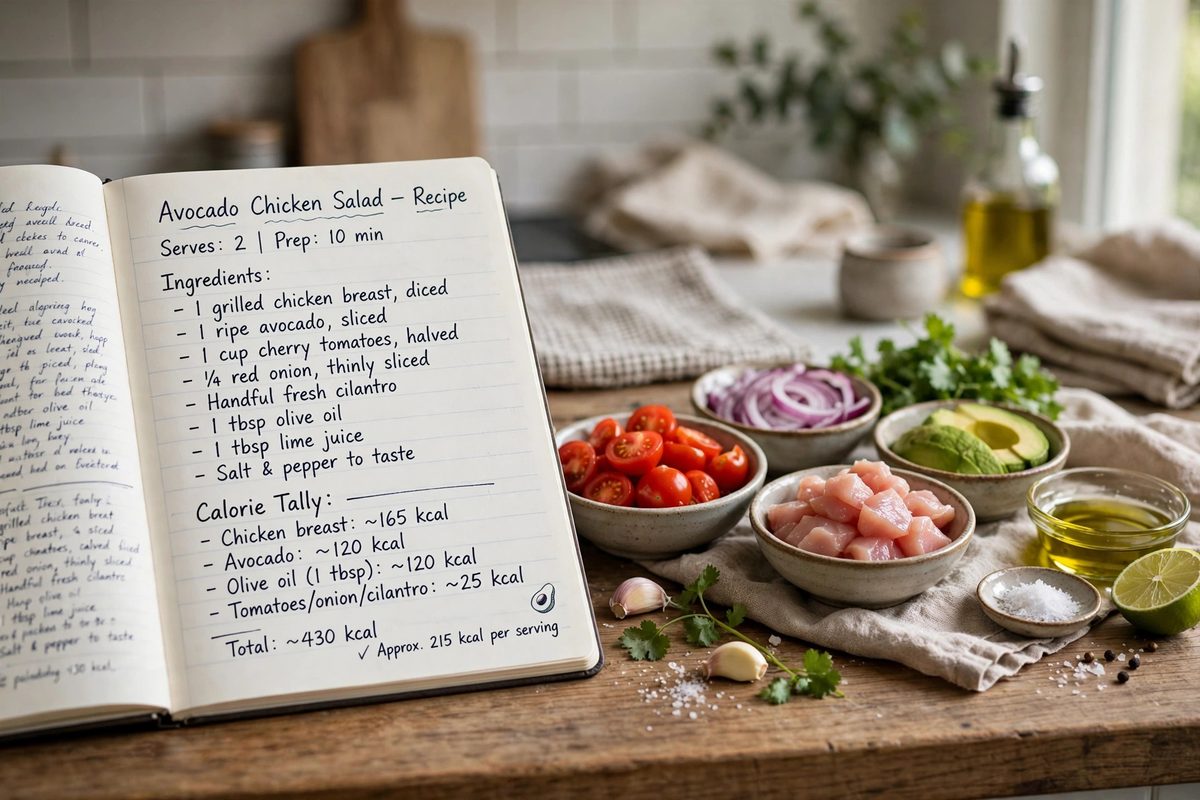
Five traps account for almost all the error in home-cooked calorie counts. Oil and butter come first: a tablespoon is 119 calories, and most home cooks pour one to three tablespoons without measuring. Sauces and dressings come second: ranch, mayonnaise, and sweet chili sauce run 90 to 140 calories a tablespoon, and a salad dressing can add 300 calories to a 200-calorie salad. Tasting while cooking is third: a spoonful here and a piece there easily adds 100 to 200 calories that never reach the plate. Second helpings are fourth: the pot total is fixed, so a second serving is not free — it is the same per-serving number again. And drinks are fifth: a glass of wine is about 125 calories and a soda is 140, and neither appears in the recipe at all. The fix for all five is the same: measure the oil, count the sauce, plate the portion, and log the drink. None of it needs an app — it needs a scale, a measuring spoon, and ten seconds of honesty.
Counting every meal forever is a chore, and it is not the goal. The goal is to calibrate your eye. After two to four weeks of weighing, most people can estimate a plate within 10 to 15% — and that is precise enough for weight management, because the error is small next to the oil and sauces that actually move the total. From there, switch to maintenance habits: the plate rule (half vegetables, a palm of protein, a fist of carbohydrate, a thumb of fat), the same breakfast most days, and a weekly weigh-in to catch drift. Come back to the scale whenever your weight moves in a direction you did not intend, or when a new recipe enters the rotation — one careful count of a new dish gives you its number for good. If counting ever feels compulsive or distressing, stop and talk to your doctor or a registered dietitian: the tool is meant to serve you, not to run your life. For the daily target behind all of this, our calorie calculator sets your number, and our macro calculator splits it into protein, carbs, and fat.
Our build-a-meal calculator adds up the foods on your plate — chicken, rice, salmon, avocado, and more — and shows the share of your daily target.
Total My PlateWritten by the Live Fitness Check editorial team · Reviewed against our calculator methodology · Last updated November 2026
Disclaimer: This guide is for general information only and is not medical advice. Food values are standard USDA-based averages and vary by brand, cut, and preparation. Talk to your doctor or a registered dietitian before starting a weight-loss or restricted diet, especially if you are pregnant, take medication, or have diabetes, heart disease, or a history of disordered eating.