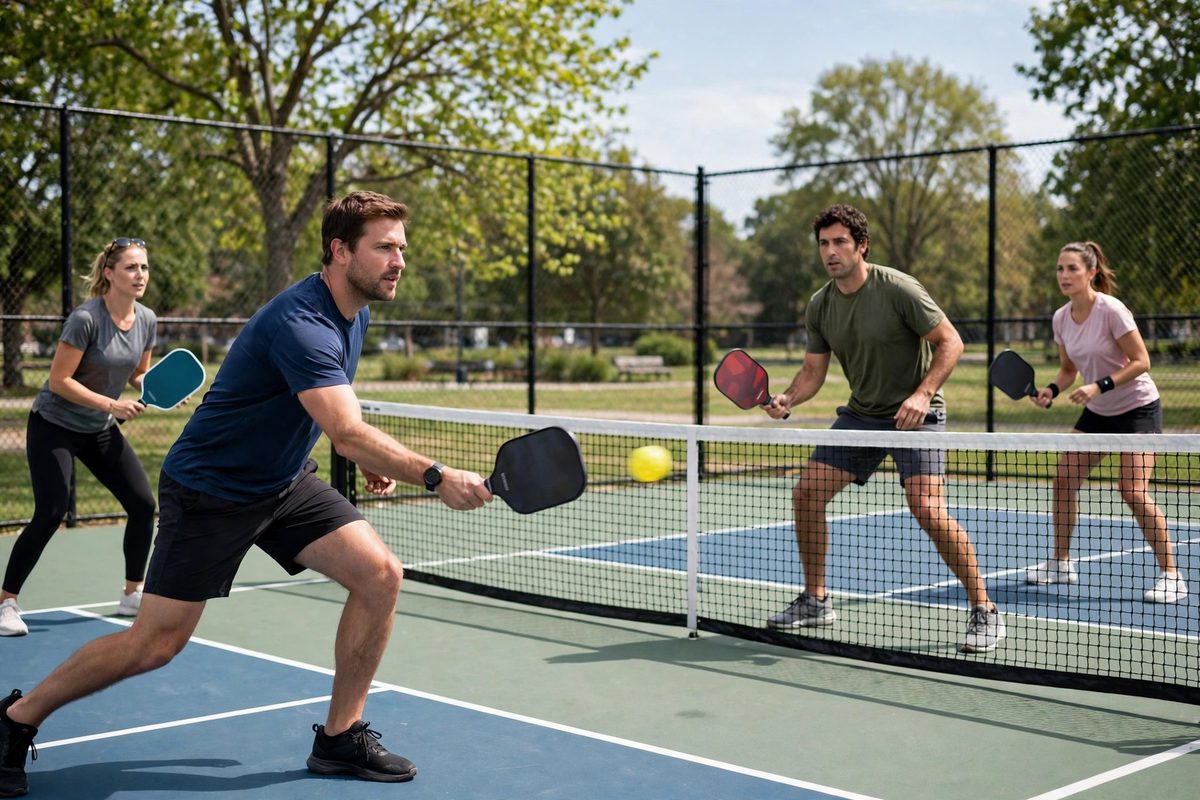
Here is the short answer: pickleball burns roughly 265 to 750 calories per hour — and the format is the whole story. Social doubles at a relaxed pace burns about 325 calories per hour for a 160 lb player. Competitive singles burns nearly double that, about 545–650. The court is small, the rallies are short, and how hard you play matters more than how long you play. In this guide you will see the singles-versus-doubles chart, the MET math behind every number, why doubles burns less, and how pickleball fits a weight-loss plan — or calculate your own burn with our calories-burned calculator.
Pickleball, running, swimming — estimate any session with our calories-burned calculator and see your daily target with the TDEE calculator.
Calculate My BurnPickleball intensity is measured in METs (metabolic equivalents): 1 MET is your resting burn, and the formula is calories = MET × body weight in kg × hours played. The four intensity levels below come from the Compendium of Physical Activities' racquet-sport values, adapted to pickleball's smaller court and shorter rallies.
| Format (60 min) | METs | 130 lb (59 kg) | 160 lb (73 kg) | 190 lb (86 kg) | 220 lb (100 kg) |
|---|---|---|---|---|---|
| Casual social doubles | 4.5 | ~265 | ~327 | ~388 | ~449 |
| Moderate doubles (competitive rallies) | 5.5 | ~324 | ~399 | ~474 | ~549 |
| Vigorous doubles / casual singles | 6.5 | ~383 | ~472 | ~560 | ~649 |
| Competitive singles | 7.5 | ~442 | ~544 | ~646 | ~748 |
Worked example, so you can check the math: a 160 lb (72.6 kg) player in a moderate doubles game (5.5 METs) for one hour burns 5.5 × 72.6 × 1 = 399 calories. The same player in competitive singles (7.5 METs) burns 7.5 × 72.6 × 1 = 544 calories — 36% more for the same hour, because singles means covering the whole court yourself.
Doubles pickleball burns less for three mechanical reasons. First, you share the court: with a partner covering half the ground, you move roughly half the distance per rally. Second, you rest between points: in doubles, half the rallies end without you touching the ball, and those seconds of standing still add up over an hour. Third, the court is small: a pickleball court is 20 × 44 ft, about a quarter the area of a tennis court, so even singles involves shorter sprints than tennis.
None of this makes doubles a bad workout. A 160 lb player in social doubles still burns ~327 calories per hour — comparable to a brisk walk, and far more than sitting. And doubles has the advantage that actually matters for weight loss: people keep playing it. The social format is why pickleball became America's fastest-growing sport, with millions of new players in the US in recent years. Three social doubles sessions a week at ~327 calories each is ~980 calories a week — nearly 1,000 calories of activity you actually enjoy, which beats 1,500 calories of exercise you quit after two weeks. For the low-impact complement to pickleball, see our swimming guide — and if you want to know your heart-rate zones during play, our heart-rate-zones calculator sets them.
Most recreational sessions run 90 minutes to 2 hours, often with breaks between games. The table below shows what that actually adds up to for a 160 lb player:
| Session (160 lb player) | Approx. calories | Notes |
|---|---|---|
| 60 min social doubles | ~327 | The standard evening session |
| 90 min social doubles (with breaks) | ~460 | Breaks between games lower the hourly average |
| 2 hours social doubles | ~653 | Two hours of play, not two hours of continuous movement |
| 60 min competitive singles | ~544 | Continuous court coverage, minimal rest |
| 90 min competitive singles | ~816 | Serious session — hydrate and eat afterward |
The break caveat matters: a "2-hour session" with 20 minutes of sitting between games is really ~100 minutes of play. Wearables tend to overcount pickleball for the same reason they undercount Pilates — wrist movement from paddle swings inflates the estimate, while the stop-start pattern confuses heart-rate algorithms. The MET table above is more reliable than a watch for this sport.
Pickleball alone will not drive major weight loss — and any article claiming otherwise is selling paddles. Three moderate doubles sessions a week burn roughly 1,200 calories a week, which is about a third of a pound of fat per week before any diet changes. That is real, but slow. Where pickleball genuinely helps weight loss is as the activity you do not quit: it builds the exercise habit, preserves muscle and mobility (especially for players over 50, who make up much of the sport's growth), and pairs naturally with the two things that actually drive weight loss — a calorie deficit and enough protein.
The practical stack: play 3–4 times a week, set your daily target with our TDEE calculator, eat to a modest deficit using our calorie-deficit calculator, and hit your protein target with our protein calculator. Pickleball is the fun part of that plan, not the whole plan — and that is exactly why it works.
Our calories-burned calculator estimates any session in seconds.
Calculate My SessionWritten by the Live Fitness Check editorial team · Reviewed against our calculator methodology · Last updated October 2026
Disclaimer: This guide is for educational purposes only and is not medical advice. Calorie figures are estimates based on MET values; actual burn varies with effort, fitness, and playing style. If you are new to exercise, start gradually and talk to your doctor.