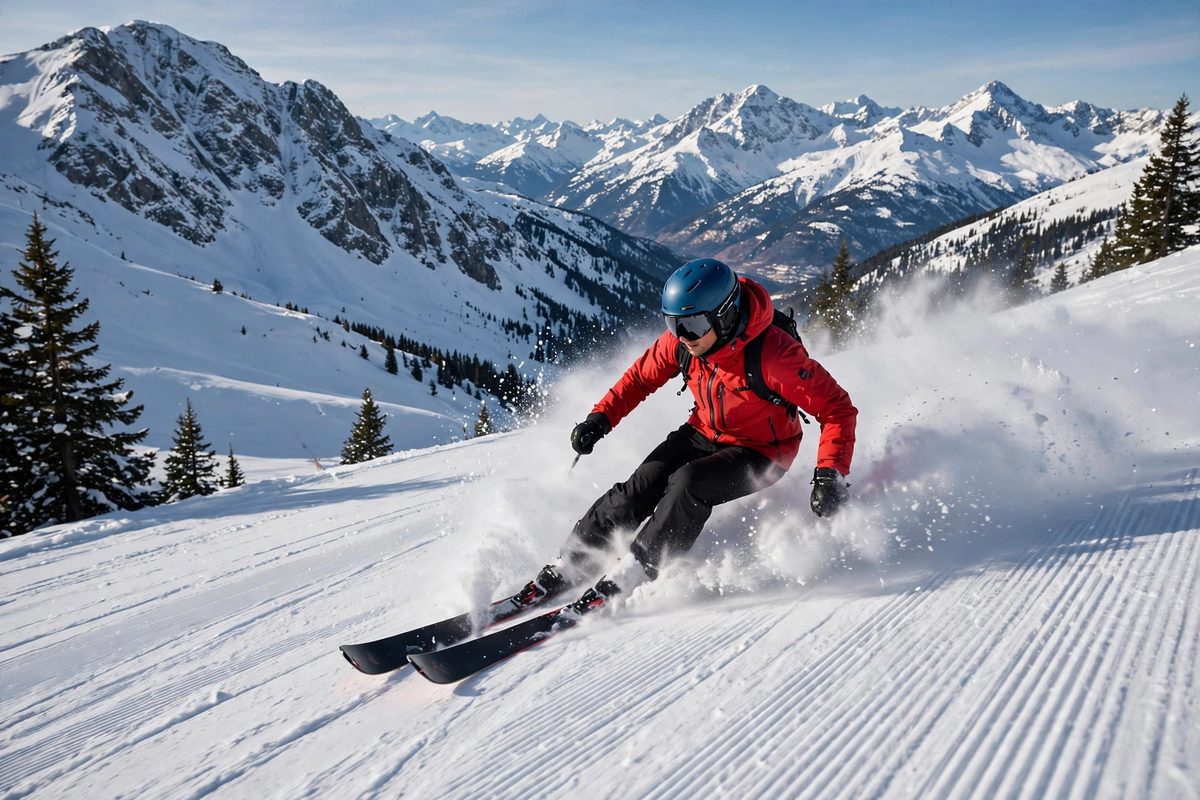
Downhill skiing burns roughly 457 calories per hour of active skiing and cross-country skate skiing burns roughly 943 calories per hour for a 160 lb (72.6 kg) skier — but the honest number for a resort day is far lower than the hourly rate suggests, because much of a ski day is spent on lifts, in lift lines, and at lunch. In this guide you will see the downhill-versus-cross-country chart, the full-day math for an 8-hour resort day, and why cross-country skiing is one of the highest-burn exercises that exists — or check any session with our calories-burned calculator.
A 160 lb skier burns about 312 calories an hour on light downhill runs (4.3 METs), 457 on moderate downhill (6.3 METs), 581 on vigorous downhill (8.0 METs), 617 on moderate classic cross-country (8.5 METs), 820 on vigorous classic (11.3 METs), and 943 on vigorous skate skiing (13.0 METs). A full 8-hour resort day with 4 hours of actual skiing burns about 1,830 calories from skiing. Try your own numbers in our calories-burned calculator or TDEE calculator.
Calculate My Ski DaySkiing intensity is measured in METs (metabolic equivalents): 1 MET is your resting burn, and the formula is calories = MET × body weight in kg × hours of active skiing. The values below use the Compendium of Physical Activities: downhill light 4.3, moderate 6.3, vigorous 8.0; cross-country classic moderate 8.5, vigorous 11.3; cross-country skate vigorous 13.0. Every cell is computed from that formula with weight converted as pounds × 0.4536, then rounded to the nearest whole calorie. Crucially, these are per hour of skiing, not per hour at the resort.
| Skiing type (60 min active) | METs | 130 lb (59.0 kg) | 160 lb (72.6 kg) | 190 lb (86.2 kg) | 220 lb (99.8 kg) |
|---|---|---|---|---|---|
| Downhill, light (gentle groomers) | 4.3 | ~254 | ~312 | ~371 | ~429 |
| Downhill, moderate | 6.3 | ~371 | ~457 | ~543 | ~629 |
| Downhill, vigorous (steeps, moguls) | 8.0 | ~472 | ~581 | ~689 | ~798 |
| Cross-country classic, moderate | 8.5 | ~501 | ~617 | ~733 | ~848 |
| Cross-country classic, vigorous | 11.3 | ~666 | ~820 | ~974 | ~1,128 |
| Cross-country skate, vigorous | 13.0 | ~767 | ~943 | ~1,120 | ~1,297 |
Worked example, so you can check the math: a 160 lb (72.6 kg) skier on moderate downhill runs (6.3 METs) for one active hour burns 6.3 × 72.6 × 1 = 457 calories. The same skier skate skiing vigorously (13.0 METs) for one hour burns 13.0 × 72.6 × 1 = 943 calories — more than double, because cross-country skiing drives with both arms and legs continuously, with no lift doing the climbing for you.
Most ski-day calorie claims quietly multiply the hourly rate by the whole day, and that is where the fantasy creeps in. A typical resort day runs about 8 hours from first lift to last, but a recreational skier actually skis for roughly half of it. The rest is chairlifts, lift lines, traversing to lifts, lunch, and bathroom breaks. Chairlift riding itself burns barely above resting — you are sitting, albeit in the cold, in ski boots. So the honest math for a 160 lb skier on moderate downhill runs is 4 active hours × 457 = 1,830 calories from skiing, not 8 × 457 = 3,656. That is still a big day — roughly half a pound of fat worth of activity before food — but it is not the 3,500-plus figure that resort marketing implies. Skiers who track with a watch often see inflated totals for the same reason: wrist movement and altitude changes confuse the algorithms, and few watches subtract lift time.
Cold adds a small real bonus that is often overstated. Shivering and cold exposure do raise energy expenditure, but for a well-dressed skier working hard, the effect is modest — perhaps tens of calories an hour, not hundreds. The far bigger cold effect is behavioral: cold skiers take longer lodge breaks and drink more hot chocolate, which can quietly return several hundred calories. Enjoy the lodge, by all means — just do not count it as part of the workout. For winter cardio you can do at home between trips, see our jump rope guide and hiking guide.
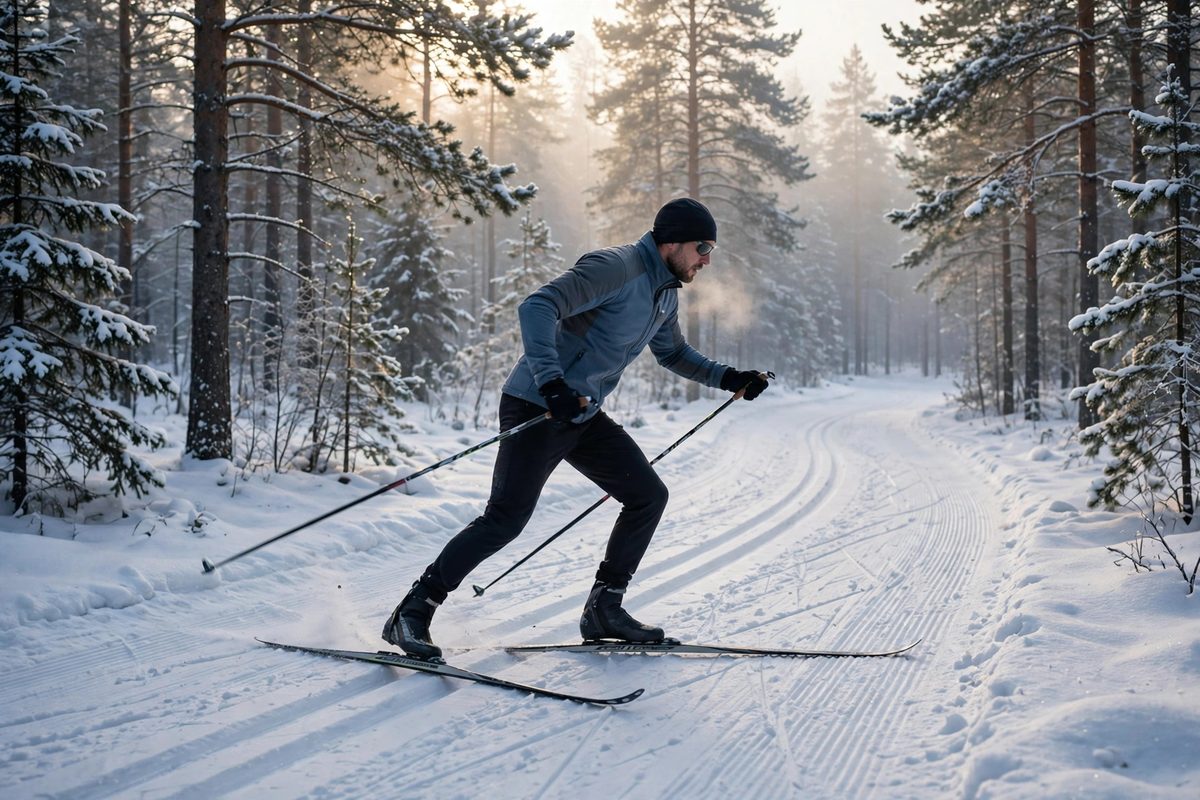
Cross-country skiing is, by the numbers, one of the most energy-hungry exercises a human can do, and the reason is mechanical. Downhill skiing is mostly eccentric leg work punctuated by lift rides: gravity pulls you down, and your legs brake and steer. Cross-country skiing is continuous propulsion: every stride drives with the legs and poles with the arms, the whole body works without rest, and there is no lift. At 13.0 METs, vigorous skate skiing sits above running at 7 mph and rivals competitive rowing. That is also why cross-country skiers famously eat enormous amounts during training season — a two-hour vigorous skate session for a 160 lb skier burns about 1,886 calories (943 × 2), which is close to a full day's resting burn for many people. Beginners should not start at that intensity: classic technique on flat groomed trails at a moderate pace (617 calories an hour at 160 lb) is already a serious workout, and learning the diagonal stride properly prevents the exhausting herringbone shuffle that ruins many first outings.
Skiing will not carry a weight-loss plan on its own for most people, simply because most people ski a handful of days a winter. A week-long ski trip with 4 active hours a day at moderate downhill pace burns about 1,830 calories a day from skiing — over 6 days, roughly 10,980 calories, or about 3 lb of fat equivalent before food. But ski trips also come with big lodge meals, beer, and hot chocolate, and many skiers eat back the entire deficit by dinner. The skiers who actually lose weight over winter are the ones who treat skiing as the fun peak of a consistent routine: regular cardio through the week, checked with our TDEE calculator and heart-rate zones calculator, with ski days as a bonus rather than the plan. If you live near trails, cross-country skiing changes the equation entirely — two or three skate sessions a week through winter is a genuinely high-volume cardio habit, and it is far kinder on knees than winter running on icy pavements.
The calorie math means nothing if the day ends in the clinic, and skiing injuries cluster in predictable ways. Warm up with two easy groomer runs before tackling steeps or moguls; cold muscles and a first-run black diamond are a classic combination for knee injuries. Hydrate deliberately — cold suppresses thirst, altitude increases water loss, and many skiers drink far too little until the headache arrives. Eat lunch even if you are not hungry, because skiing on empty after a big morning burns through glycogen and wrecks afternoon technique, which is when falls happen. Wear a helmet every run, no exceptions, and check bindings before the trip rather than discovering a problem on the first lift. Finally, respect fatigue: the last run of the day, when legs are tired and light is flat, produces a disproportionate share of injuries. Quitting one run early costs you about 115 calories of moderate downhill skiing and may save you a season.
Our calories-burned calculator estimates any ski session in seconds.
Calculate My Ski DayWritten by the Live Fitness Check editorial team · Reviewed against our calculator methodology · Last updated October 2026
Disclaimer: This guide is for educational purposes only and is not medical advice. Calorie figures are estimates from the Compendium of Physical Activities; actual burn varies with terrain, technique, altitude, temperature, and fitness. Ski within your ability, wear a helmet, and talk to your doctor before vigorous exercise at altitude.