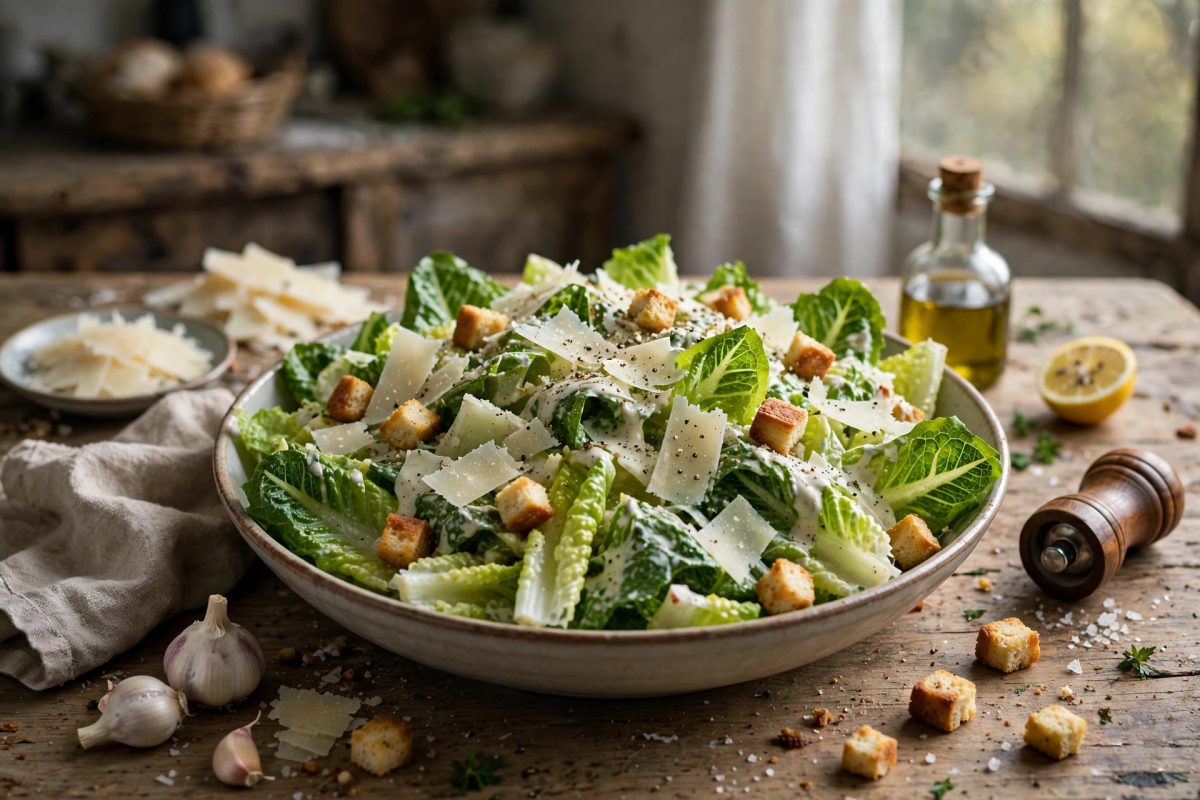
A classic Caesar salad is about 450 calories, a light-dressing version is about 300 calories, and adding grilled chicken brings the classic to about 550 calories. The surprise for most people is that the lettuce is almost irrelevant — romaine contributes only about 15 calories — while the dressing alone can cost more than the rest of the salad combined. Below you will see the dressing math, price the croutons and parmesan, compare classic, light, and chicken versions, and learn the dressing-on-the-side trick — or check where any salad fits your day with our calorie calculator.
A classic Caesar builds as romaine (about 15 calories) plus a quarter cup of full-fat Caesar dressing (about 300 calories) plus a half cup of croutons (about 65 calories) plus 2 tablespoons of parmesan (about 45 calories) — 425 calories by the components, about 450 calories in practice once dressing brands and generous pouring are counted. Swap the dressing for a light version and the total falls to about 300 calories. See how any version fits your target in our calorie deficit calculator or macro calculator.
Check My Daily TargetEvery total in this guide comes from the same simple addition: romaine plus dressing plus croutons plus parmesan, with chicken added on top. All figures are USDA FoodData Central-style approximations for typical US supermarket and restaurant products, not laboratory measurements of one specific brand, so treat them as planning numbers.
| Component (typical serving) | Calories | Notes |
|---|---|---|
| Romaine lettuce, 2 cups chopped | ~15 | The cheapest part of the salad by far |
| Caesar dressing, full-fat, 2 tbsp | ~150 | Brands range about 130–170 per 2 tbsp |
| Caesar dressing, full-fat, 1/4 cup | ~300 | The standard restaurant pour |
| Caesar dressing, light, 1/4 cup | ~150 | About half the calories of full-fat |
| Croutons, 1/2 cup | ~65 | About 30 calories per 1/4 cup |
| Parmesan, grated, 2 tbsp | ~45 | About 20 calories per tablespoon |
| Grilled chicken, 3 oz (85 g) | ~140 | Skinless breast, sliced over the salad |
Worked from the chart, the classic is 15 + 300 + 65 + 45 = 425 calories by the components, stated as about 450 calories to allow for dressing brands at the top of their range and the generous restaurant pour. The light version is 15 + 150 + 65 + 45 = 275 calories, stated as about 300 calories for the same reason — and because most light versions still include a drizzle of oil or a few extra croutons. The chicken version is the classic 425 plus 140 = 565 calories, stated as about 550 calories. In every case the method is the same: price the dressing first, because it decides the total.
Full-fat Caesar dressing is about 150 calories per 2 tablespoons, which makes it one of the most calorie-dense foods on any salad bar — denser per bite than the chicken many people add for protein. The jump from 2 tablespoons to a quarter cup (4 tablespoons) doubles the dressing cost from 150 to 300 calories, and restaurant salads routinely use a quarter cup or more because the dressing is tossed through the leaves rather than drizzled on top.
That is why dressing on the side is the single most effective Caesar trick. A side portion is typically 2 tablespoons (about 150 calories) instead of a quarter cup (about 300 calories), saving roughly 150 calories with no change to the salad itself — you still get the flavor in every bite by dipping your fork. Light Caesar dressings, at roughly 70 to 80 calories per 2 tablespoons, cut the cost roughly in half again: a quarter cup of light dressing is about 150 calories, the same as 2 tablespoons of full-fat. Yogurt-based Caesar dressings go further, around 45 calories per 2 tablespoons, but they taste tangier and thinner, so they work best mixed half-and-half with regular dressing.
Croutons and parmesan together cost about 110 calories in the classic build — 65 for a half cup of croutons and 45 for 2 tablespoons of parmesan — which is roughly a quarter of the whole salad. Neither part is worth cutting entirely, because both deliver the crunch and salty flavor that make a Caesar a Caesar, but both are easy to halve without noticing.
Halving the croutons to a quarter cup saves about 30 calories, and halving the parmesan to 1 tablespoon saves about 20 calories — 50 calories together, which is modest alone but meaningful combined with the dressing swap. The trap to avoid is the refill: croutons are the part of a Caesar most likely to be topped up at a salad bar or restaurant, and a second half cup adds another 65 calories silently. If you love croutons, measure them once at home and serve them in a small bowl rather than from the bag.
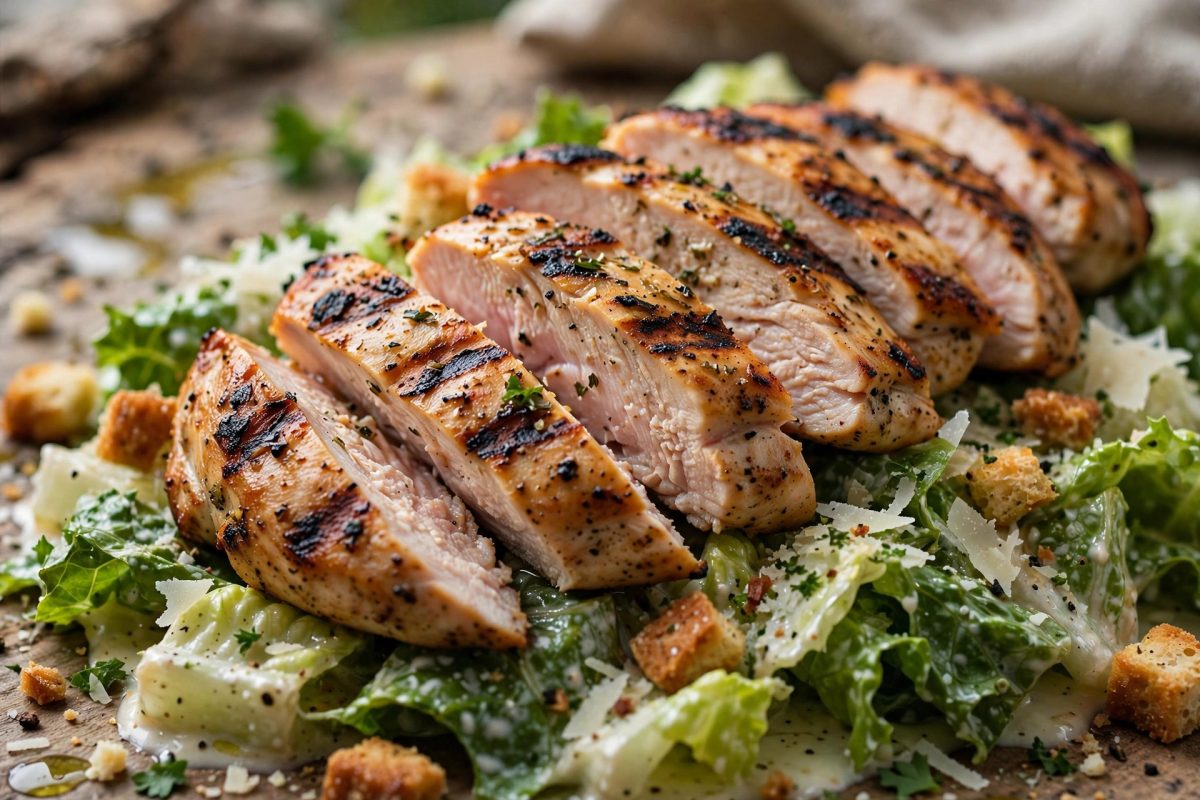
A classic Caesar is about 450 calories, a light Caesar is about 300 calories, and a chicken Caesar is about 550 calories — a spread of 250 calories between the lightest and heaviest versions of what most menus list as one dish. The table below shows exactly where each version's calories come from, so you can build the one that matches your goal.
| Version | Dressing | Croutons + parmesan | Total |
|---|---|---|---|
| Classic Caesar | Full-fat, 1/4 cup (~300) | ~110 | ~450 (15 + 300 + 65 + 45 = 425, rounded up for brand range) |
| Light Caesar | Light, 1/4 cup (~150) | ~110 | ~300 (15 + 150 + 65 + 45 = 275, rounded up) |
| Chicken Caesar | Full-fat, 1/4 cup (~300) | ~110 + chicken 3 oz (~140) | ~550 (425 + 140 = 565, rounded) |
| Light chicken Caesar | Light, 1/4 cup (~150) | ~110 + chicken 3 oz (~140) | ~415 (275 + 140 = 415) |
The light chicken Caesar deserves attention because it is the best of both worlds: at about 415 calories it has more protein than the classic Caesar (about 30 grams versus about 8 grams) for fewer calories, thanks to the dressing swap paying for the chicken. For anyone ordering a Caesar as a meal rather than a side, light dressing plus chicken is the build to remember. Restaurant chicken Caesars, which often use 4 to 6 oz (113 to 170 g) of chicken and extra dressing, can reach 700 to 900 calories — check the menu figure when one is published.
Restaurant Caesar salads commonly run 600 to 900 calories without chicken and 800 to 1,100 calories with chicken, far above the homemade classic at about 450 calories. The gap comes from three places: more dressing (often a third of a cup or more, about 450 calories alone), larger crouton portions, and chicken portions of 6 oz (170 g) instead of 3 oz (85 g). Add a bread basket and the meal can pass 1,200 calories while still feeling like "just a salad."
The homemade advantage is control. At home you measure the dressing, you choose the crouton portion, and you stop at 3 oz of chicken — and the salad still tastes like a Caesar. If you order out, ask for dressing on the side and use about 2 tablespoons: that one request typically saves 150 to 300 calories, more than any other change available at the table. For a closer look at another salad that surprises people, see how many calories are in a salad.
Our calorie deficit calculator shows where any salad fits your target.
Check My Daily TargetWritten by the Live Fitness Check editorial team · Reviewed against our calculator methodology · Last updated November 2026
Disclaimer: This guide is for educational purposes only and is not medical advice. Calorie figures are USDA-style approximations for typical products; actual values vary by brand, portion, and preparation. Talk to your doctor or a registered dietitian before making significant changes to your diet.
