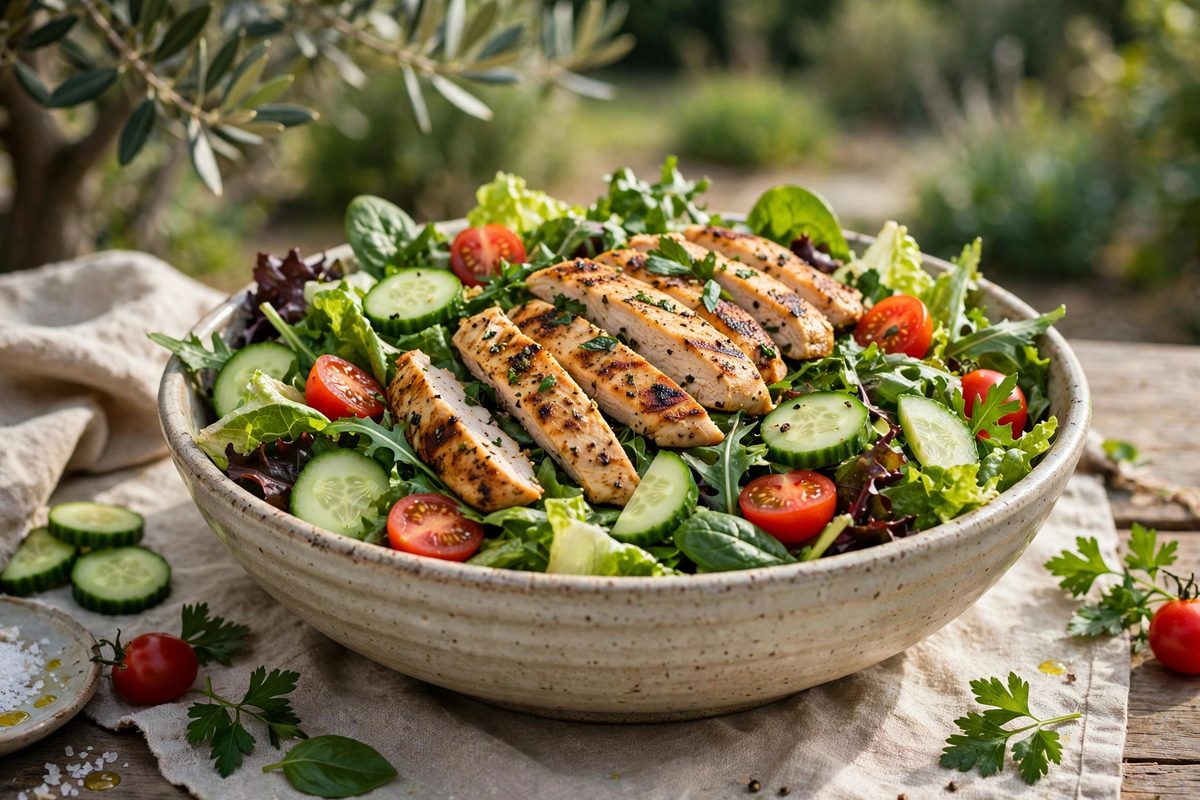
"How many calories in a salad?" has no single answer, because a salad is not a food — it is a construction project. A plain garden salad is roughly 100–150 calories, a Greek salad is roughly 250–350, a Caesar with chicken is roughly 450–700, and a Cobb is roughly 600–800. The greens at the bottom contribute almost nothing; the dressing poured on top often contributes the most. In this guide you will price every layer — greens, proteins, and dressings — so you can build the salad you actually want, at the calories you actually intend — or total any bowl with our calorie calculator.
Base greens run about 7–8 calories per cup (romaine about 8, spinach about 7), so even a huge 4-cup base is only about 30 calories. Proteins add 90–180 per serving, and dressings add 60–160 per 2 tablespoons — with restaurant pours often reaching 4–6 tablespoons, or 280–480 calories of dressing alone. Build deliberately with our calorie calculator or macro calculator.
Calculate My SaladStart with the good news, because it is genuinely good. Leafy greens are among the lowest-calorie foods that exist, and they are also among the most nutrient-dense per calorie. A generous base costs almost nothing, which means the base is never the problem — and also never the solution, since greens alone will not keep you full for long. The table below uses USDA figures per cup, loosely packed.
| Green (per cup) | Calories | Notes |
|---|---|---|
| Romaine lettuce | ~8 | The Caesar base; sturdy, crunchy, holds dressing well |
| Baby spinach | ~7 | Highest iron and folate per cup of the common greens |
| Iceberg lettuce | ~8 | Mostly water and crunch; least nutrient-dense, still fine |
| Spring mix | ~10 | A blend; slightly higher because of denser leaves |
| Kale, raw chopped | ~33 | Denser leaf, so a cup weighs more — still very low |
| Arugula | ~4 | Peppery; the lightest base of all, but wilts fast |
The practical consequence: a 4-cup base of romaine and spinach is about 30 calories, and you could double it to 8 cups — a genuinely enormous bowl — and still be under 65. Vegetables added on top stay in the same spirit: a cup of cucumber is about 16 calories, a cup of cherry tomatoes about 27, a cup of shredded carrots about 45, and a cup of bell pepper strips about 30. None of these will break a salad. What breaks salads comes next, and it is not the vegetables.
A salad without protein is a side dish that leaves you hungry in an hour, and hunger in an hour is how salads end with a vending-machine epilogue. Protein is the layer that turns greens into lunch, and the range is wide enough to choose deliberately. The table uses standard 3 oz (85 g) cooked portions unless noted.
| Protein (3 oz / 85 g unless noted) | Calories | Notes |
|---|---|---|
| Extra-firm tofu | ~90 | Lightest complete protein here; great with sesame dressing |
| Grilled chicken breast | ~140 | The default for a reason: lean, filling, predictable |
| Canned tuna in water, drained | ~180 | Higher than chicken; watch the mayonnaise it often travels with |
| Hard-boiled egg (1 large) | ~78 | Cheap, portable protein; two eggs = about 156 |
| Black beans (1/2 cup) | ~110 | Fiber plus protein; the most filling plant option per calorie |
| Grilled steak strips | ~180 | Cut and fat content move this up or down sharply |
| Grilled shrimp | ~85 | Very lean; a generous portion stays under 100 |
Notice what the protein ladder teaches: the difference between the lightest and heaviest common salad proteins is about 90 calories per serving — real, but small compared with the dressing ladder below, where a single choice can swing 100 calories per 2 tablespoons and restaurant portions multiply it. If you are optimizing a salad, optimize the dressing first and the protein second. For protein targets across the day, see our protein calculator, and for a fruit-and-protein comparison, our smoothie guide.
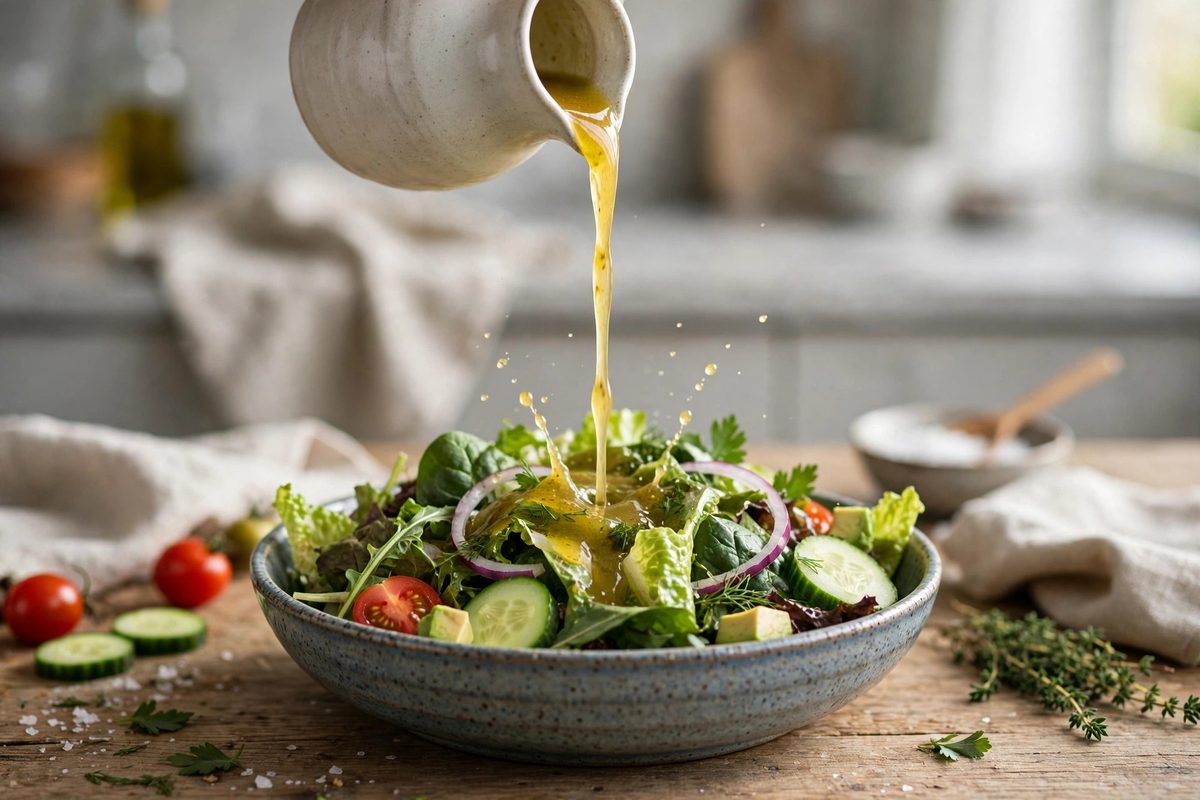
Dressing is where salads are won and lost, because dressing is mostly oil, and oil is 120 calories per tablespoon before anything else is added. The table prices a standard 2-tablespoon serving, which is what nutrition labels assume — and what almost nobody actually pours. Restaurant salads commonly arrive with 4 to 6 tablespoons of dressing, and a salad bar ladle can deliver even more.
| Dressing (per 2 tbsp) | Calories | At 4 tbsp (typical restaurant pour) |
|---|---|---|
| Balsamic vinaigrette | ~60–90 | ~120–180 |
| Italian vinaigrette | ~70–90 | ~140–180 |
| Ranch | ~140 | ~280 |
| Blue cheese | ~145 | ~290 |
| Caesar | ~160 | ~320 |
| Honey mustard | ~150 | ~300 |
| Fat-free vinaigrette | ~20–30 | ~40–60 |
Read that middle column against the greens table and the warning writes itself: 2 tablespoons of Caesar dressing (160 calories) outweighs twenty cups of romaine. At a restaurant pour of 4 tablespoons, Caesar dressing alone (320 calories) exceeds an entire garden salad twice over. Three defenses work reliably. First, ask for dressing on the side and dip your fork — most people use about half as much and taste it more. Second, choose vinaigrettes over creamy dressings when the goal is a lighter meal; the gap is 50–100 calories per serving before portions multiply it. Third, at home, measure 2 tablespoons once: it looks smaller than you expect, which is exactly why measuring matters. A salad whose dressing you measured is a salad whose calories you know.
Putting the layers together, here is what the famous salads actually cost. Ranges reflect the dressing portion and the cheese, crouton, and bacon extras that define each salad — the extras are small in weight and large in calories, which is the recurring theme of this article.
| Salad | Typical calories | What drives it |
|---|---|---|
| Garden salad (greens + vegetables, vinaigrette) | ~100–150 | Almost all dressing; the vegetables are negligible |
| Greek salad (feta, olives, vinaigrette) | ~250–350 | Feta (about 75 per oz) and olives (about 35 per 10) do the work |
| Caesar with chicken (romaine, Parmesan, croutons, Caesar dressing) | ~450–700 | Dressing plus croutons (about 60 per 1/2 cup) plus cheese |
| Cobb (chicken, bacon, egg, cheese, avocado, ranch) | ~600–800 | Everything at once: four calorie-dense toppings plus creamy dressing |
| Taco salad (beef, cheese, sour cream, tortilla bowl) | ~700–900 | The fried tortilla bowl alone can add 300–400 calories |
The Cobb deserves a moment, because it is the salad most likely to ambush a dieter. It sounds virtuous — it is, after all, a salad — but a standard Cobb stacks chicken (140), bacon (about 90 for 2 slices), a hard-boiled egg (78), cheddar (about 115 per oz), half an avocado (120–160), and ranch (140 per 2 tablespoons) over greens that contribute almost nothing. That is 683–723 calories before a restaurant's extra dressing pour, squarely in the 600–800 range, and roughly the same as a burger meal. It is also, to be fair, a genuinely nutritious and filling meal — protein, fiber, healthy fats, and vegetables in one bowl. The point is not to avoid the Cobb; it is to order it knowingly, perhaps with vinaigrette instead of ranch (saving about 50–80 calories per serving) and dressing on the side.
Build one: the light lunch, about 300 calories — 4 cups of romaine and spinach (about 30), a cup of mixed vegetables (about 45), 3 oz of grilled chicken (140), and 2 tablespoons of balsamic vinaigrette (about 75) = about 290 calories, rounded to a 300 target with a sprinkle of feta. Build two: the satisfying workday lunch, about 500 calories — the same base and vegetables (about 75), 3 oz of chicken (140), half an avocado (120), a tablespoon of pumpkin seeds (about 50), and 2 tablespoons of vinaigrette (75) = about 460 calories, landing near 500 with a whole-wheat roll. Build three: the hungry-day Cobb-style bowl, about 750 calories — greens and vegetables (75), chicken (140), an egg (78), an ounce of cheddar (115), half an avocado (120), 2 slices of bacon (90), and ranch on the side, dipped, not poured (about 70 for a tablespoon) = about 688 calories, near 750 with croutons. Same bowl shape, three different meals — and the difference is entirely in layers two and three, never in the greens. Check any build against your day with our TDEE calculator and fiber calculator.
Our calorie calculator totals any bowl in seconds.
Calculate My SaladWritten by the Live Fitness Check editorial team · Reviewed against our calculator methodology · Last updated October 2026
Disclaimer: This guide is for educational purposes only and is not medical advice. Calorie figures are USDA-based estimates; actual values vary by brand, portion, and preparation. If you follow a prescribed diet, talk to your doctor or dietitian.
