
A classic grilled cheese — two slices of white bread, 1 oz (28 g) of cheddar, and a tablespoon of butter — is about 375 calories. It is a simple build with only three parts, which means every swap you make shows up directly in the total: change the bread, the cheese, or the spread and you change the sandwich by a known amount. Below you will price each part, compare breads and cheeses, see why diner versions run much higher, and build a lighter version that still melts properly — or check where any sandwich fits your day with our calorie calculator.
Two slices of white bread (about 160 calories) plus 1 oz (28 g) of cheddar (about 115 calories) plus 1 tablespoon of butter (about 100 calories) totals 160 + 115 + 100 = 375 calories. No single part dominates, which means no single swap fixes everything — but it also means every swap helps. See how any version fits your target in our calorie deficit calculator or macro calculator.
Check My Daily TargetEvery total in this guide comes from the same simple addition: bread plus cheese plus spread, with extras added on top. All figures are USDA FoodData Central-style approximations for typical US supermarket products, not laboratory measurements of one specific brand, so treat them as planning numbers.
| Component (typical serving) | Calories | Notes |
|---|---|---|
| White bread, 2 slices | ~160 | About 80 per slice |
| Cheddar cheese, 1 oz (28 g) | ~115 | One standard slice or a small handful shredded |
| Butter, 1 tbsp | ~100 | Split across both outer faces of the bread |
| Tomato slices (2) | ~10 | The cheapest upgrade in this guide |
| Bacon, 2 slices | ~90 | Cooked crisp, drained |
| Ham, 2 slices | ~70 | Deli ham, standard thickness |
Worked from the chart, the classic is 160 + 115 + 100 = 375 calories. Add tomato and the sandwich becomes 385 calories while tasting noticeably fresher. Add bacon and it becomes 465 calories, and add both bacon and tomato and it reaches 475 calories — still an ordinary lunch, but no longer a light one. The method never changes: price the bread, the cheese, the spread, and the extras, and you will land close to the true total for your exact build.
Switching bread changes the sandwich by 0 to 30 calories per sandwich, which is smaller than most people expect — bread choice matters more for fiber and fullness than for calories. Whole wheat brings roughly 3 to 4 grams of fiber per sandwich versus about 1 gram for white bread, which is a real nutritional upgrade even though the calorie saving is only about 10 calories.
| Bread, 2 slices | Calories | Classic sandwich total* |
|---|---|---|
| White bread | ~160 | ~375 (160 + 115 + 100) |
| Whole-wheat bread | ~170 | ~385 (170 + 115 + 100) |
| Sourdough bread | ~190 | ~405 (190 + 115 + 100) |
| Texas toast (thick slices) | ~220 | ~435 (220 + 115 + 100) |
*Classic total uses 1 oz (28 g) of cheddar and 1 tablespoon of butter.
Sourdough's extra 30 calories come from thicker, denser slices, not from anything mysterious about fermentation — and sourdough's tang pairs so well with sharp cheddar that many cooks consider it worth the cost. Texas toast is the one to watch: its thick slices add about 60 calories over white bread before you touch the cheese or butter, and diner versions often use it. For a lighter sandwich, whole wheat is the honest pick — similar calories to white, much more fiber, and a sturdier crumb that holds melted cheese well.
Swapping cheese changes the sandwich by up to 30 calories per ounce, and the differences are bigger than the bread differences. Part-skim mozzarella is the lightest common choice at about 85 calories per ounce, while cheddar, Swiss, American, and pepper jack all cluster between 105 and 115 calories per ounce.
| Cheese, 1 oz (28 g) | Calories | Classic sandwich total* |
|---|---|---|
| Part-skim mozzarella | ~85 | ~345 (160 + 85 + 100) |
| Swiss | ~105 | ~365 (160 + 105 + 100) |
| American | ~110 | ~370 (160 + 110 + 100) |
| Cheddar | ~115 | ~375 (160 + 115 + 100) |
| Pepper jack | ~110 | ~370 (160 + 110 + 100) |
*Classic total uses white bread and 1 tablespoon of butter.
The portion warning matters more than the variety choice. Most home cooks use 2 oz (57 g) of cheese, not 1 oz — two slices or a generous handful — which doubles the cheese cost to about 230 calories for cheddar and pushes the classic sandwich from 375 to about 490 calories. If your grilled cheese always seems to run higher than guides suggest, the cheese portion is almost certainly why. Weighing an ounce once, seeing what it looks like, and cooking by eye from there is the single most useful habit in this guide.
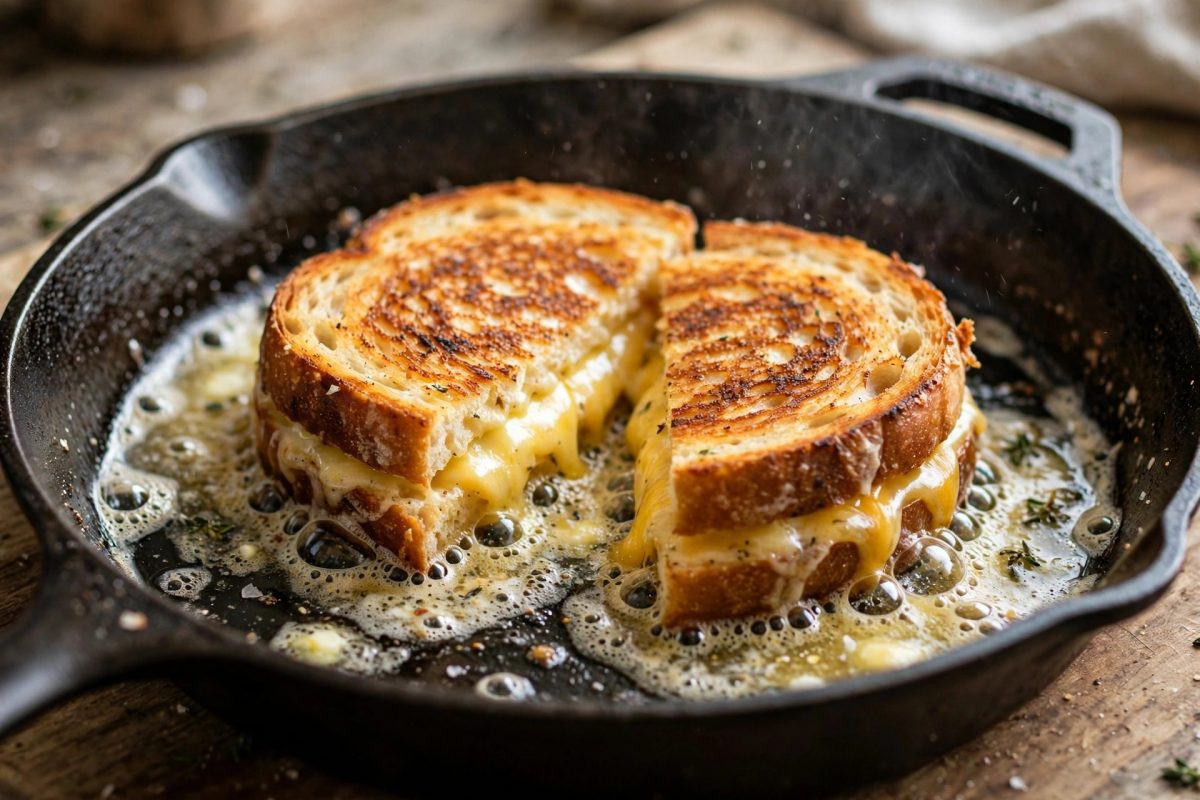
Butter and mayonnaise are nearly identical in calories — about 100 calories per tablespoon for butter and about 90 to 100 calories per tablespoon for mayonnaise — so the popular mayo-outside trick is a flavor and browning choice, not a calorie saving. Mayonnaise browns beautifully and evenly because its oil and egg proteins crisp well, and many cooks prefer its tang, but it will not make your sandwich lighter.
What does make it lighter is using less spread, or replacing it. Cooking spray in a good nonstick pan adds a negligible amount of calories and still produces a crisp crust, saving roughly 100 calories per sandwich versus a full tablespoon of butter. A thin smear — half a tablespoon, about 50 calories — is a reasonable middle ground that keeps most of the buttery flavor. Either way, the spread decision alone can move the classic sandwich from 375 calories down to about 275 calories with spray, or up to about 475 calories if you butter generously at 2 tablespoons.
A diner grilled cheese commonly runs 500 to 700 calories, roughly 125 to 325 calories above the homemade classic at 375 calories. Diners typically use thicker bread, 2 oz (57 g) of cheese instead of 1 oz, more butter on a flat-top grill, and often serve it with fries or chips that add 300 or more calories on the side.
| Version | Typical calories | Why |
|---|---|---|
| Homemade classic | ~375 | White bread, 1 oz cheddar, 1 tbsp butter |
| Homemade with tomato | ~385 | Adds 10 calories of tomato |
| Homemade double-cheese | ~490 | 2 oz cheddar instead of 1 oz |
| Diner, typical | ~500–700 | Thick bread, double cheese, extra butter |
That does not make diner grilled cheese off-limits; it makes the side dish the real decision. A diner sandwich with a side salad is a reasonable lunch, while the same sandwich with fries can pass 900 calories. If you want the full diner experience at home, use Texas toast and 2 oz of cheese deliberately — about 550 calories — and enjoy it as the main event rather than a snack. For a closer look at another comfort classic built the same way, see how many calories are in mac and cheese.
A lighter grilled cheese lands around 285 calories without giving up what makes it a grilled cheese: whole-wheat bread, part-skim mozzarella, tomato slices, and cooking spray instead of butter. The math is 170 (whole wheat) + 85 (mozzarella) + 10 (tomato) + 0 (spray, negligible) = 265 calories, or about 285 calories if you count a thin smear of butter at half a tablespoon for flavor.
That is 90 calories below the classic 375-calorie sandwich, and the sandwich is actually bigger and more filling thanks to the tomato and the extra fiber in whole wheat. Add a handful of spinach inside — about 5 calories — and a cup of tomato soup on the side (about 100 calories for a prepared cup), and you have a complete lunch around 385 calories that feels generous rather than restricted. Check the effect on your daily totals with our protein calculator.
Our calorie deficit calculator shows where any sandwich fits your target.
Check My Daily TargetWritten by the Live Fitness Check editorial team · Reviewed against our calculator methodology · Last updated November 2026
Disclaimer: This guide is for educational purposes only and is not medical advice. Calorie figures are USDA-style approximations for typical products; actual values vary by brand, portion, and preparation. Talk to your doctor or a registered dietitian before making significant changes to your diet.