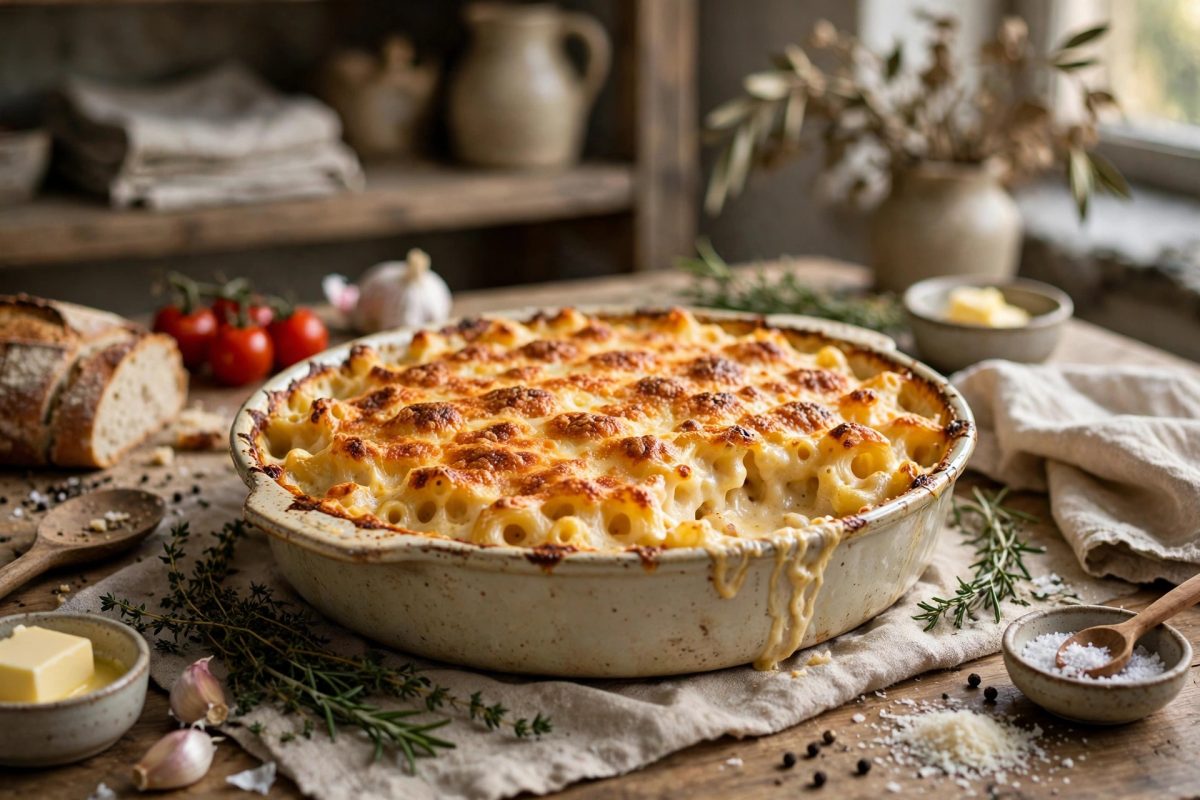
Boxed mac and cheese, prepared as directed, is about 400 calories per cup, while a rich homemade version is about 500 calories per cup — and a lightened homemade version can come in around 300 calories per cup. The gap between versions is wide because mac and cheese is mostly pasta, cheese, butter, and milk, and each of those can be dialed up or down. Below you will compare boxed and homemade, price the portion ladder, see what add-ins really cost, and build a lighter version that still tastes like mac and cheese — or check where any portion fits your day with our calorie calculator.
A measured cup of boxed mac and cheese is about 400 calories, a measured cup of homemade is about 500, and a measured cup of lightened homemade is about 300 — but most people serve themselves 1.5 to 2 cups, which turns those figures into 600 to 1,000 calories before any add-ins. Measure the first scoop once and you will never guess again. See how any portion fits your target in our calorie deficit calculator or macro calculator.
Check My Daily TargetHomemade mac and cheese costs about 100 calories more per cup than boxed because it uses real cheese, real butter, and real milk in generous amounts, while boxed versions use a thinner cheese sauce made with less fat. A typical boxed preparation (pasta plus cheese sauce powder plus 2 tablespoons of butter and a quarter cup of milk per box, divided into about 3 cups) lands near 400 calories per cup. A classic homemade bechamel version — elbow macaroni, a butter-flour roux, whole milk, and 8 oz (227 g) of cheddar for a 4-cup batch — lands near 500 calories per cup.
The USDA FoodData Central entries for prepared macaroni and cheese cluster in the same range, roughly 400 to 500 calories per cup depending on recipe, which is reassuring: the numbers in this guide are not outliers. Restaurant mac and cheese is a different animal again, often 800 to 1,000 calories per serving, because restaurants use heavy cream, extra cheese, and portions of 2 cups or more. Baked versions with a breadcrumb topping add roughly 40 calories per 2 tablespoons of buttered crumbs, which is small compared with the portion effect but worth knowing.
Doubling your portion doubles your calories exactly, which sounds obvious but is the single most useful fact in this guide because mac and cheese portions are so easy to underestimate. A heaping serving spoon holds roughly 1 cup, and most bowls comfortably hold 2 cups, so a "normal" serving at home is often 1.5 cups without anyone noticing.
| Portion (prepared) | Boxed (~400/cup) | Homemade (~500/cup) | Lightened (~300/cup) |
|---|---|---|---|
| 1/2 cup | ~200 | ~250 | ~150 |
| 1 cup | ~400 | ~500 | ~300 |
| 1 1/2 cups | ~600 | ~750 | ~450 |
| 2 cups | ~800 | ~1,000 | ~600 |
Worked from the ladder, a 1.5-cup serving of homemade mac and cheese is 1.5 times 500 = 750 calories, and a 2-cup serving is 1,000 calories — half of many people's entire daily budget in one side dish. The same 1.5-cup serving of the lightened version is 450 calories, a saving of 300 calories for the same volume of food. If you love mac and cheese, the portion ladder is your best friend: a measured cup plus a big salad beats an unmeasured bowl plus guilt every time.
Add-ins change mac and cheese by 15 to 140 calories per serving, and the best ones add bulk or protein rather than just fat. Broccoli is the star: a half cup of steamed broccoli florets adds only about 15 calories while making the portion visibly bigger and adding fiber and vitamin C. Chicken adds real protein at a moderate cost, while bacon adds mostly fat and salt.
| Add-in (per 1-cup serving) | Calories added | Homemade cup total |
|---|---|---|
| Broccoli, 1/2 cup | ~15 | ~515 (500 + 15) |
| Buttered breadcrumbs, 2 tbsp | ~40 | ~540 (500 + 40) |
| Bacon, 2 slices crumbled | ~90 | ~590 (500 + 90) |
| Grilled chicken, 3 oz (85 g) | ~140 | ~640 (500 + 140) |
| Extra cheddar, 1 oz (28 g) | ~115 | ~615 (500 + 115) |
The practical lesson is to add volume before richness. Broccoli and cauliflower florets, diced tomatoes, and peas all stretch a cup of mac and cheese into a bigger, more satisfying meal for almost nothing, while extra cheese and bacon do the opposite — they make an already rich dish richer without making it more filling. A chicken-and-broccoli mac and cheese at 655 calories per cup (500 + 140 + 15) is a complete high-protein meal, whereas a bacon-and-extra-cheese version at 705 calories per cup (500 + 90 + 115) is mostly an indulgence. Both have their place; only one should be the weeknight default.
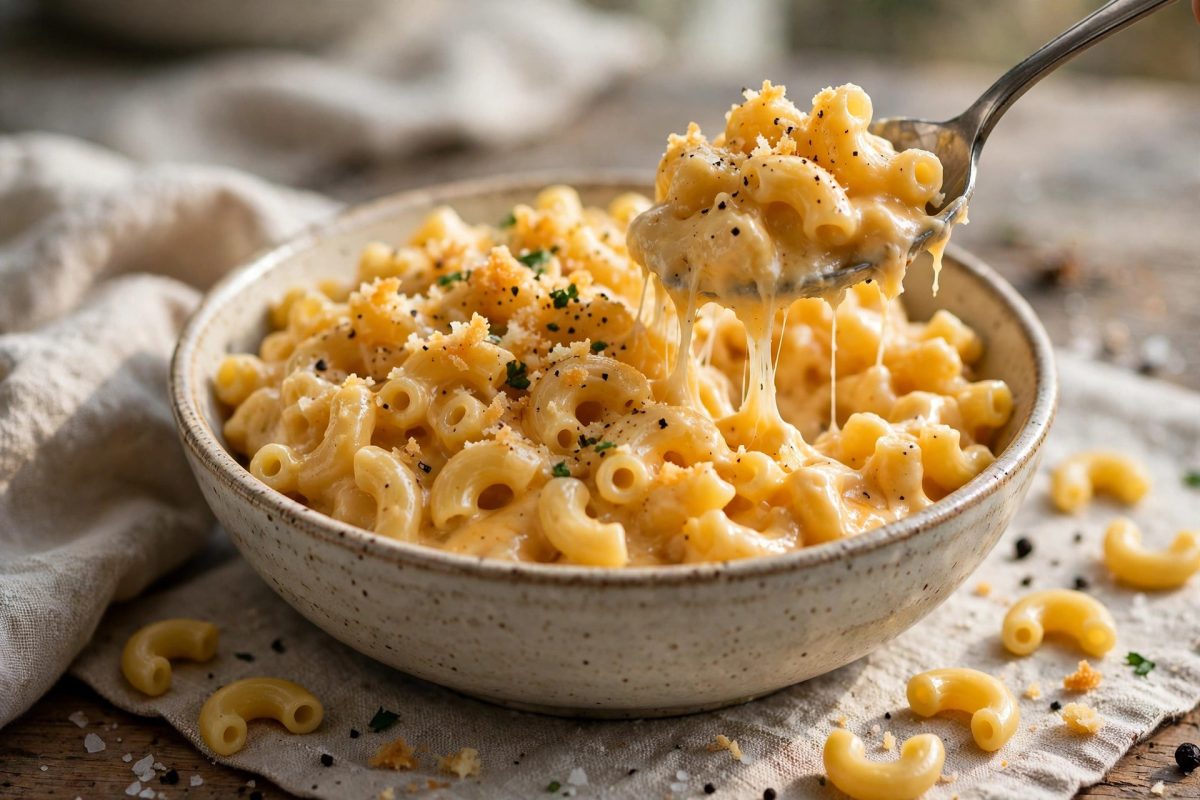
A lightened homemade mac and cheese lands around 300 calories per cup by changing three things: low-fat milk instead of whole milk, part-skim mozzarella and reduced-fat cheddar instead of full-fat cheddar, and pureed butternut squash or cauliflower blended into the sauce for body. The squash version is the surprise winner — it keeps the sauce thick and golden while replacing a meaningful share of the cheese and butter, and most tasters cannot identify it in a blind taste.
The math for a lightened batch is roughly 200 calories per cup saved versus classic homemade: about 60 calories from the milk swap, about 60 from the cheese swap, and about 80 from replacing part of the cheese sauce with pureed squash or cauliflower. Serve a measured cup of the lightened version with a side salad and you have a complete dinner around 450 calories, versus 750 calories for 1.5 cups of classic homemade with no salad. For a closer look at another cheese classic built the same way, see how many calories are in a grilled cheese sandwich.
How you prepare a boxed mix changes its calories by 50 to 100 calories per cup, because the butter and milk are the only variables you control. Preparing a box with the full 4 tablespoons of butter the box suggests, rather than 2 tablespoons, adds roughly 50 calories per cup across a 3-cup yield. Using water instead of milk saves only about 15 calories per cup but costs a lot of creaminess, while using 2% milk instead of whole milk saves about 10 calories per cup.
The honest boxed ranking is: prepared light (2 tablespoons butter, 2% milk) about 380 calories per cup; prepared as directed about 400 calories per cup; prepared rich (4 tablespoons butter, whole milk) about 450 calories per cup. None of these differences rivals the portion effect, but if you eat boxed mac and cheese weekly, the light preparation saves roughly 70 calories per cup, or about 100 calories per typical 1.5-cup serving, for no real sacrifice. Check your portion against your daily totals with our protein calculator.
Our calorie deficit calculator shows where any portion fits your target.
Check My Daily TargetWritten by the Live Fitness Check editorial team · Reviewed against our calculator methodology · Last updated November 2026
Disclaimer: This guide is for educational purposes only and is not medical advice. Calorie figures are USDA-style approximations for typical products; actual values vary by brand, portion, and preparation. Talk to your doctor or a registered dietitian before making significant changes to your diet.