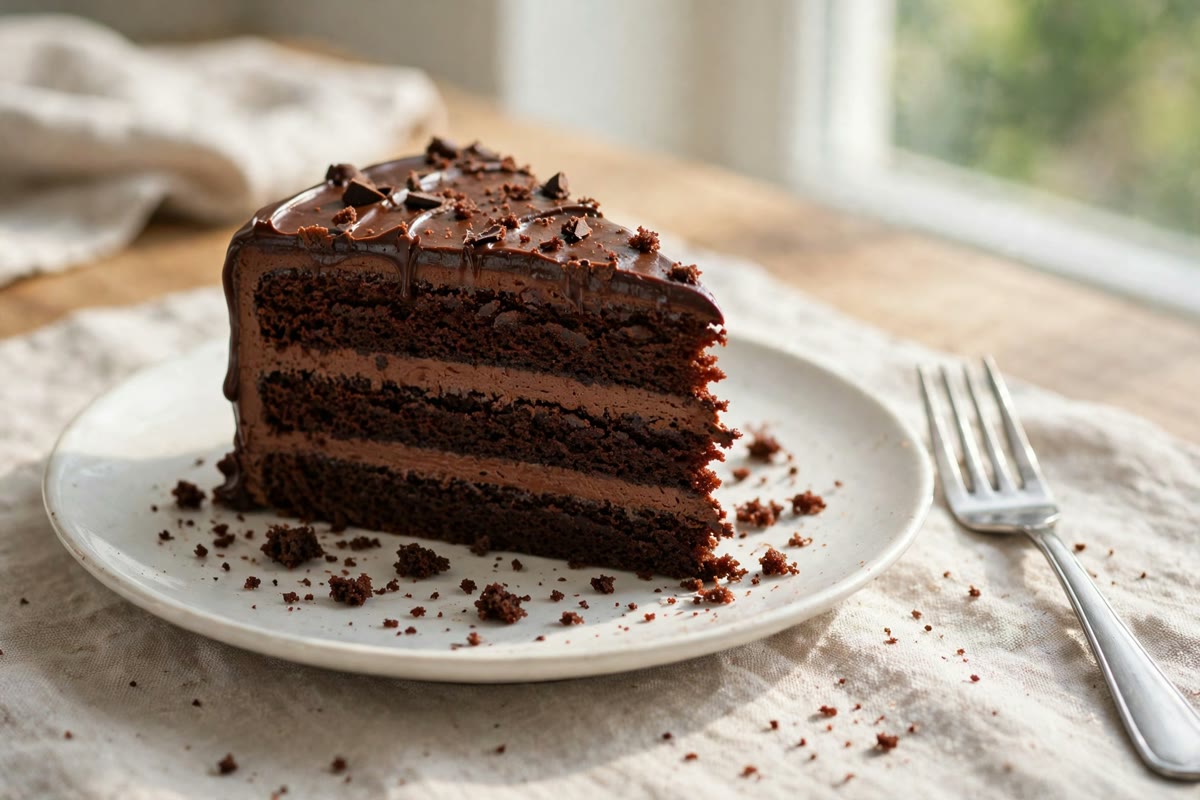
Here is the short answer: a slice of cake has roughly 250 to 700+ calories — and the "slice" is the entire story, because a bakery slice can be two or three times the size of a homemade one. A modest slice of chocolate layer cake runs ~350–450; a dense New York cheesecake slice can pass 700. The cake itself is only half the equation: frosting adds 100–200 calories per serving on its own. In this guide you will see the per-cake chart, the frosting math, why bakery slices are so much bigger, and how to handle birthday season — or check any dessert instantly with our calorie calculator.
Cake, ice cream, the whole party spread — log it with our calorie calculator and see the macro split with the macro calculator.
Check My DessertAll figures below assume a standard serving — about 3.5 oz (100 g), roughly one-twelfth of a 9-inch layer cake. Bakery servings are often larger; see the next section.
| Cake (one standard ~3.5 oz slice) | Approx. calories | What drives it |
|---|---|---|
| Angel food cake | ~120–150 | No fat, no yolks — the light exception |
| Vanilla / birthday cake with buttercream | ~300–400 | Butter + sugar in both crumb and frosting |
| Chocolate layer cake with fudge frosting | ~350–450 | Cocoa, oil/butter, dense frosting |
| Carrot cake with cream cheese frosting | ~350–450 | Oil-based crumb + rich frosting; the "vegetable" is marketing |
| Red velvet with cream cheese frosting | ~400–500 | Oil crumb + thick frosting layer |
| Pound cake (plain slice) | ~300–350 | Butter, sugar, eggs in equal measure — dense |
| New York cheesecake | ~400–700 | Cream cheese + eggs + sugar; the densest standard slice |
| Tiramisu (restaurant portion) | ~400–500 | Mascarpone + soaked ladyfingers; portions run large |
The ranking logic is simple: fat + sugar density. Angel food is mostly egg-white foam and sugar — no butter, no yolks — which is why it is the outlier at ~130. Cheesecake is essentially baked custard made of cream cheese, which is why a single slice can carry the calories of an entire meal. Carrot cake deserves its callout: the carrots contribute moisture and a health halo, but the oil-based crumb and cream cheese frosting make it one of the heavier standard cakes.
People count the cake and forget the frosting — but on a layer cake, frosting is roughly a third of the slice by weight and nearly half the calories. Buttercream is essentially butter whipped with powdered sugar: about 130–150 calories per 2-tablespoon serving, and a generously frosted layer-cake slice carries 3–4 tablespoons. Cream cheese frosting runs similar (~120–140 per 2 tbsp); chocolate ganache is denser (~150–180 per 2 tbsp); whipped-cream frosting is the lightest (~50–60 per 2 tbsp, mostly air).
This is why "cake" comparisons mislead: a lightly glazed pound cake slice (~300) and a thickly frosted chocolate layer slice (~450) are different foods wearing the same name. When you are served cake, the frosting thickness is the fastest visual calorie read you have. For the frozen-dessert equivalent of this math, see our guide on how many calories are in a scoop of ice cream.
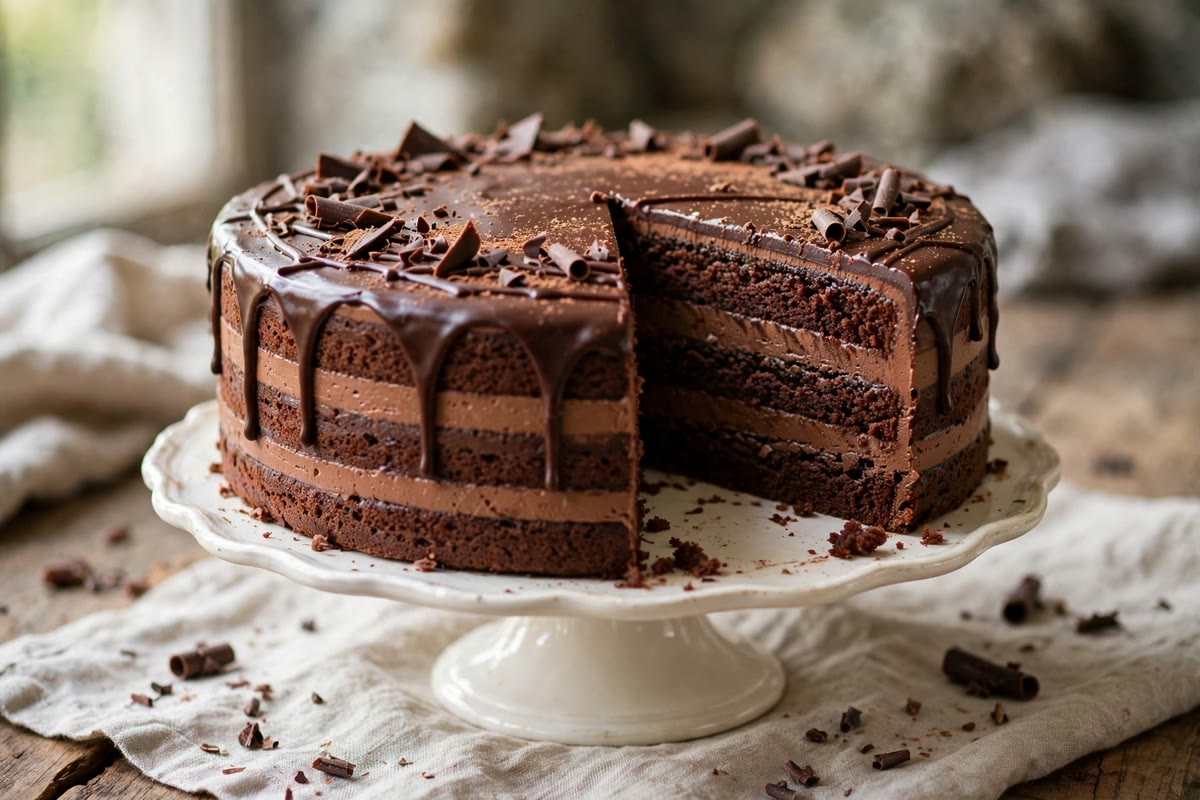
The chart above uses a ~3.5 oz standard slice. Now the bad news: almost nobody serves that slice. Bakery and restaurant slices are cut for celebration, not for nutrition labels — a typical bakery slice of chocolate cake runs 5–7 oz (140–200 g), which at ~120–140 calories per ounce lands at 600–900 calories. Cheesecake Factory-style slices are famous for crossing 800–1,000+ calories; those are not standard slices, they are wedges the size of a paperback.
The fix is visual, not mathematical: a standard slice is about the size of a deck of cards. If your slice is the size of two decks, double the chart number. Sharing one bakery slice between two people is the highest-leverage move in this article — you get the full experience at roughly a standard serving each.
Cake is a sometimes food, and sometimes foods do not need to be optimized — they need to be bounded. The strategies that work for people tracking calories: eat the cake, skip the seconds (one slice is the plan; the second slice is the accident); share the bakery slice; choose your cake — if you genuinely prefer cheesecake, have the cheesecake and skip the random office brownies later; log it before the party using the chart above, so the number is decided rather than discovered. One 400-calorie slice at a party changes nothing about a week; the pattern of untracked slices does. Our cheeseburger guide covers the same "main-event food" logic for fast food.
Our calorie calculator keeps dessert honest in seconds.
Calculate My DessertWritten by the Live Fitness Check editorial team · Reviewed against our calculator methodology · Last updated October 2026
Disclaimer: This guide is for educational purposes only and is not medical advice. Calorie figures are estimates; actual values vary widely by recipe and serving size. If you are managing diabetes or another condition affected by sugar intake, talk to your doctor.