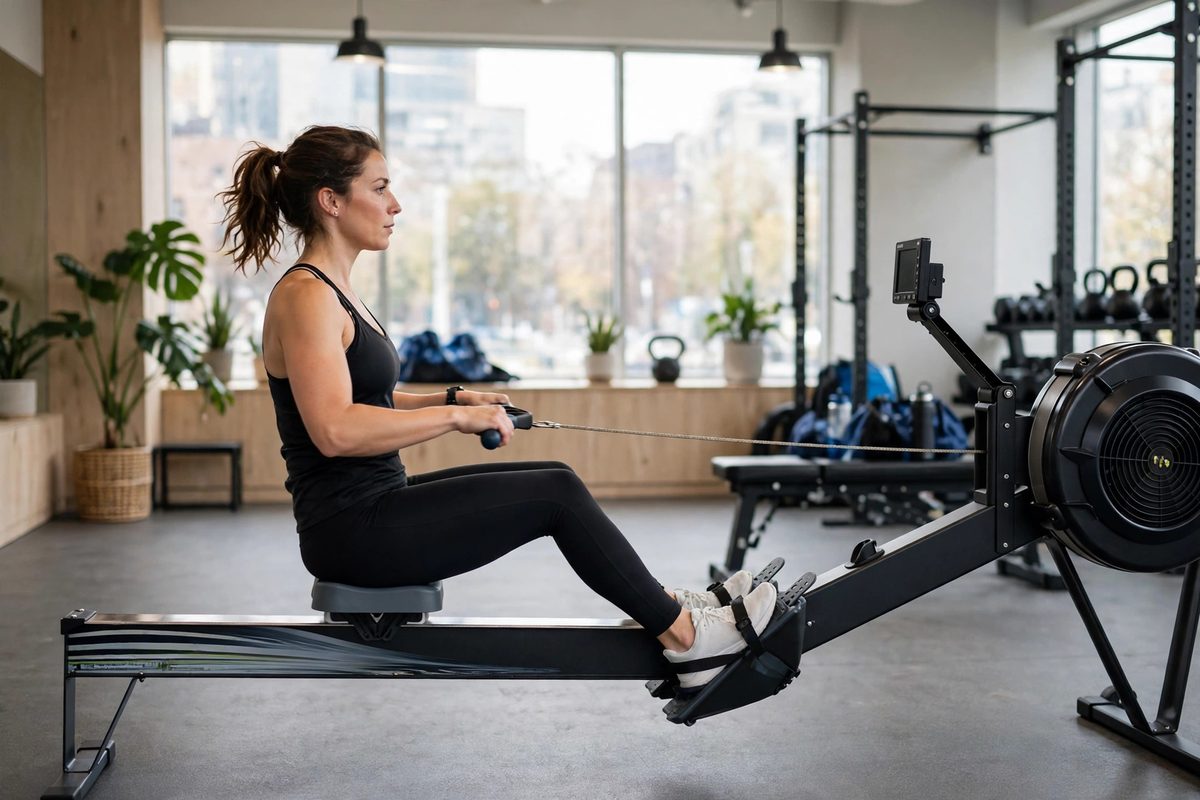
Rowing burns roughly 508 calories an hour at a moderate pace and 798 calories an hour at a vigorous pace for a 160 lb (72.6 kg) rower — and wattage, not time on the machine, is what decides where you land in that range. A gentle 100-watt paddle and a hard 250-watt interval session are both "rowing," but the second burns more than twice as much per hour. In this guide you will see the wattage-by-weight chart, why your erg screen can mislead you, what 30 minutes really adds up to, and how rowing fits a weight-loss plan — or check any session instantly with our calories-burned calculator.
A 160 lb rower burns about 363 calories an hour at light effort (5.0 METs), 508 at moderate effort (7.0 METs), 798 at vigorous effort (11.0 METs), and 1,016 at maximum effort (14.0 METs). Technique matters too: a sloppy stroke wastes energy without moving the flywheel faster, so good form is free speed. Try your own numbers in our calories-burned calculator or TDEE calculator.
Calculate My RowRowing intensity is measured in METs (metabolic equivalents): 1 MET is your resting burn, and the formula is calories = MET × body weight in kg × hours rowed. The intensity levels below use the Compendium of Physical Activities values for rowing: light 5.0, moderate 7.0 to 7.3, vigorous 11.0, and maximum effort 14.0. Every cell is computed from that formula with weight converted as pounds × 0.4536, then rounded to the nearest whole calorie.
| Intensity (60 min) | METs | 130 lb (59.0 kg) | 160 lb (72.6 kg) | 190 lb (86.2 kg) | 220 lb (99.8 kg) |
|---|---|---|---|---|---|
| Light, easy paddle | 5.0 | ~295 | ~363 | ~431 | ~499 |
| Moderate, steady state | 7.0 | ~413 | ~508 | ~603 | ~699 |
| Moderate, upper range | 7.3 | ~430 | ~530 | ~629 | ~728 |
| Vigorous, hard intervals | 11.0 | ~649 | ~798 | ~948 | ~1,098 |
| Maximum effort, race pace | 14.0 | ~826 | ~1,016 | ~1,207 | ~1,397 |
Worked example, so you can check the math: a 160 lb (72.6 kg) rower at a moderate 7.0 METs for one hour burns 7.0 × 72.6 × 1 = 508 calories. The same rower at a vigorous 11.0 METs burns 11.0 × 72.6 × 1 = 798 calories. That 290-calorie gap is the whole story of rowing: pace, not duration, is the lever. Adding 10 minutes at an easy pace buys you about 60 calories; pushing the same 10 minutes hard buys you about 130.
Wattage is the most honest measure of rowing effort because it is a direct output reading, not a feeling. As a rough guide for a recreational rower, under about 100 watts feels like a warm-up paddle, 120 to 160 watts is a sustainable steady-state pace you can hold for 30 to 45 minutes, 180 to 220 watts is hard interval territory, and over 250 watts is a short, serious effort. Your split time — the time per 500 meters shown on the screen — tells the same story in reverse: a 2:30 split is relaxed, a 2:00 split is strong steady work, and a 1:45 split is racing. Beginners should ignore both numbers for the first few sessions and learn the stroke instead. The rowing stroke is legs, then back, then arms on the drive, and arms, back, legs on the recovery; most new rowers pull far too much with their arms, which exhausts the smallest muscles first and caps the wattage they can hold.
For comparison with other full-body cardio, see our cycling guide and swimming guide — rowing sits above both at vigorous effort because it recruits legs, back, and arms together, and unlike running it does so with almost no joint impact. That combination is why rowing is a favorite for heavier exercisers and for anyone returning from a knee or ankle injury.
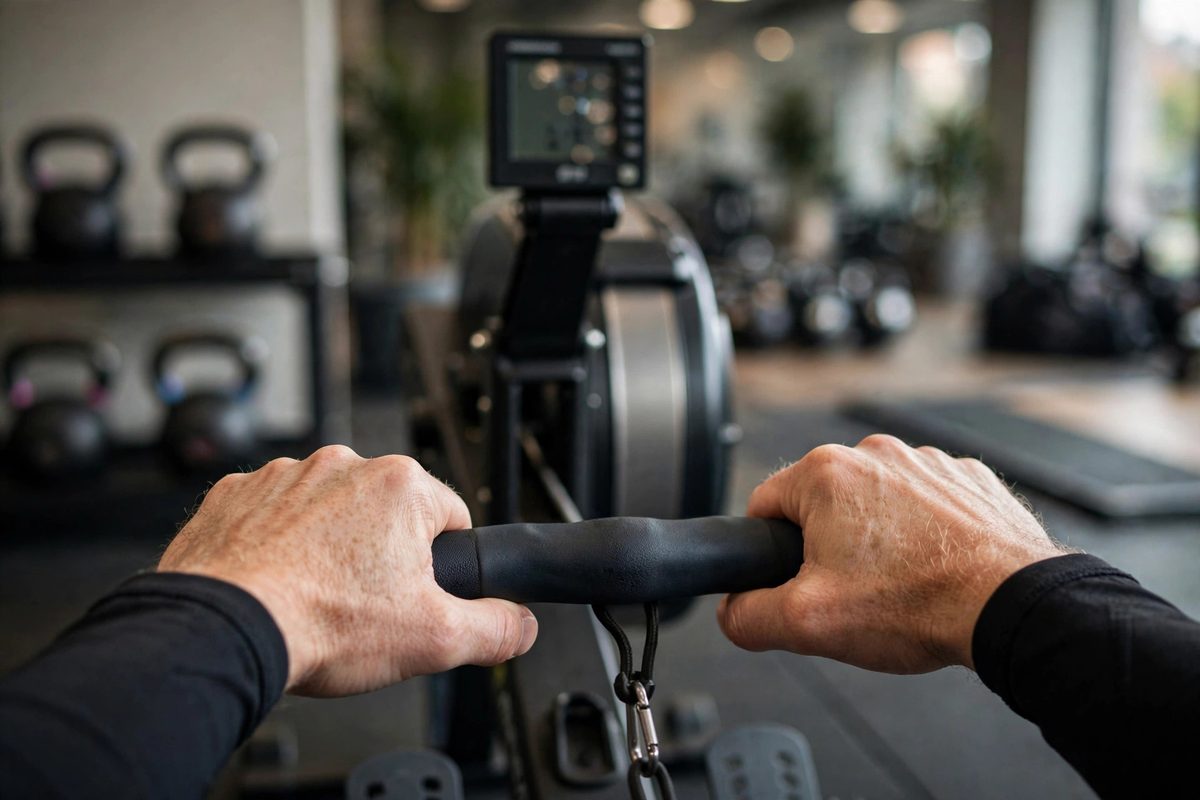
Your rowing machine's calorie display is an estimate, and it has a known bias you should understand. Most ergs estimate calories from flywheel power using a formula that assumes a fixed body weight — historically around 175 lb — plus a baseline for resting metabolism. That means a lighter rower sees an inflated number and a heavier rower sees a deflated one, because the machine does not know how much you weigh. A 130 lb rower whose screen claims 500 calories for a moderate hour has probably burned closer to 413, while a 220 lb rower whose screen claims the same 500 has probably burned closer to 699. The fix is simple: use the MET table above with your real weight, or enter your weight into the machine if it offers that option, and treat the screen number as a rough guide rather than a bank balance. The same caution applies to every cardio machine display; rowing ergs are just unusually open about the formula behind theirs.
Thirty minutes is the most common rowing session, and it is enough to matter. For a 160 lb rower, 30 minutes at a moderate 7.0 METs burns about 254 calories (508 ÷ 2), and 30 minutes at a vigorous 11.0 METs burns about 399 calories (798 ÷ 2). Three moderate 30-minute rows a week therefore burn about 762 calories a week — roughly a fifth of a pound of fat per week before any diet change. That sounds small, and it is, honestly: no single exercise drives major weight loss on its own. Where rowing earns its place is in the weekly stack. It is low-impact enough to do four or five times a week without the joint complaints that end running plans, it builds back and leg strength at the same time as it burns calories, and a 30-minute session fits a lunch break. Pair it with a daily target from our TDEE calculator and a protein target from our protein calculator, and the rowing becomes the reliable activity base of a plan that also includes eating slightly less.
The plan that survives real life is three to four rows a week: two steady 30-minute rows at a pace where you can still talk in short sentences, plus one interval session — for example, 8 rounds of 2 minutes hard and 2 minutes easy — and, if you enjoy it, one longer 45-minute weekend row. At 160 lb that is roughly 508 + 508 + 450 (intervals average out near moderate-to-vigorous) = about 1,460 calories a week from rowing alone, before diet. Protect the plan with the basics: warm up for 5 minutes at an easy pace, keep your back flat and your core braced rather than rounding over at the catch, and cool down rather than stopping cold from a hard effort. If your lower back aches after rowing, the cause is almost always technique — overreaching at the catch or pulling with a rounded back — not fitness, and a single coaching session or a careful technique video fixes it faster than any amount of extra effort. Check your effort zones with our heart-rate zones calculator to keep easy rows genuinely easy.
Our calories-burned calculator estimates any row in seconds.
Calculate My RowWritten by the Live Fitness Check editorial team · Reviewed against our calculator methodology · Last updated October 2026
Disclaimer: This guide is for educational purposes only and is not medical advice. Calorie figures are estimates from the Compendium of Physical Activities; actual burn varies with effort, technique, fitness, and body weight. If you are new to exercise, start gradually and talk to your doctor.
