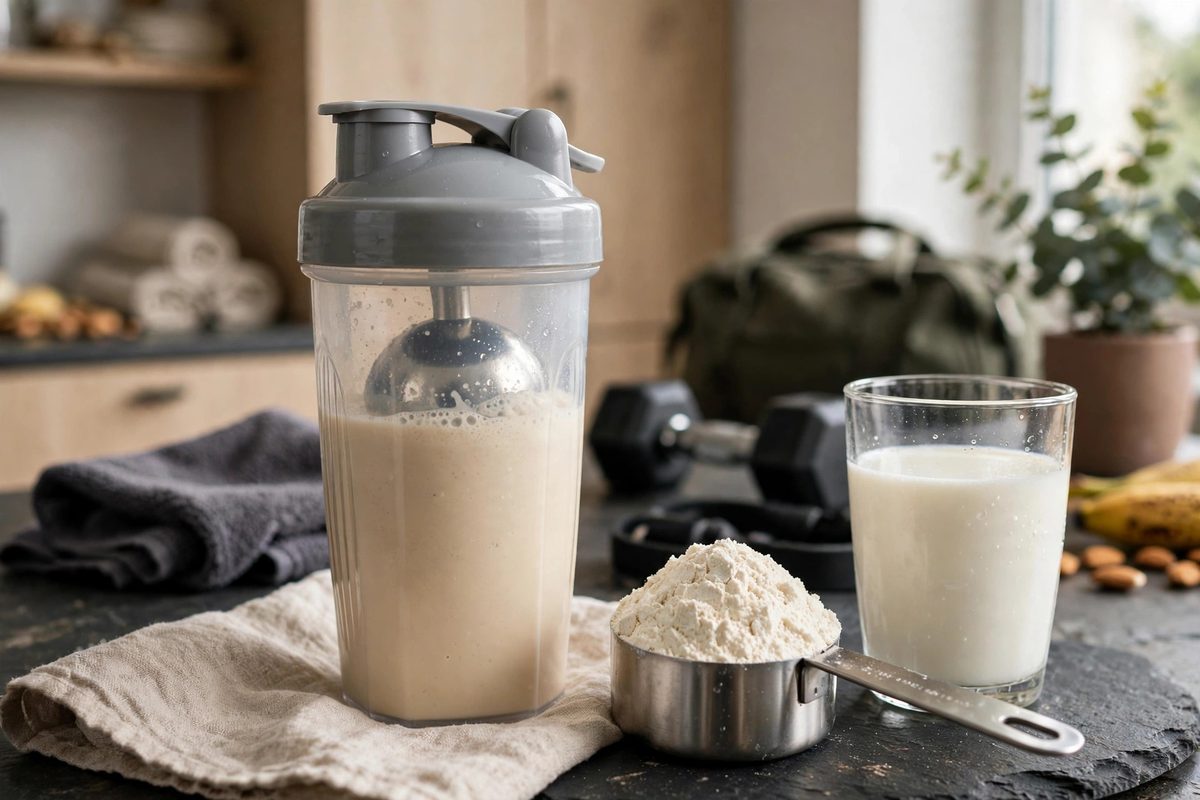
Here is the short answer: a protein shake has roughly 120 to 600+ calories — and the base liquid decides most of it. One scoop of whey protein mixed with water is about 120 calories. The same scoop mixed with whole milk is about 270. A premade bottled shake is 160–200. A mass gainer is 600+ and is barely a protein shake at all. In this guide you will see the base-liquid chart, the scoop math, the mass-gainer trap, and how a shake fits into your daily protein target — or check any shake instantly with our calorie calculator.
Shakes, smoothies, meals — log any of them with our calorie calculator and set your daily target with the protein calculator.
Check My ShakeA standard scoop of whey protein isolate or concentrate carries about 110–130 calories and 20–25 g of protein on its own. Everything after that is the liquid you choose:
| 1 scoop whey + liquid (8–12 oz) | Approx. calories | Protein | Best for |
|---|---|---|---|
| Water | ~120 | ~24 g | Cutting, post-workout, lowest calories |
| Skim / nonfat milk | ~210 | ~32 g | Balanced — extra protein for +90 calories |
| 2% milk | ~240 | ~32 g | Middle ground on taste and calories |
| Whole milk | ~270 | ~32 g | Bulking, or when the shake replaces a meal |
| Unsweetened almond milk | ~130–150 | ~25 g | Dairy-free with almost no calorie penalty |
| Oat milk (sweetened) | ~220–250 | ~26 g | Creamy taste — check the label, sweetened versions add sugar |
The milk ladder is simple: each step from skim to whole adds about 30 calories per cup, and milk adds ~8 g of protein on top of the powder's ~24 g. A water shake is a protein delivery system; a whole-milk shake is a small meal. Both are fine — the mistake is drinking the meal version while counting the delivery-system calories.
| Shake | Approx. calories | Protein | Notes |
|---|---|---|---|
| 1 scoop + water | ~120 | ~24 g | The baseline |
| 2 scoops + water | ~240 | ~48 g | Doubles cleanly — no hidden cost |
| 2 scoops + whole milk | ~390 | ~56 g | Approaching a meal; fine post-workout |
| Premade bottled shake (11–14 oz) | ~160–200 | ~30 g | Convenient, pricier per gram; check for added sugar |
| Powder + banana + peanut butter + milk | ~450–550 | ~35–40 g | Now it is a smoothie, not a shake — see our smoothie guide |
| Mass gainer (2 scoops) | ~600–1,250 | ~40–50 g | Mostly maltodextrin carbs — the trap below |
Two scoops is the cleanest way to raise protein without raising complexity: it doubles the protein for exactly double the calories, with no extra sugar. Premade bottles are the convenience tax — roughly the same nutrition as a homemade milk shake at 2–3× the price per serving.
Mass gainers sit in the protein aisle but are not protein shakes. A typical serving is 600–1,250 calories with only 40–50 g of protein — the rest is maltodextrin, a fast-digesting starch that spikes blood sugar much like pure sugar. Per calorie, a mass gainer delivers less protein than a plain whey shake, at 5–10× the calories.
Mass gainers have exactly one legitimate use: for hard gainers who genuinely cannot eat enough whole food to gain weight, and who have already tried eating more real meals. For everyone else — including most people trying to build muscle while staying lean — a mass gainer is a milkshake with a gym label. Our creatine guide covers the other supplement most lifters actually benefit from, at 0 calories per serving.

The standard evidence-based protein target for active adults is about 1.6–2.2 g per kg of body weight per day (roughly 0.7–1.0 g per lb). For a 160 lb (73 kg) person, that is ~115–160 g per day. One shake with water (~24 g) covers about a fifth of that target for 120 calories — the best protein-per-calorie ratio of any common food except egg whites and plain Greek yogurt.
The practical rule: food first, shake as the gap-filler. Eat your protein at meals, then use a shake to close whatever gap remains — typically one scoop after training, or one scoop in the morning if breakfast is light. Two shakes a day is fine; four shakes a day means your meals need fixing, not your supplement shelf. Use our protein calculator to set your exact target, then divide it across meals using our macro calculator.
A shake is not a meal, even at the same calories. Liquid protein does not keep you full the way chewed food does — chewing, volume, and fiber all drive satiety, and a shake has almost none of them. A 270-calorie whole-milk shake leaves you hungry in an hour; a 270-calorie plate of eggs and toast keeps you full for three. That is why shakes work best as supplements to meals, not replacements for them — except post-workout, when fast, easy protein is exactly what you want and appetite is often low anyway.
If you do use a shake as a meal replacement, add the missing pieces: a banana for carbs and potassium, a handful of oats for fiber, or a spoonful of peanut butter for staying power — and count the new total honestly using the build chart in our smoothie guide, because you have just built a smoothie.
Our protein calculator sets your target in seconds.
Calculate My ProteinWritten by the Live Fitness Check editorial team · Reviewed against our calculator methodology · Last updated October 2026
Disclaimer: This guide is for educational purposes only and is not medical advice. Calorie and protein figures are estimates; actual values vary by brand and serving size. If you have kidney disease or another condition affected by protein intake, talk to your doctor.