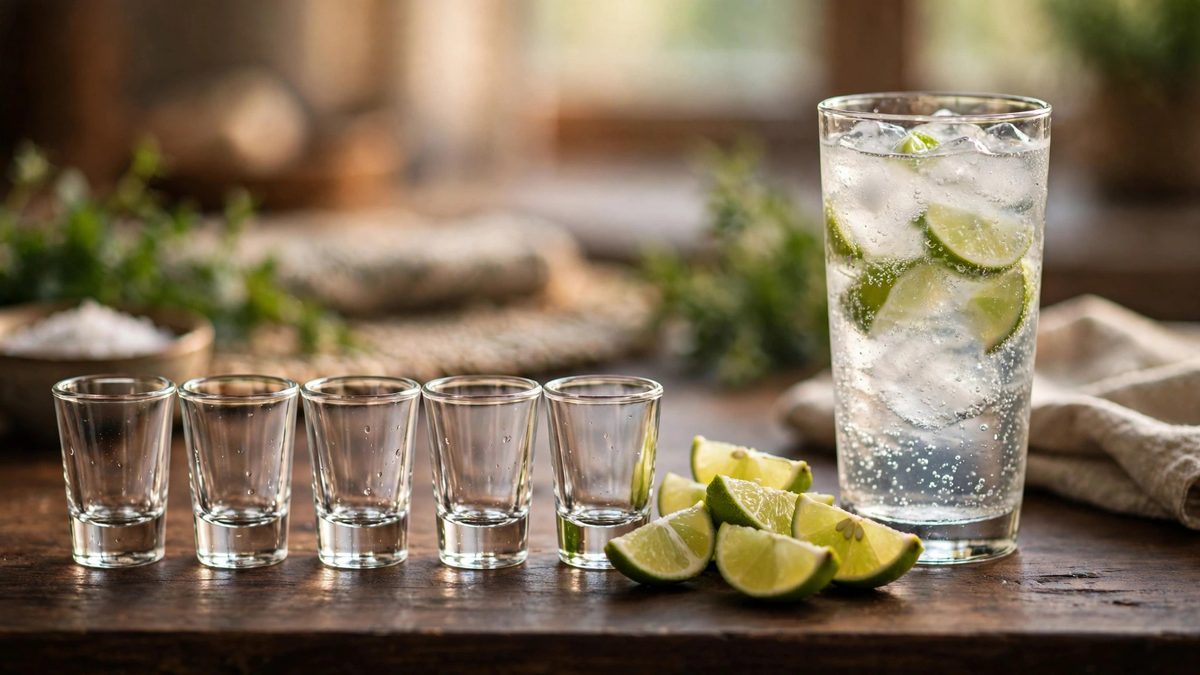
Here is the short answer: a standard 1.5 oz shot of vodka, gin, whiskey, tequila, or rum at 80 proof has about 97 calories — and the spirit you choose barely matters. The calories in neat spirits come almost entirely from ethanol, so two spirits at the same proof are effectively identical. What actually changes the calorie count is the proof on the bottle and, far more than anything else, what you mix the shot with. A vodka soda runs about 100 calories; the same vodka in a Long Island Iced Tea can top 500. In this guide you will see the shot-by-shot, proof-by-proof comparison for all five spirits, the mixer trap that blows up most "light" drinks, and which cocktails stay lightest — or check your pours instantly with our alcohol unit calculator.
Enter your drink size and strength into our alcohol unit calculator to see the alcohol units and calories in any pour — shots, cocktails, beer, or wine.
Check My DrinkA standard US shot is 1.5 fluid ounces (44 ml). For any distilled spirit at 80 proof (40% ABV), that pour contains about 97 calories — the figure the USDA lists for 1.5 oz of 80-proof distilled spirits. It does not matter whether the label says vodka, gin, whiskey, tequila, or rum: at the same proof, every one of them lands within a calorie or two of the same number.
Why? Because distillation leaves the sugar and carbs behind. The calories in a neat spirit come almost entirely from ethanol itself, which delivers about 7 calories per gram — nearly twice as much energy per gram as carbs or protein (4 cal/g), and only slightly less than fat (9 cal/g). A 1.5 oz shot at 80 proof contains about 14 grams of pure ethanol, and 14 × 7 ≈ 97–100 calories. The spirit's flavor — juniper in gin, oak in whiskey, agave in tequila — adds essentially zero energy.
This is the comparison most drinkers actually want: five spirits, three common proofs, one standard 1.5 oz shot. Calories scale with proof because proof is just twice the ABV — more ethanol, more calories. Use 97 calories at 80 proof as your anchor and scale: 97 × (proof ÷ 80).
| Spirit | 70 proof (35%) — 1.5 oz | 80 proof (40%) — 1.5 oz | 100 proof (50%) — 1.5 oz |
|---|---|---|---|
| Vodka | ~85 cal | ~97 cal | ~121 cal |
| Gin | ~85 cal | ~97 cal | ~121 cal |
| Whiskey / bourbon | ~85 cal | ~97 cal | ~121 cal |
| Tequila (blanco) | ~85 cal | ~97 cal | ~121 cal |
| Rum (white) | ~85 cal | ~97 cal | ~121 cal |
The table looks almost boring — and that is the point. Once you know the proof, you know the shot. Most standard bottles (Smirnoff, Bacardi, Beefeater, Jose Cuervo) are 80 proof, so ~97 calories is the number to memorize. Bottled-in-bond whiskeys and some navy-strength gins hit 100+ proof (~121+ per shot); budget flavored vodkas sometimes drop to 70 proof (~85 per shot), though some flavored versions add sugar — check the label rather than assuming.
No. Aging in oak adds flavor compounds and color, not sugar or carbs — a 12-year whiskey at 80 proof has the same ~97 calories per shot as unaged vodka at 80 proof. Spiced and flavored rums can be the exception: products with added sugar or cream liqueurs (think coconut rum with added sweeteners) may carry extra carbs, so treat those as mixed drinks and read the label.
Choosing vodka over whiskey saves you nothing — but choosing soda water over tonic saves you 80+ calories per drink. The mixer is where "light" drinks quietly become desserts. A few numbers for common 8 oz mixer servings: soda water or sparkling water ~0 cal, diet tonic ~0, regular tonic water ~83 cal, orange juice ~110 cal, regular cola ~140 cal per 12 oz (~90 per 8 oz), cranberry juice cocktail ~130 cal, margarita mix ~100+ cal per 4 oz, piña colada mix ~150+ cal per 4 oz, coconut cream ~150 cal per 2 oz.
That means the same 97-calorie shot becomes a ~100-calorie vodka soda with soda water and lime, or a ~180-calorie gin and tonic with regular tonic, or a ~240-calorie rum and cola. None of the spirit changed — the mixer did all the damage.
Cocktails layer spirits, liqueurs, and mixers, so the ranges widen. These are typical single-serving estimates for standard recipes:
| Cocktail (standard recipe) | Approx. calories | Where the calories come from |
|---|---|---|
| Vodka soda (1.5 oz vodka + soda + lime) | ~100 | Nearly all the shot itself |
| Gin and tonic (1.5 oz gin + 6 oz tonic) | ~160 | Shot (~97) + tonic (~60) |
| Mojito (1.5 oz rum + soda + sugar + mint) | ~150–200 | Shot + 1–2 tsp sugar |
| Martini (2.5 oz gin + dry vermouth) | ~160–200 | Bigger spirit pour + vermouth |
| Margarita (1.5 oz tequila + triple sec + lime) | ~200–300 | Tequila + sweet orange liqueur; frozen sugary mixes run higher |
| Moscow mule (1.5 oz vodka + ginger beer) | ~150–200 | Shot + sweetened ginger beer |
| Piña colada (rum + coconut cream + pineapple) | ~400–500 | Rum + coconut cream + juice/syrup |
| Long Island Iced Tea (4 spirits + triple sec + cola) | ~500+ | ~3 oz of spirits plus sugary mixers — the heaviest standard cocktail |
Two patterns to notice. First, restaurant and bar pours run heavier than these recipes: free-poured shots are often 2 oz, not 1.5, and house cocktails can contain two or three full shots — always assume the menu number is a floor, not a ceiling. Second, frozen and "tiki" drinks are calorie outliers because blenders need sugar-heavy mixes to taste good; a piña colada can carry the calories of a small meal.
Across all drink types, the lightest options per standard serving are: (1) neat spirits or spirit + soda water — ~97–100 calories, unbeatable per drink; (2) light beer or hard seltzer — ~100 calories; (3) a 5 oz glass of dry wine — ~120–125 calories; (4) a 12 oz regular lager — ~150 calories; (5) cocktails — ~150–500+ depending on the build. That ranking holds only if pours stay honest: spirits win per drink but lose per evening when free-poured doubles turn a "light" vodka soda into 200 calories before the mixer is even considered.
Yes — and this matters more than the per-drink number. Your body treats ethanol as a toxin and prioritizes burning it first, which pauses fat burning for hours. Alcohol also lowers inhibitions around food (late-night snacks are rarely salads), disrupts sleep quality, and can raise next-day appetite. The practical takeaway: one or two measured drinks fit into most calorie plans if you log them honestly — our calorie calculator can set your daily target — but "just a couple of drinks" routinely becomes several hundred unlogged calories plus a loosened diet. Measure pours, count mixers, and log the full drink.
For a broader look at alcohol and calories, read our guides on how many calories are in a pint of beer and how many calories are in a burrito — because the food that follows the drinks is often the bigger number.
Plug in the size and strength — our alcohol unit calculator works out the units and calories in any pour.
Check My DrinkWritten by the Live Fitness Check editorial team · Reviewed against our calculator methodology · Last updated October 2026
Disclaimer: This guide is for educational purposes only and is not medical advice. If you are pregnant, taking medication, or managing a health condition, talk to your doctor about alcohol. Please drink responsibly and never drink and drive.
