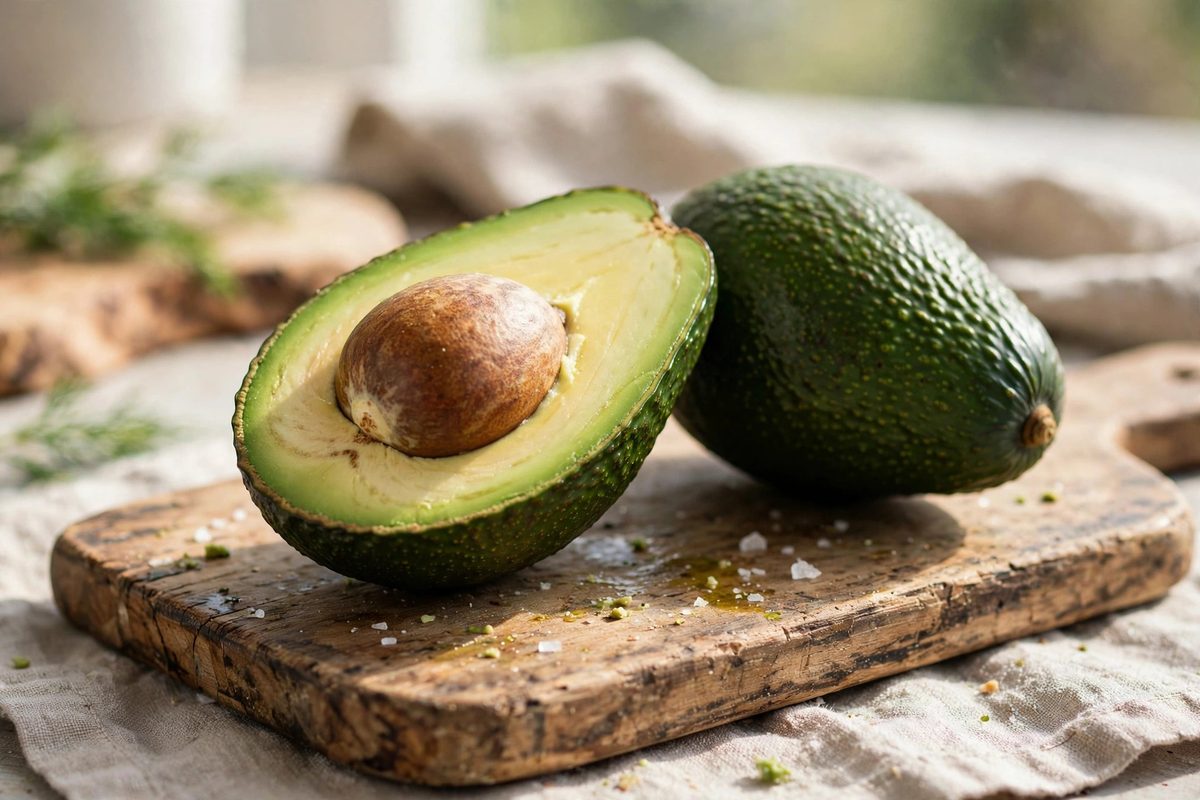
An avocado has 160 calories per 100 grams of flesh — that is 1.6 calories per gram, the only number you need to price any portion. A whole medium avocado (about 150 g of flesh) is about 240 calories; a large one (about 201 g of flesh) is about 322 calories; and the FDA's official serving, 50 g or about a third of a medium avocado, is 80 calories. In this guide you will see the per-gram math applied to every portion, the pit-and-peel trap that inflates most guesses, the Hass-versus-Florida difference, and the guacamole and toast math — or price any portion with our calorie calculator.
Avocado flesh runs 160 calories per 100 g (USDA), so any portion is simply grams × 1.6: 50 g = 80, 75 g = 120, 100 g = 160, 150 g = 240, 201 g = 322. The trap is weighing the whole fruit, pit and peel included, and pricing it as if it were all edible. Plan any meal with our calorie calculator or macro calculator.
Calculate My PortionEvery figure below is the same calculation — grams of edible flesh × 1.6 calories per gram — rounded to the nearest whole calorie. The USDA standard is 160 calories per 100 g of raw Hass avocado flesh, and the FDA serving size is 50 g (one-third of a medium avocado). If you remember nothing else, remember 1.6: it lets you price a smear on toast, a scoop in a salad, or a whole fruit without looking anything up.
| Portion | Flesh weight | Calories | Notes |
|---|---|---|---|
| FDA serving | 50 g | ~80 | About 1/3 of a medium avocado; 2–3 tbsp mashed |
| Quarter medium avocado | ~38 g | ~60 | A modest toast smear |
| Half medium avocado | ~75 g | ~120 | The common toast or salad portion |
| Half medium, generous | ~100 g | ~160 | Large halves run closer to this than to 120 |
| Whole medium avocado | ~150 g | ~240 | USDA medium fruit, flesh only |
| Whole large avocado | ~201 g | ~322 | USDA large fruit, flesh only |
| 1 cup mashed | ~230 g | ~368 | About 1.5 medium avocados; the guacamole base |
Note the honest range on "half an avocado": the task brief's 120–160 span is not sloppy writing, it is real fruit variation. A small medium avocado yields about 75 g per half (120 calories); a plump one yields closer to 100 g per half (160 calories). If you eat half an avocado daily and always assume the low end, you undercount by about 40 calories a day — 280 a week, or about 14,560 a year, roughly 4 lb of energy. Weighing the flesh once or twice calibrates your eye permanently, and it is the single best habit this article can give you.
Here is the trap that inflates most avocado guesses. A whole medium avocado weighs about 200 g on the scale, but roughly 30–40% of that weight is pit and peel — about 60–70 g you do not eat. If you weigh a 200 g fruit and price it at 1.6 calories per gram, you get 320 calories for a fruit that actually delivers about 240. The error runs the other way, too: nutrition labels and apps that list "1 medium avocado = 240 calories" already exclude pit and peel, so anyone who adds a pit allowance on top double-counts. The clean rule is to weigh only what you eat: scoop the flesh onto the scale, or halve the fruit, remove the pit, and weigh the flesh. A kitchen scale costs less than a week's avocados and ends the guessing for every food in this series, not just this one. For a comparable weigh-it-yourself food, see our cereal guide and smoothie guide.
Not all avocados are the same fruit, nutritionally. The Hass avocado — small, pebbly-skinned, the variety in nearly every US supermarket — is the dense, creamy one at 160 calories per 100 g. The Florida avocado (also called the Dominican or Choquette type) is larger, smoother-skinned, and noticeably more watery, running roughly 25% fewer calories per gram — about 120 calories per 100 g, or 1.2 per gram. A whole Florida avocado can still out-calorie a Hass because the fruit itself is bigger: a 300 g Florida fruit might yield 200 g of flesh at 1.2 calories per gram, about 240 calories, similar to a medium Hass. The practical point is narrower than the headline: if you buy Hass, use 1.6; if you buy the big smooth Florida type, use about 1.2 and enjoy the lighter texture in salads, where its lower fat content is actually an advantage. Either way, the fat is overwhelmingly monounsaturated — the same heart-friendly fat family as olive oil — which is why dietitians keep recommending a food that is, calorie for calorie, one of the densest fruits in the store.
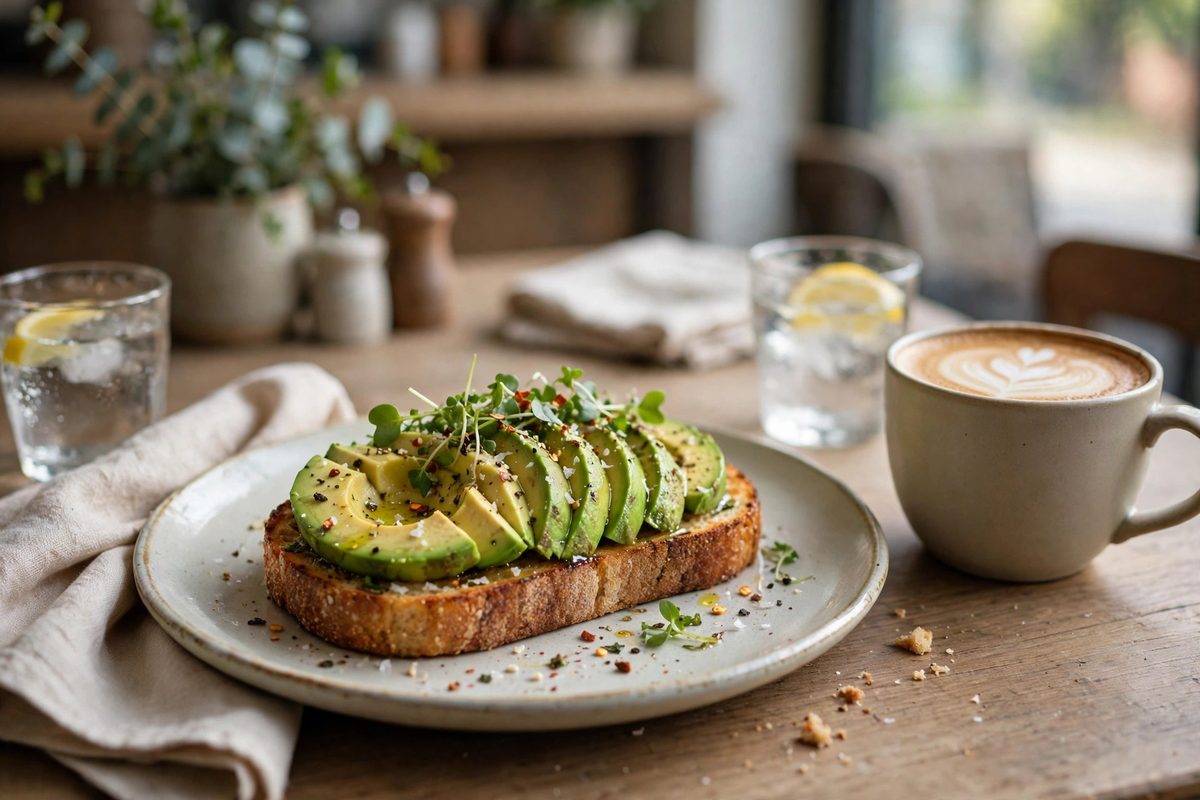
Guacamole is where avocado portions escape their bounds, because nobody eats guacamole by the FDA serving. A standard homemade guacamole — 2 medium avocados (about 300 g flesh, 480 calories) plus tomato, onion, lime, and cilantro (negligible) plus a pinch of salt — totals about 480 calories for the bowl before a single chip. At a quarter cup per serving (about 58 g), that is about 92 calories per serving, and the bowl serves about 5. The chips, however, are the real story: a single ounce of tortilla chips (about 28 g, a small handful) adds about 140 calories, so a typical "a few scoops" snack of a quarter cup of guacamole plus 2 oz of chips runs about 92 + 280 = 372 calories — and most people eat twice that without noticing, because chips are designed to be eaten mindlessly. Avocado toast follows the same pattern: half a medium avocado (120 calories) on a slice of whole-wheat bread (about 80 calories) with a drizzle of olive oil (about 40 calories per teaspoon) is about 240 calories before any egg, chili flakes, or second slice. None of this makes guacamole or toast a bad choice — both are nutrient-dense and satisfying — but it does mean the avocado is rarely the most caloric part of the snack. Price the vehicle, not just the passenger.
Avocado is calorie-dense and genuinely good for you, and both facts are true at once — the tension between them is a portion question, not a contradiction. At 240 calories, a whole medium avocado carries about the same energy as a small fast-food burger, but it also delivers about 10 g of fiber, about 15 g of monounsaturated fat, potassium (about 700 mg, more than a banana), and folate, with almost no sodium and no cholesterol. In weight-loss studies, people who eat avocado regularly tend to feel fuller and snack less afterward, which is why it survives in deficit plans despite its density. The failure mode is not the avocado; it is the unmeasured avocado — the whole large fruit mashed onto toast with oil, eaten daily, and counted as "one serving" because the label said 80. Use the 1.6 rule, weigh the flesh when it matters, and avocado earns its reputation. Check your daily totals with our TDEE calculator and your fat and fiber targets with our macro calculator and fiber calculator.
Our calorie calculator totals any meal in seconds.
Calculate My PortionWritten by the Live Fitness Check editorial team · Reviewed against our calculator methodology · Last updated October 2026
Disclaimer: This guide is for educational purposes only and is not medical advice. Calorie figures are USDA-based estimates; actual values vary by variety, ripeness, and fruit size. If you follow a prescribed diet, talk to your doctor or dietitian.