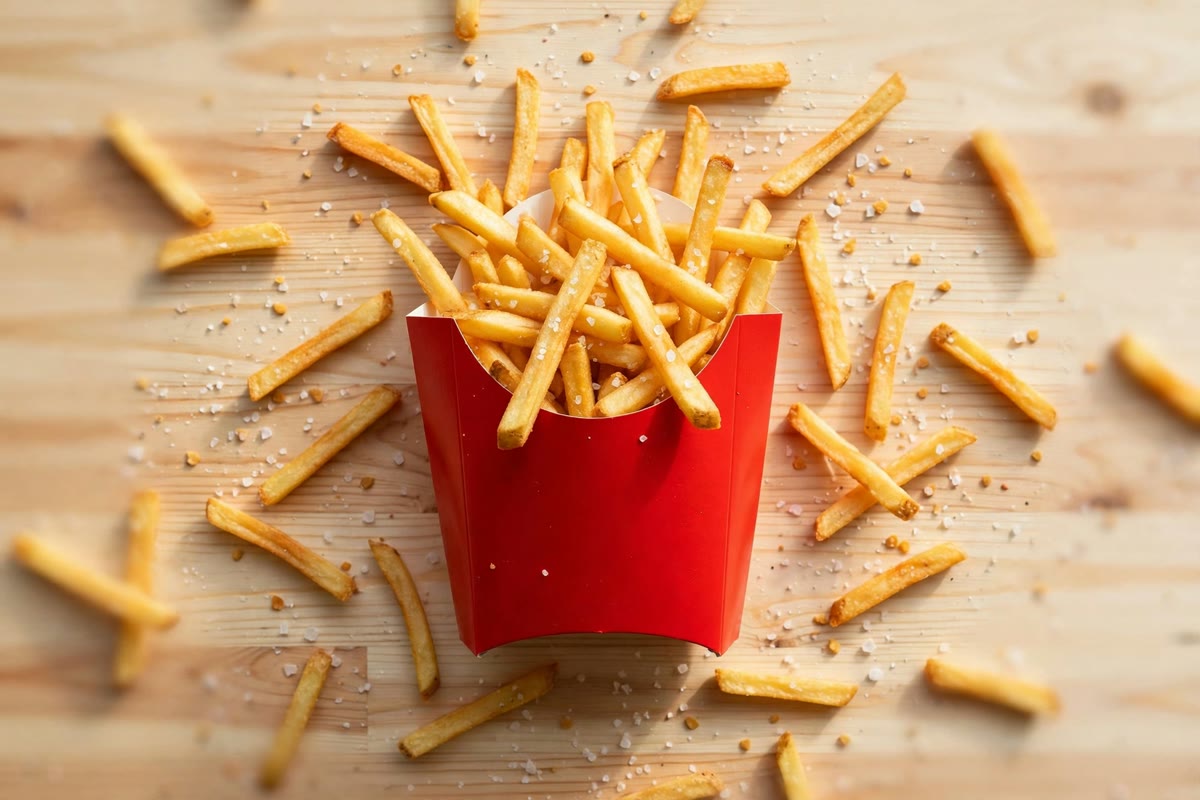
Here is the short answer: a small order of fast-food fries has about 220 calories, a medium about 320, and a large about 480 — but "french fries" is really a 150-to-800+ calorie range depending on the size, the cut, and how they were cooked. A batch of homemade fries fried in hot oil can run ~320–365 calories per 3.5 oz (100 g), while oven-baked fries from the same potato land closer to 150–200. In this guide you will see the size-by-style chart, why the cut of the fry changes the calories, what loaded fries really cost, and how to keep fries in your life without blowing your day — or check any meal instantly with our calorie calculator.
Add up the whole meal — fries, burger, and drink — with our calorie calculator, then see how it fits your day with the calorie deficit calculator.
Check My MealThere is no single number, but the anchor points most people want are the fast-food sizes, because that is where most fries are eaten. McDonald's — the most-published reference point — lists roughly ~220 calories for a small (about 2.3 oz / 65 g), ~320 for a medium (about 3.7 oz / 105 g), and ~480 for a large (about 5.9 oz / 168 g). Other chains land in the same neighborhood for equivalent sizes: a regular order of fries at most major US chains runs 300–400 calories, and large orders routinely cross 450.
Those numbers already tell you the most important thing about fries: size is the whole game. A small and a large from the same fryer differ by more than 250 calories — the gap between "fits easily" and "half a meal." Supersizing fries roughly doubles the calories of the side for a few cents, which is exactly why it is such a good deal for the restaurant and such a bad deal for your calorie budget.
A plain baked potato is one of the most filling foods per calorie in existence — about 160 calories for a medium 5.3 oz (150 g) potato, mostly starch and water. Fries start from that same potato and roughly double the energy, because frying drives water out and pulls oil in. Hot oil is pure fat at 9 calories per gram, and a fry is essentially a starch sponge engineered for maximum oil contact.
This is also why the cut changes the calories. More surface area means more oil clinging to the outside:
| Fry style | Surface area | Typical calories per 3.5 oz (100 g) |
|---|---|---|
| Steak / wedge fries | Low | ~270–310 |
| Standard straight cut | Medium | ~320–365 |
| Crinkle cut | High (ridges) | ~340–380 |
| Shoestring / matchstick | Very high | ~360–400 |
| Curly fries (battered) | Very high + coating | ~380–430 |
The numbers above are ranges, not lab measurements — coating, oil temperature, and drain time all move them. But the ranking holds: the crispier and more textured the fry, the more oil it carries. Curly fries and battered fries run highest because the seasoning coating itself absorbs oil on top of the potato.
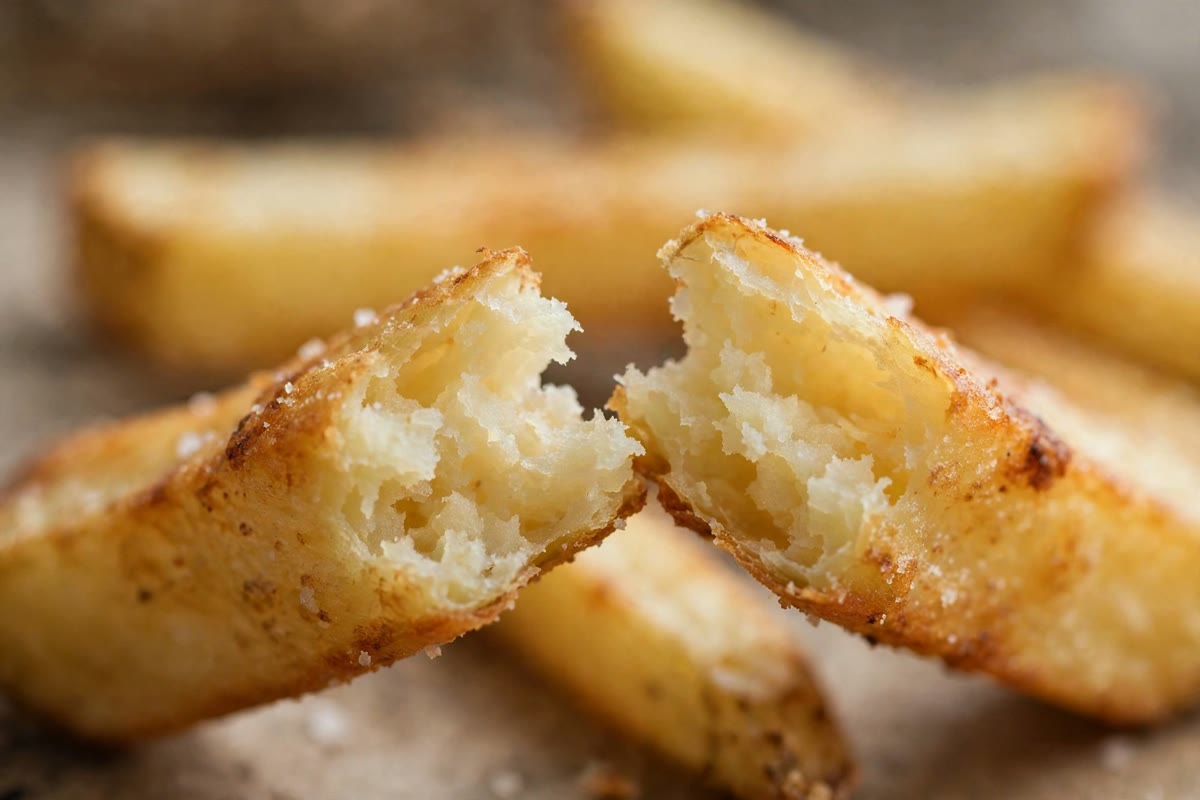
Same potato, very different outcomes. If you make fries at home, the cooking method is the single biggest lever you control:
| Style (3.5 oz / 100 g serving) | Approx. calories | Why |
|---|---|---|
| Fast-food deep-fried | ~320–365 | Full oil immersion; chains often pre-fry then finish-fry |
| Homemade deep-fried | ~300–350 | Same physics; slightly less if drained well on a rack |
| Oven-baked (light oil spray) | ~150–200 | Mostly the potato's own calories plus a teaspoon of oil |
| Air-fryer | ~150–200 | Same as oven-baked; hot air does the crisping |
| Sweet potato fries, baked | ~140–180 | Slightly less starch per gram — not a free pass |
| Sweet potato fries, deep-fried | ~320–380 | The fryer does not care that the potato is orange |
Notice the sweet potato row: baked sweet potato fries are a little lighter than baked regular fries, but deep-fried sweet potato fries are not a health food — the oil contributes the same calories either way. And air-fryer fries deserve their reputation: at roughly half the calories of deep-fried, they are the closest thing to a free upgrade in this whole article.
Plain fries are a side. Loaded fries — cheese, bacon, chili, ranch — are a meal wearing a side's name. The toppings stack fast:
| Topping (typical serving) | Approx. added calories |
|---|---|
| Cheddar cheese sauce (2 oz) | ~180–220 |
| Shredded cheddar (1 oz) | ~110 |
| Bacon crumbles (1 oz) | ~90–120 |
| Chili (4 oz ladle) | ~150–200 |
| Ranch dressing (2 tbsp) | ~140 |
| Sour cream (2 tbsp) | ~60 |
| Guacamole (2 oz) | ~90 |
Do the math on a large fast-food fries (~480) with cheese sauce (~200) and bacon (~100): ~780 calories — more than most burgers on the same menu. Loaded fries are not a side dish; log them as the main event. For context on the classic pairing, see our guides on how many calories are in a cheeseburger and how many calories are in a burrito.
Yes — with the same portion logic as any calorie-dense food. A small fries (~220 cal) fits into most deficit plans the way any 220-calorie snack does; the 3,500-calorie-per-pound rule from our pound-of-fat guide means one small fries is about one-sixteenth of a pound's worth of energy — the problem is never one small fries, it is the large-plus-loaded pattern repeated weekly. The strategies that actually work:
Downsize, don't ban. Ordering the small instead of the large saves ~260 calories — roughly the same as a 30-minute brisk walk for a 180 lb person. Bake or air-fry at home. Halving the calories per serving means you can eat a satisfying portion. Skip the liquid calories with it. Fries + regular soda is the classic 700-calorie side; fries + water or diet drink keeps the damage to the fries alone. Share the large. Splitting a large (~480) two ways is ~240 each — barely more than a small, socially painless.
Fries are just one line item — our calorie calculator totals the whole meal in seconds.
Calculate My MealWritten by the Live Fitness Check editorial team · Reviewed against our calculator methodology · Last updated October 2026
Disclaimer: This guide is for educational purposes only and is not medical advice. Calorie figures are estimates from published chain nutrition data and USDA references; actual values vary by preparation. If you are managing a medical condition, talk to your doctor or a registered dietitian.