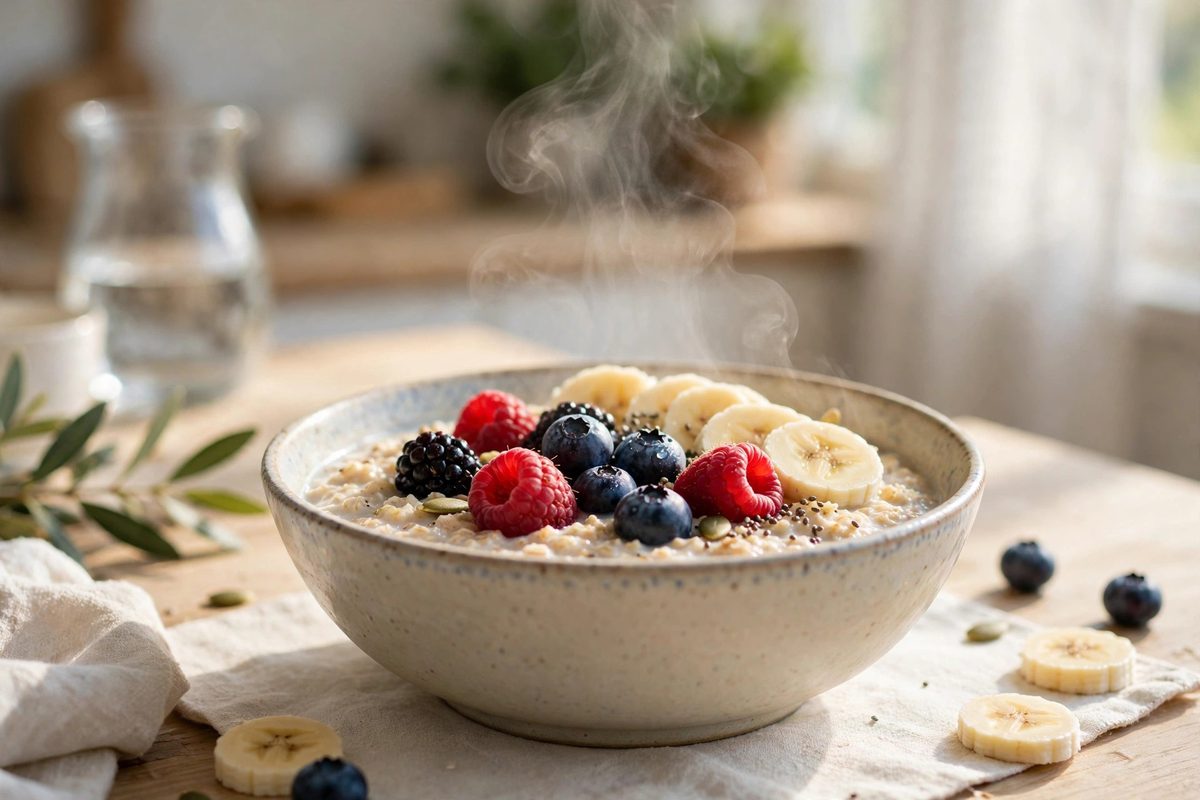
A bowl of oatmeal is roughly 150 calories for a half cup of dry rolled oats, about 166 calories for a cup cooked with water, or about 100 calories for a single instant packet — before a single topping goes on. The confusion is understandable: oats triple in volume as they absorb water, so the same oats look like very different portions depending on when you measure them. In this guide you will see the dry-versus-cooked chart, the milk ladder, and the toppings math that turns a 166-calorie breakfast into a 500-calorie one — or check any breakfast with our calorie calculator.
Half a cup (40 g) of dry rolled oats is about 150 calories; cooked with water, that same portion becomes about 1 cup (234 g) and about 166 calories — the small rise reflects the standard cooked serving, not added energy, since water has no calories. Instant packets are smaller (about 28–35 g) and run about 100 calories plain. Milk and toppings, not the oats, decide whether breakfast is light or heavy. Plan the whole bowl with our calorie calculator or macro calculator.
Calculate My BreakfastThe single most useful oatmeal fact is that water adds volume, not calories. Rolled oats absorb roughly twice their volume in water, so a half cup dry becomes about a cup cooked. The table below uses USDA figures for rolled oats and standard cooked oatmeal, with instant packets shown separately because their serving weight is smaller.
| Oatmeal form | Serving | Calories | Notes |
|---|---|---|---|
| Rolled oats, dry | 1/2 cup (40 g) | ~150 | The measuring-cup standard — weigh it once to calibrate your eye |
| Rolled oats, dry | 1 cup (80 g) | ~300 | Double portion; a genuinely large breakfast base |
| Oatmeal, cooked with water | 1 cup (234 g) | ~166 | Cooked from about 1/2 cup dry; water adds bulk, not calories |
| Instant oatmeal, plain packet | 1 packet (28–35 g) | ~100 | Smaller serving than a measured half cup of rolled oats |
| Instant oatmeal, flavored packet | 1 packet | ~130–160 | Added sugar in flavored varieties pushes it above plain |
| Steel-cut oats, dry | 1/4 cup (40 g) | ~150 | Same calories per gram as rolled; denser, so the cup measure differs |
Why does the cooked cup read 166 rather than exactly 150? Because the standard USDA cooked serving (234 g) is not precisely the cooked yield of a 40 g dry serving — it is a rounded, standardized cup, and different oat brands and cooking times absorb slightly different amounts of water. Treat 150 dry and 166 cooked as the same practical portion, and do not chase a 16-calorie difference that is really a measuring artifact. The mistake that actually matters is the opposite one: scooping a heaping cup of dry oats into the pot and calling it "one bowl," which is really two servings and about 300 calories before toppings.
Milk is the first fork in the road, and it is worth a table of its own because the range is so wide. Cooking a cup of oats in water adds nothing; cooking in milk adds the milk's full calories, and the milk you pour on top afterward counts too. The figures below are per cup (240 ml) of liquid used.
| Liquid (per cup, 240 ml) | Added calories | What it buys you |
|---|---|---|
| Water | 0 | Lightest bowl; add flavor with fruit and spice instead |
| Skim milk | ~90 | Creaminess plus about 8 g of protein, for under 100 calories |
| 2% milk | ~120 | Middle ground on richness and calories |
| Whole milk | ~150 | Richest texture; turns a 166-calorie bowl into about 316 |
| Oat milk, sweetened | ~130 | Check the label — sweetened plant milks vary widely |
The practical move for most people is cooking in water and adding a splash of milk at the end, rather than cooking in a full cup of whole milk. You get most of the creaminess for a fraction of the calories, and you keep the protein lever for toppings that actually fill you up — which brings us to the part of the bowl that matters most.
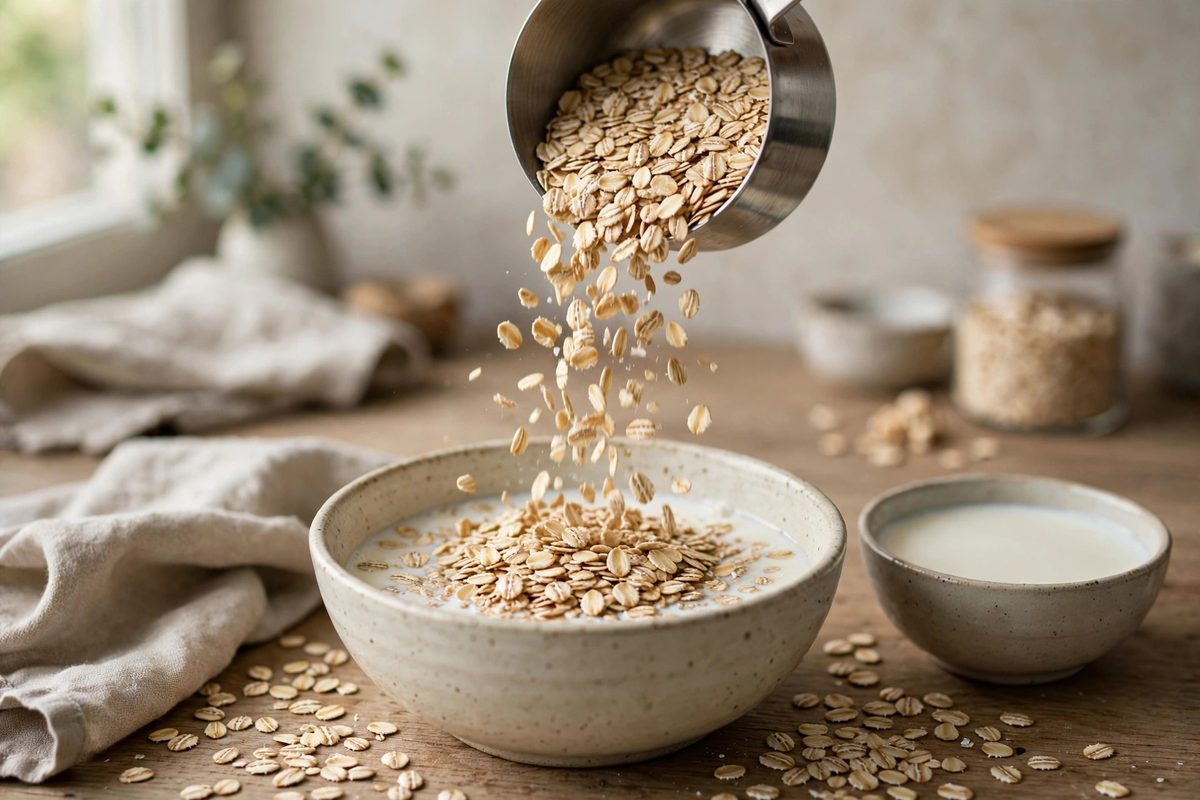
Toppings are where oatmeal breakfasts quietly double. None of these foods is "bad" — fruit, nuts, and peanut butter are all nutritious — but they are calorie-dense in very different ways, and a bowl built by eye can easily pass 500 calories while still feeling virtuous. The table uses standard USDA portions.
| Topping | Portion | Calories |
|---|---|---|
| Banana, sliced | 1 medium (118 g) | ~105 |
| Peanut butter | 1 tbsp (16 g) | ~94 |
| Honey | 1 tbsp (21 g) | ~64 |
| Mixed berries | 1/2 cup | ~30–50 |
| Walnuts, chopped | 1 oz (28 g) | ~185 |
| Brown sugar | 1 tbsp | ~52 |
| Chia seeds | 1 tbsp (12 g) | ~58 |
Build two bowls and the lesson lands. Bowl one: cooked oatmeal with water (166) plus half a banana (about 53) and a half cup of berries (about 40) = about 259 calories — light, sweet, and filling thanks to the oats' fiber. Bowl two: cooked oatmeal in whole milk (about 316) plus a full banana (105), a tablespoon of peanut butter (94), and a tablespoon of honey (64) = about 579 calories — more than double bowl one, and still recognizably "healthy oatmeal." Neither bowl is wrong; they simply serve different goals. Bowl one suits a calorie deficit, bowl two suits a hungry teenager, a manual laborer, or anyone who wants breakfast to carry them to lunch without a snack. The trap is only ever the unexamined middle: adding the peanut butter, honey, and milk together without noticing that toppings now outweigh the oats three to one.
Oatmeal's real advantage is not that it is low-calorie — at 150 calories per dry half cup, it is fairly average — but that it is unusually filling per calorie. Rolled oats deliver about 4 g of fiber per half cup dry, including beta-glucan, a soluble fiber that slows digestion and steadies blood sugar after eating. That is why a 259-calorie oatmeal breakfast often keeps people full longer than a 259-calorie pastry breakfast, and why oatmeal shows up so often in weight-loss plans despite not being a particularly low-calorie food. To maximize the effect, keep the protein up: stir in a scoop of protein powder, eat a boiled egg alongside, or use skim milk plus Greek yogurt as a topping — protein plus fiber is the combination that reliably stretches a breakfast to lunch. Check your fiber target with our fiber calculator and your protein target with our protein calculator. For a fruit-based comparison, see our cereal guide and smoothie guide.
Our calorie calculator totals any breakfast in seconds.
Calculate My BreakfastWritten by the Live Fitness Check editorial team · Reviewed against our calculator methodology · Last updated October 2026
Disclaimer: This guide is for educational purposes only and is not medical advice. Calorie figures are USDA-based estimates; actual values vary by brand, oat type, and portion. If you manage blood sugar or follow a prescribed diet, talk to your doctor or dietitian.
