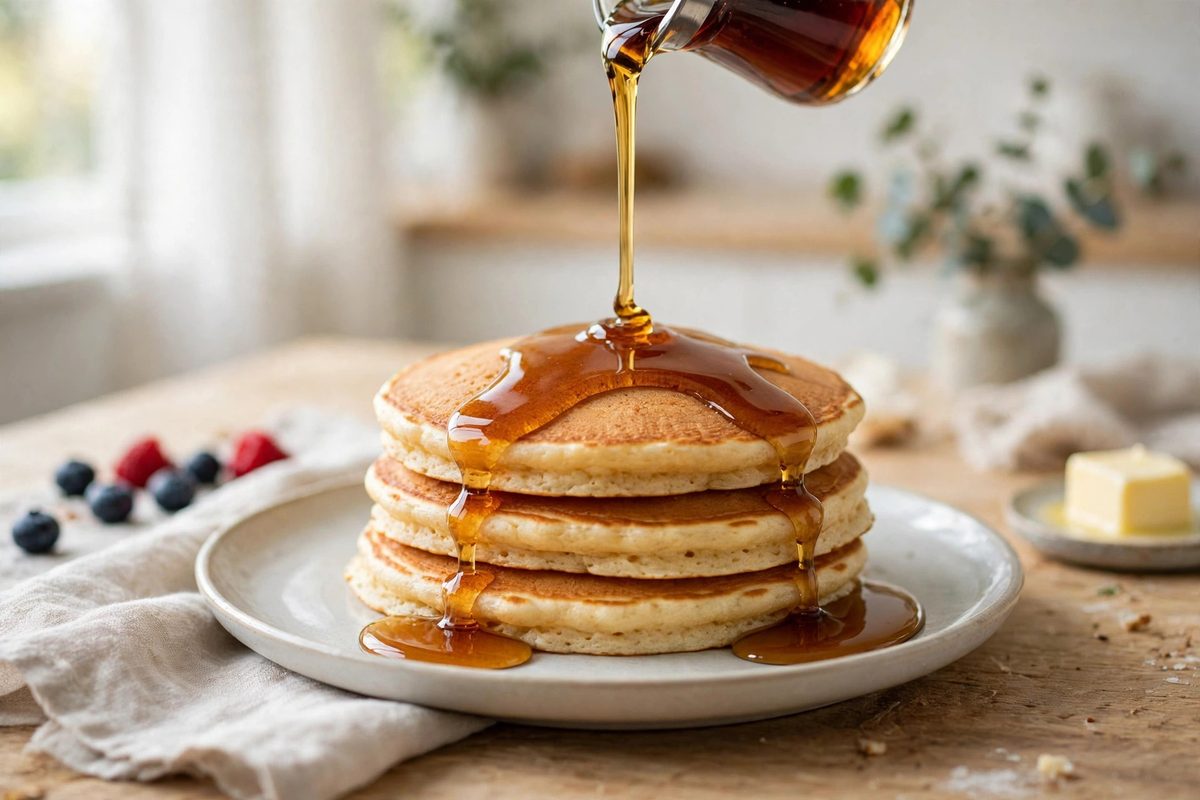
One plain pancake is about 86 calories — but almost nobody eats one plain pancake. A buttermilk pancake runs about 95, a blueberry pancake about 105, and a chocolate-chip pancake about 120, and that is before the syrup, butter, and second and third pancakes that turn a light breakfast into a 450-plus-calorie stack. The pancake itself is rarely the problem; the toppings and the stack size are. In this guide you will price every version, climb the syrup ladder, and do the stack math for one, two, and three pancakes — or total your own breakfast with our calorie calculator.
A single plain pancake (about 4 inches across, made from mix) is roughly 86 calories. Two plain pancakes with 2 tablespoons of maple syrup are about 276 calories, and three plain pancakes with maple syrup and a tablespoon of butter are about 464 calories. Toppings, not the pancake, decide whether breakfast is light or heavy — check any version against your day with our calorie calculator or macro calculator.
Calculate My BreakfastDirect answer: a plain pancake is about 86 calories, buttermilk about 95, blueberry about 105, and chocolate-chip about 120, for a standard 4-inch pancake made from mix. The differences are small per pancake — 9 to 34 calories — but they add up across a stack of three, and the toppings dwarf them all. Buttermilk adds a little richness and tang for about 9 extra calories; blueberries add natural sweetness and fiber for about 19 extra; chocolate chips add sugar and fat for about 34 extra. None of these versions is a nutritional disaster on its own. The table below uses USDA-style figures for one medium pancake.
| Pancake (1 medium, ~4 inches) | Calories | What changes it |
|---|---|---|
| Plain (from mix) | ~86 | The baseline: refined flour, egg, milk, a little oil |
| Buttermilk | ~95 | Buttermilk adds tang and a slightly richer crumb |
| Blueberry | ~105 | A small handful of berries per pancake; adds fiber and sweetness |
| Chocolate-chip | ~120 | Chips are sugar plus cocoa butter; the biggest jump of the four |
| Banana (for comparison) | ~100 | Mashed banana replaces some sugar; see our banana guide |
| Whole-wheat | ~95 | Similar calories, more fiber — a better trade than it looks |
Size matters more than flavor. The figures above assume a 4-inch pancake, the size a standard ladle of batter produces. Restaurant and diner pancakes are routinely 6 to 8 inches across — double the diameter means roughly four times the area, and a single diner pancake can easily reach 200 to 350 calories before a single drop of syrup. If your pancake covers the plate, count it as two or even three of the pancakes in this table. This is the same portion trap that shows up in our rice portion guide: the unit on the label is smaller than the unit on the plate. When in doubt, count by weight or by diameter, not by "one pancake."
Direct answer: maple syrup is about 52 calories per tablespoon (104 per 2 tablespoons), honey about 64 per tablespoon (128 per 2 tablespoons), and butter about 102 per tablespoon. Two tablespoons of syrup is the standard serving on a label, but a free pour from a pitcher at a diner is often 4 tablespoons or more — 208 calories of maple syrup before you have eaten a bite. Honey looks natural and wholesome, but it is actually denser in calories than maple syrup, tablespoon for tablespoon. Butter is the heaviest topping of all: a single tablespoon adds more calories than a whole plain pancake.
| Topping | Per tablespoon | Per 2 tablespoons | Notes |
|---|---|---|---|
| Maple syrup (real) | ~52 | ~104 | The classic; mostly sugar, with trace minerals |
| Honey | ~64 | ~128 | Denser than maple — "natural" does not mean lighter |
| Butter (salted) | ~102 | ~204 | One tablespoon outweighs one plain pancake |
| Powdered sugar (1 tbsp) | ~30 | ~60 | Light-looking, but it is still pure sugar |
| Fresh berries (1/2 cup) | — | ~25–40 per 1/2 cup | The cheapest topping in calories, and the most filling |
| Peanut butter (1 tbsp) | ~94 | ~188 | Adds protein and fat; filling, but count it |
| Sugar-free syrup (2 tbsp) | — | ~10–20 | The biggest calorie saving available, if you like the taste |
The practical lesson is simple: measure the syrup once, and you will never un-measure it. Two tablespoons looks small in a pitcher and generous on a plate, which is exactly why diners pour four. At home, pour syrup into a small measuring cup or a shot glass rather than straight from the bottle, and put the butter on with a knife rather than a melting pat that hides its size. Swapping 4 tablespoons of maple syrup (208 calories) for 2 tablespoons (104) saves more than switching from chocolate-chip to plain pancakes across a whole stack. For the same reason, fresh berries are the best topping upgrade in this article: a half cup of blueberries costs about 40 calories and makes syrup almost unnecessary.
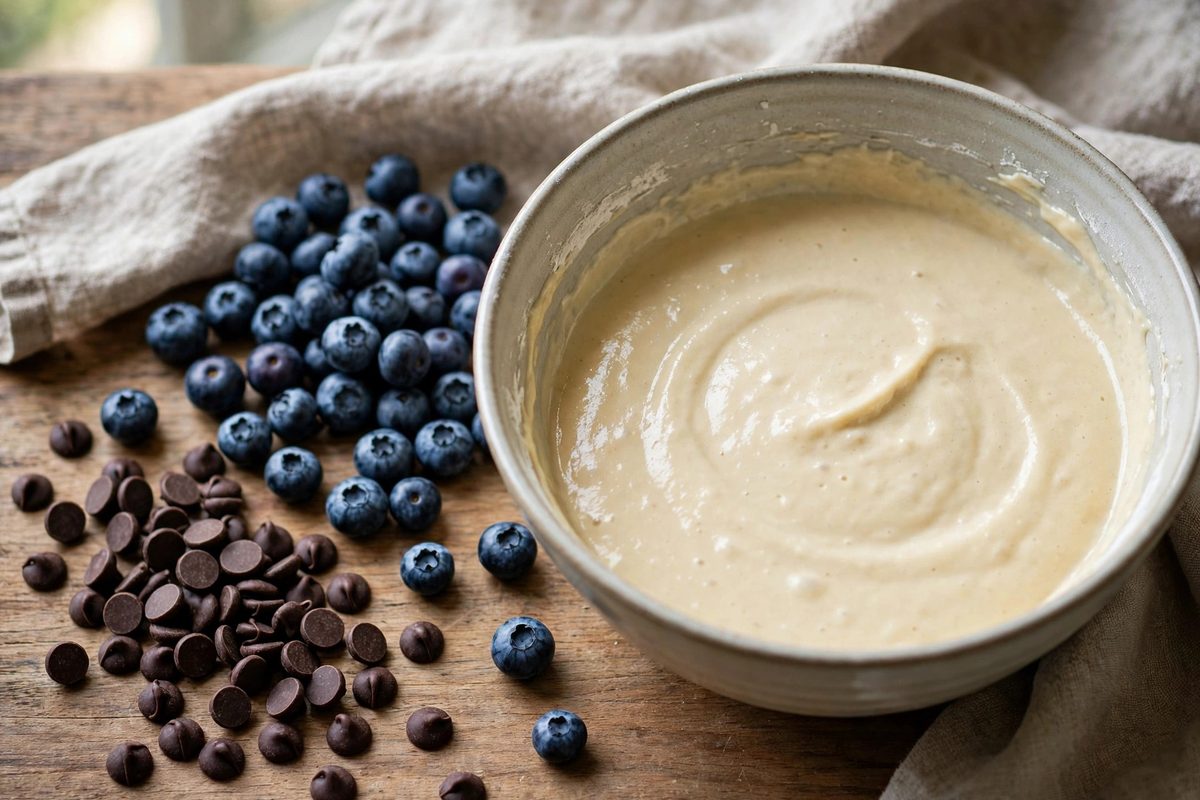
Direct answer: one plain pancake with syrup is about 190 calories, two plain pancakes with syrup are about 276, and three plain pancakes with syrup and butter are about 464. The math is just multiplication plus toppings, and doing it once makes every future pancake breakfast predictable. The table below builds stacks from the plain 86-calorie pancake; swap in 95, 105, or 120 for buttermilk, blueberry, or chocolate-chip and add 9, 19, or 34 calories per pancake.
| Stack | Math | Total calories |
|---|---|---|
| 1 plain pancake, dry | 86 | ~86 |
| 1 plain + 2 tbsp maple syrup | 86 + 104 | ~190 |
| 2 plain + 2 tbsp maple syrup | 172 + 104 | ~276 |
| 2 blueberry + 2 tbsp maple syrup | 210 + 104 | ~314 |
| 3 plain + 2 tbsp maple syrup + 1 tbsp butter | 258 + 104 + 102 | ~464 |
| 3 chocolate-chip + 2 tbsp syrup + 1 tbsp butter | 360 + 104 + 102 | ~566 |
| 2 plain + berries instead of syrup | 172 + 40 | ~212 |
Check the arithmetic on the headline stack: three plain pancakes are 3 × 86 = 258 calories, plus 104 for the syrup and 102 for the butter gives 258 + 104 + 102 = 464 calories. That is a perfectly reasonable breakfast for many adults — roughly a quarter of a 2,000-calorie day — but it is not the "light" breakfast people imagine when they order pancakes, and the chocolate-chip version at 566 is heavier still. Add bacon (about 90 calories for two slices) or sausage links (about 150–200 for two) and a diner breakfast can pass 750 before coffee. None of this means pancakes are off the menu; it means a two-pancake stack with berries is a genuinely different meal from a three-pancake stack drowned in syrup, and the difference is about 250 calories.
Direct answer: barely. A from-scratch pancake and a mix pancake of the same size land within about 10 calories of each other, because both are mostly flour, egg, milk, and a little fat. What changes the calories is what you add to the batter — extra butter, sugar, or oil — and how big you make them. A scratch recipe that uses whole milk and two tablespoons of melted butter across eight pancakes adds only about 25 calories per pancake, while a mix made with water instead of milk saves a similar amount. Whole-wheat flour swaps in fiber without changing the calorie count much. The honest conclusion: choose mix or scratch for taste and convenience, not for calories, and spend your calorie attention on size and toppings instead. If you want a lighter pancake that still tastes like a pancake, add mashed banana or blueberries to the batter and cut the added sugar — you gain flavor and fiber for roughly the same calories. Pair the result with protein, such as eggs or Greek yogurt on the side, and the meal will keep you full far longer than pancakes alone; our protein calculator can size that side for you.
Direct answer: keep the stack to two, measure the syrup, and let fruit do the sweetening. Two plain or blueberry pancakes with a half cup of berries and a single tablespoon of maple syrup land around 240–280 calories — a light, genuinely enjoyable breakfast that leaves room for coffee and a protein side. If you love the full diner stack, have it knowingly and less often, or split the difference: three pancakes, syrup measured at 2 tablespoons, no butter, and berries on top lands around 400 calories instead of 560-plus. Weekend pancakes with the family are not a diet failure; a daily unmeasured pour is a quiet habit that adds up to hundreds of extra calories a week. For more on the foods that quietly move a breakfast, see our cereal guide and the Body & Nutrition hub for the full food series.
Our calorie calculator totals any breakfast in seconds.
Calculate My BreakfastWritten by the Live Fitness Check editorial team · Reviewed against our calculator methodology · Last updated October 2026
Disclaimer: This guide is for educational purposes only and is not medical advice. Calorie figures are USDA-based estimates; actual values vary by brand, portion, and preparation. If you follow a prescribed diet, talk to your doctor or dietitian.